Product Information
Extra Information
Product Information
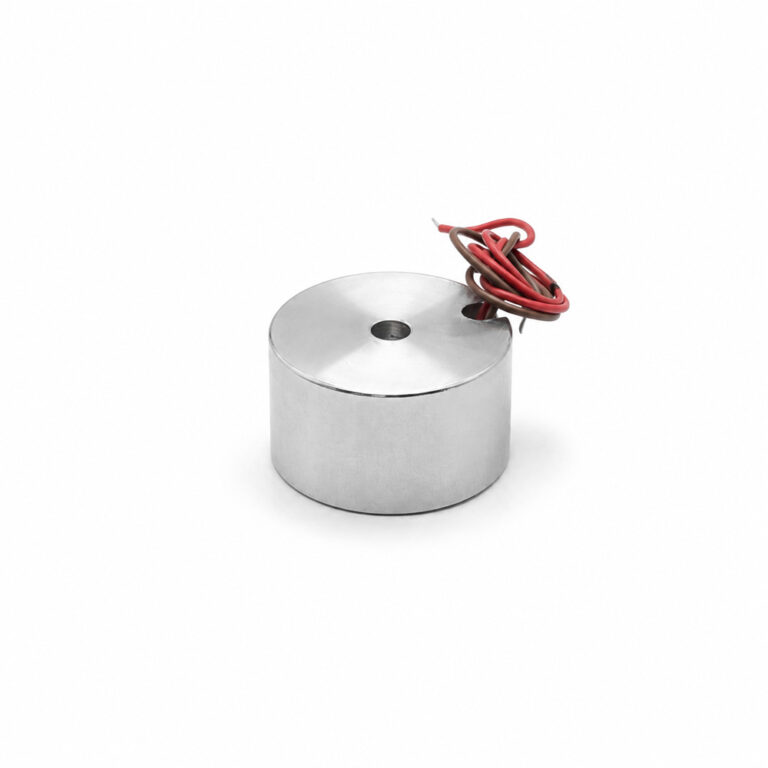
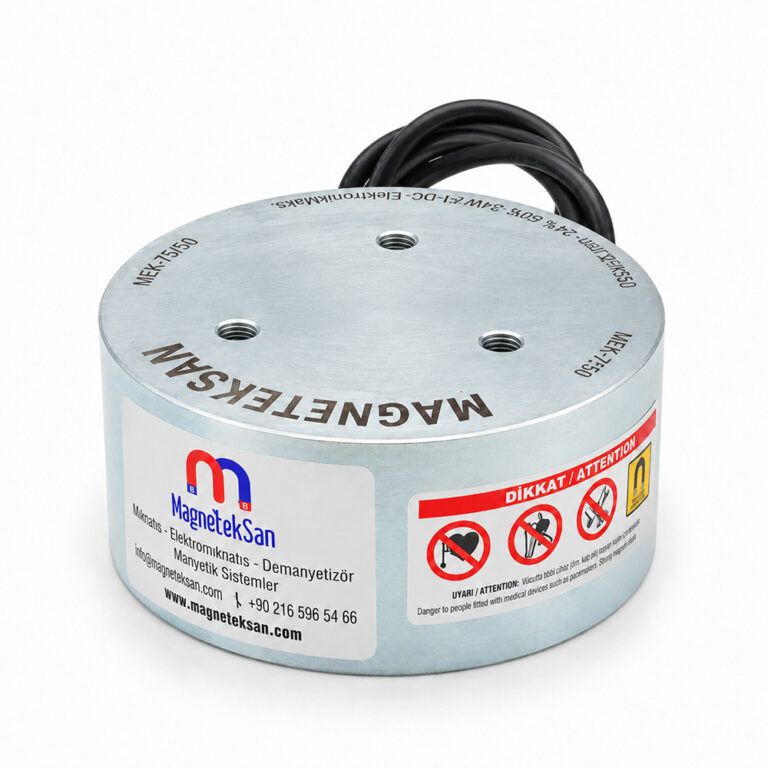
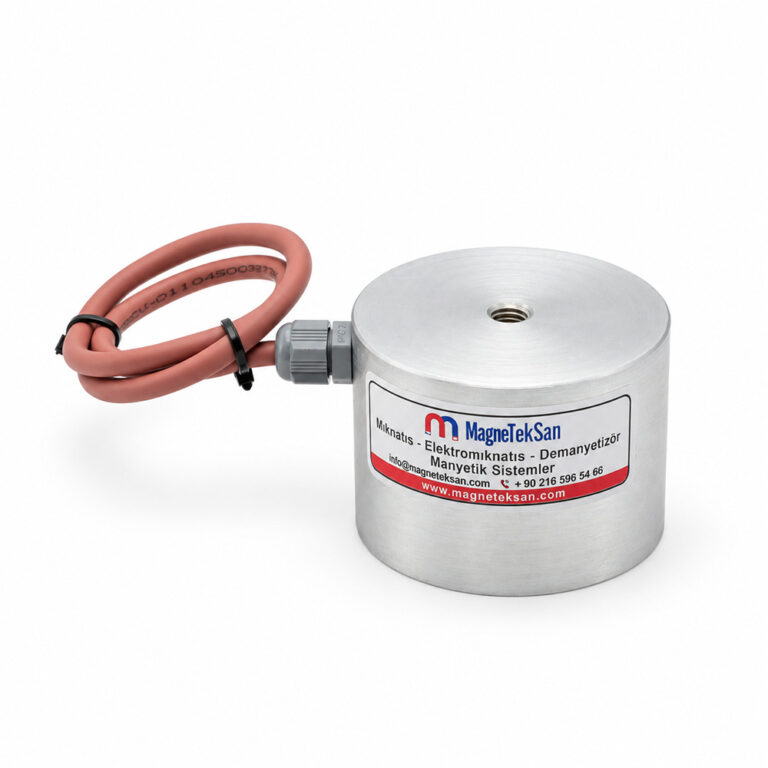
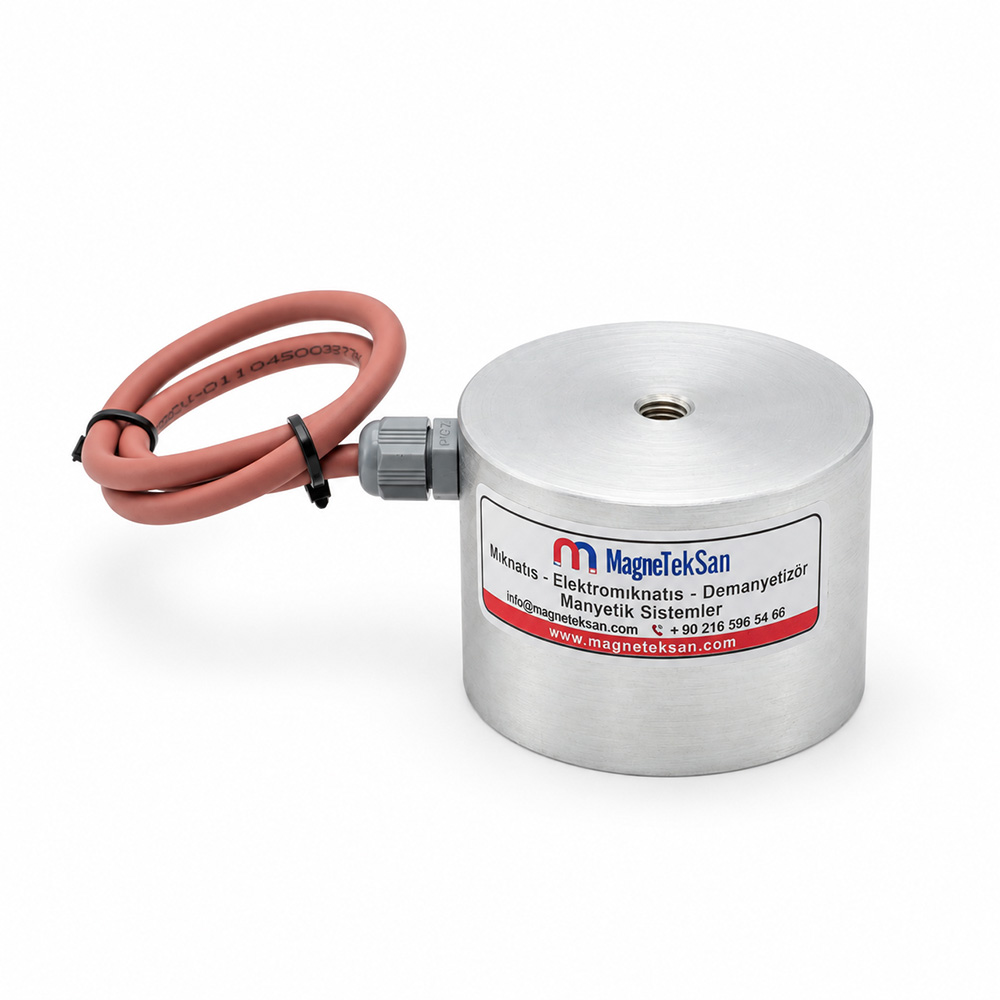
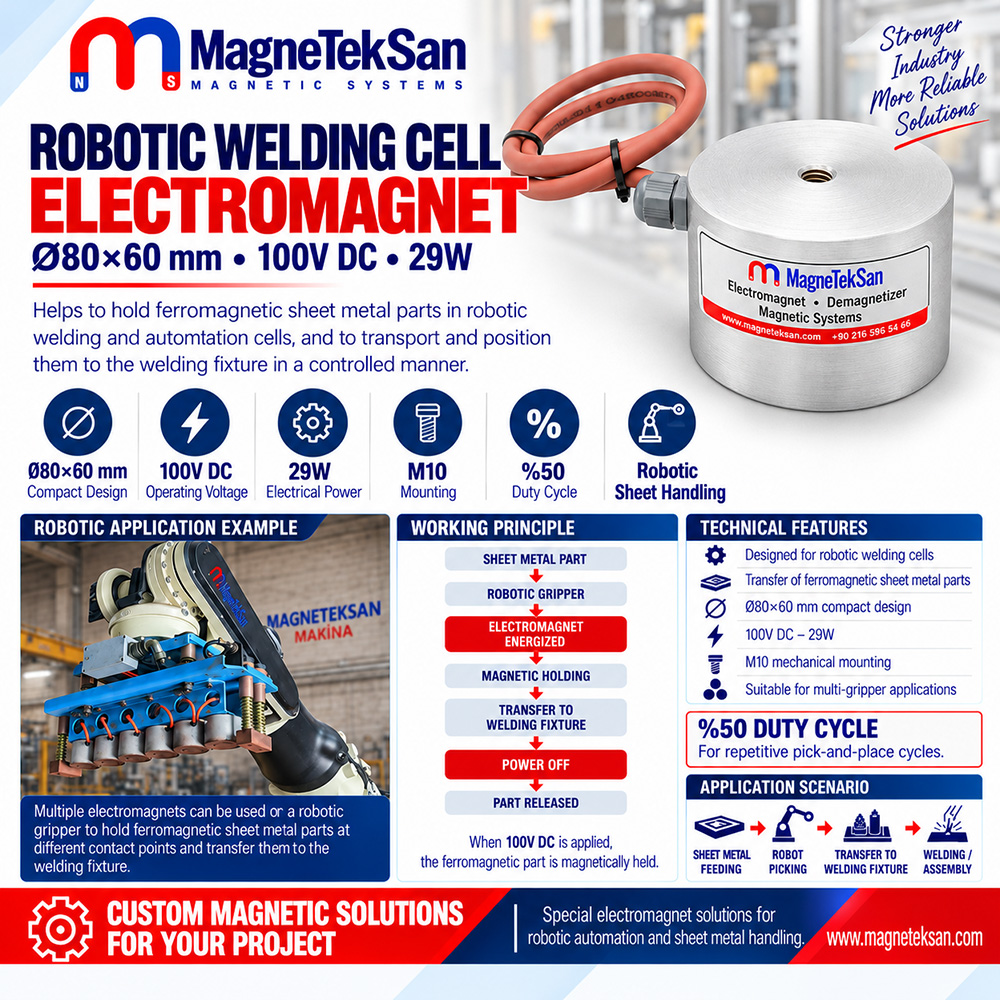
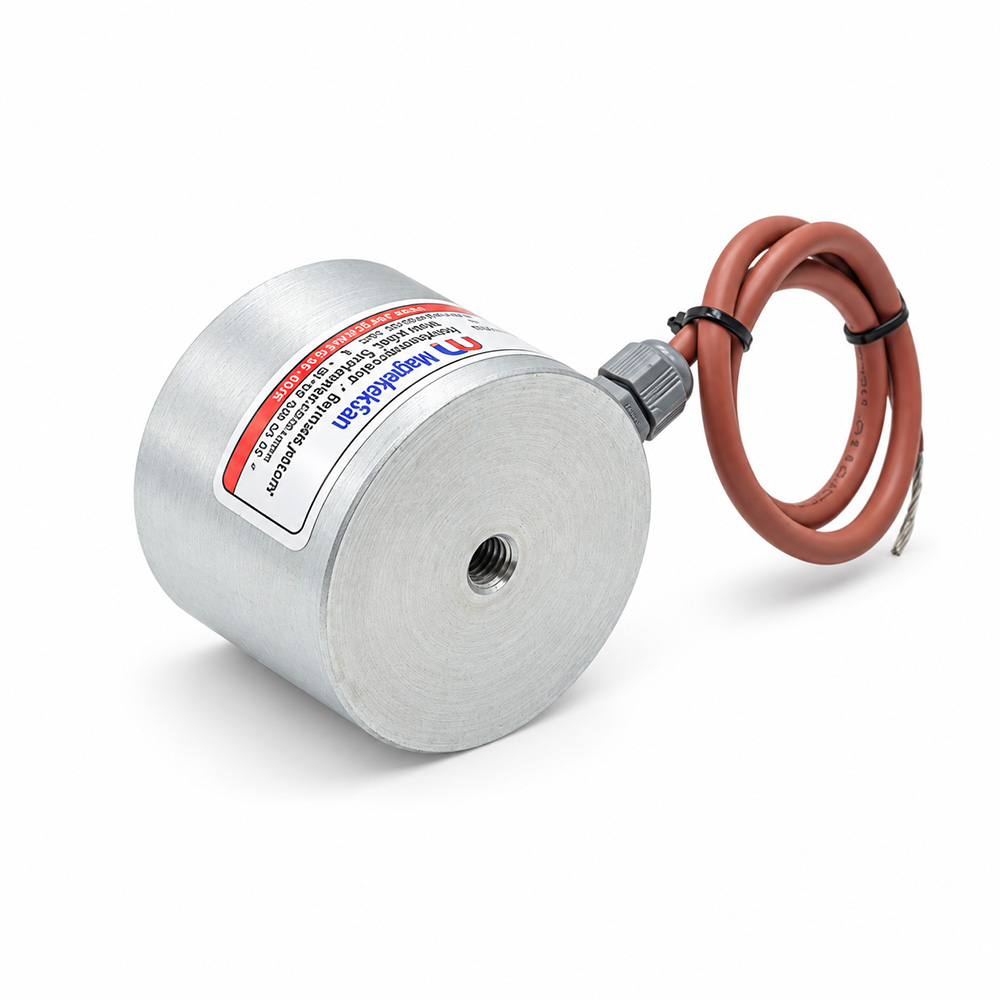
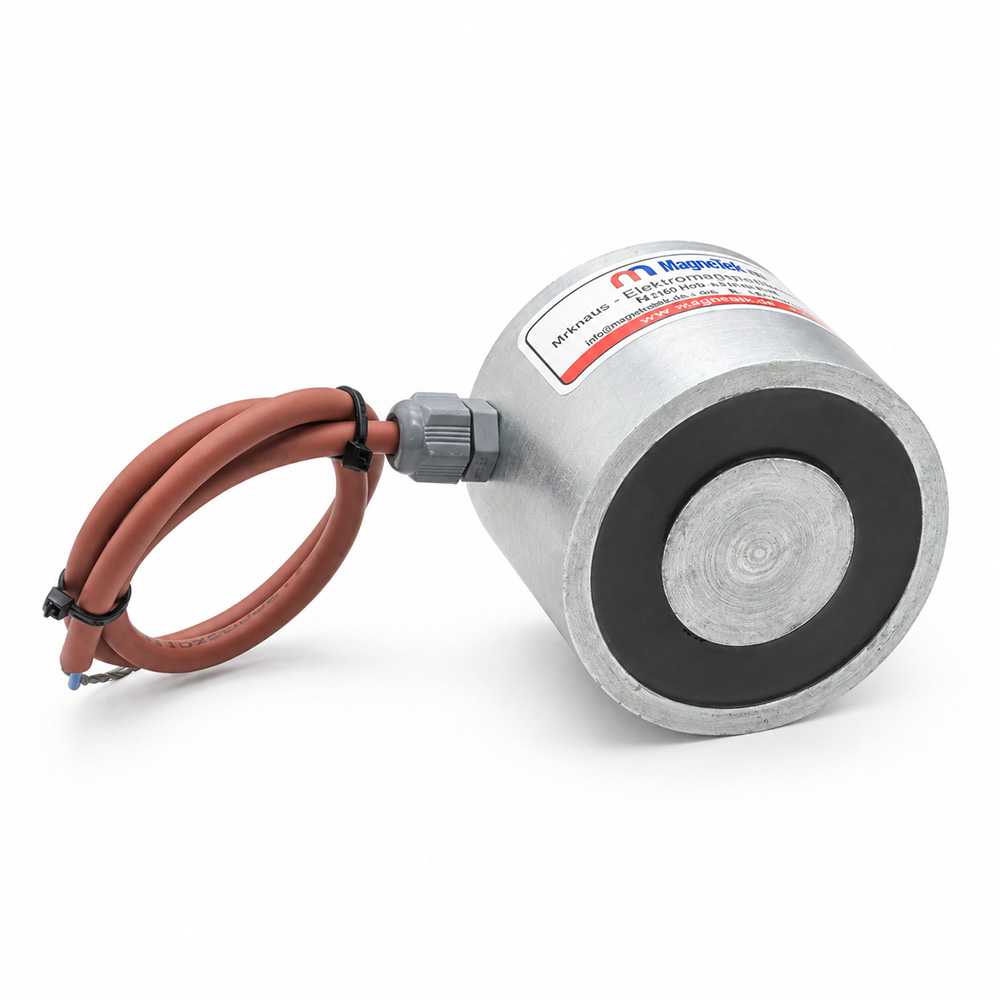
The Robotic Welding Cell Electromagnet is a compact Ø80×60 mm DC electromagnet designed to help robotic systems pick up, transfer and position ferromagnetic sheet metal and steel parts onto welding fixtures. It operates at 100V DC and 29W, features an M10 mechanical connection and a 50% duty cycle, and multiple units can be integrated into a robotic gripper according to the geometry of the workpiece.
| Technical Specification | Value |
|---|---|
| Product Type | Robotic DC Electromagnet |
| Main Application | Sheet Metal Feeding to Robotic Welding Cell |
| Diameter | Ø80 mm |
| Height | 60 mm |
| Operating Voltage | 100V DC |
| Electrical Power | 29W |
| Mechanical Connection | M10 |
| Duty Cycle | 50% |
| Mounting | Robot Gripper / Custom Carrier |
| Target Material | Ferromagnetic Iron / Steel |
| Operating Principle | Hold When Energized / Release When Power Is Switched Off |
Extra Information
What is a Robotic Welding Cell Electromagnet?
A Robotic Welding Cell Electromagnet is an electrically controlled magnetic holding device designed to help a robot pick up ferromagnetic components and transfer them to a designated welding or assembly fixture.
The electromagnet does not perform the welding operation itself. Its primary function is to hold, move, position and release suitable ferromagnetic sheet metal or steel components as part of an automated material-handling process.
How is the electromagnet used in a robotic welding cell?
A typical process can be:
Ferromagnetic Sheet Metal Part
↓
Robot Gripper Approaches
↓
Ø80×60 mm Electromagnets Are Energized
↓
Sheet Metal Part Is Magnetically Held
↓
Part Is Transferred to the Welding Fixture
↓
Part Is Positioned on the Fixture
↓
Power to the Electromagnets Is Switched Off
↓
Part Is Released
↓
Welding / Assembly Process Begins
This allows magnetic gripping to be integrated into an automated pick-transfer-place sequence.
Why use an electromagnet in a robotic welding cell?
Robotic production cells may require sheet metal components to be repeatedly:
- picked up,
- transported,
- positioned on a fixture,
- released at a controlled location.
For suitable ferromagnetic parts, an electromagnet can be evaluated as an electrically controlled gripping solution instead of, or together with, mechanical gripper fingers.
Can multiple electromagnets be used on the same robot gripper?
Yes.
Multiple Ø80×60 mm electromagnets can be positioned on the same robot end effector to create several magnetic contact points on a larger or longer workpiece.
The required number and arrangement should be determined according to:
- workpiece dimensions,
- workpiece weight,
- geometry,
- contact points,
- center of gravity,
- robot payload,
- acceleration and motion conditions.
Using several electromagnets does not automatically establish a specific lifting capacity.
Why are multiple electromagnets used?
A single electromagnet may not provide the required contact distribution for a large or geometrically complex sheet metal component.
Using multiple electromagnets allows magnetic contact points to be distributed over different areas of the part. Their number, spacing and position should therefore be designed according to the actual workpiece rather than selected only according to the overall dimensions of the gripper.
What does Ø80×60 mm mean?
The electromagnet has:
- Ø80 mm diameter
- 60 mm height
Its compact round construction can make it possible to position several electromagnets on a single robotic gripper or custom end-of-arm tooling system.
What does 100V DC mean?
The nominal operating voltage of the electromagnet is:
100V DC
The product must therefore be operated using a suitable DC power supply and control system designed for its electrical requirements.
What does 29W mean?
The specified electrical power of the electromagnet is:
29W
This figure represents the electrical power rating of the electromagnet.
It does not mean:
29W = 29 kg lifting capacity
Electrical power and magnetic holding capacity are different technical parameters.
What does a 50% duty cycle mean?
This product has a 50% duty cycle.
Therefore, it should not be treated as a continuously energized 100% duty electromagnet outside its validated operating conditions. The robotic process should be designed around an appropriate:
hold → transfer → release → wait
cycle.
Because no verified fixed ON/OFF duration is specified for this model, a statement such as “30 seconds ON / 30 seconds OFF” should not be assumed.
What is the M10 connection used for?
The electromagnet features an M10 mechanical connection.
This connection can be used to mount the electromagnet to:
- a robot gripper plate,
- a carrier structure,
- custom automation tooling,
- an adjustable magnetic gripping system.
The mechanical design of the mounting system must be suitable for the robot and the actual workpiece.
How can the electromagnet be mounted on a robot gripper?
The electromagnet can be mechanically secured to a suitable carrier plate through its M10 connection.
For systems using multiple electromagnets, the carrier plate should be designed according to:
- workpiece dimensions,
- magnetic contact locations,
- workpiece center of gravity,
- robot payload,
- dynamic motion conditions.
The gripper design should also allow the working faces of the electromagnets to make suitable contact with the workpiece.
Which materials can the electromagnet hold?
The product is primarily intended for materials with sufficient ferromagnetic properties, such as:
- iron,
- carbon steel,
- suitable steel sheet,
- other ferromagnetic metal components.
Actual holding performance depends on the material as well as the physical conditions of the contact surface.
Can it hold aluminium sheet?
No.
Aluminium is not ferromagnetic and is not held by a conventional electromagnet in the same way as carbon steel or iron.
Can it hold copper or brass components?
No.
Copper and brass are not normally ferromagnetic materials and therefore cannot be handled by this electromagnet in the same way as ferromagnetic iron or carbon steel.
Can it hold stainless steel?
It depends on the stainless-steel grade and its metallurgical condition.
Some stainless steels can show a noticeable magnetic response, while certain austenitic stainless-steel grades may have very low magnetic response.
Therefore, magnetic holding should not be guaranteed for all stainless-steel components. Testing with the actual workpiece is recommended where stainless steel is involved.
Does sheet thickness affect magnetic holding performance?
Yes.
Sheet thickness can influence the magnetic circuit. With very thin sheet metal, the electromagnet may not be able to develop the same holding performance that it could achieve with a more suitable ferromagnetic section.
For this reason, the actual workpiece should be tested under representative operating conditions.
Why is the contact area important?
The working face of the electromagnet should preferably make direct, even and sufficiently large contact with the ferromagnetic workpiece.
Holding performance can be reduced by:
- curved surfaces,
- warped sheet metal,
- welding spatter,
- burrs,
- paint,
- rust,
- dirt,
- surface irregularities,
- gaps between the magnet and the workpiece.
The actual contact condition is therefore an important part of robotic gripper design.
What happens if there is an air gap between the electromagnet and the sheet metal?
As the air gap between the electromagnet and the ferromagnetic workpiece increases, magnetic holding force decreases.
For effective magnetic contact, the working face should therefore contact the workpiece as directly and evenly as practical.
Can it be used on painted sheet metal?
Potentially, yes.
Paint does not necessarily prevent a ferromagnetic steel sheet from being attracted. However, the paint layer creates additional distance between the electromagnet and the steel surface and can therefore reduce magnetic holding performance.
The actual painted workpiece should be tested before the final robotic application is approved.
Can it be used for feeding parts before welding?
Yes.
This is the main application of this model.
The robot can use the electromagnets to pick up the sheet metal component, transfer it into the welding cell and position it on the appropriate welding fixture. The electromagnets can then be de-energized to release the component before the next process stage.
Should the electromagnet continue holding the component during welding?
This should be evaluated separately for the specific application.
During welding, the system may be exposed to:
- heat,
- welding spatter,
- mechanical stresses,
- electrical effects,
- magnetic effects.
The primary positioning of this product is therefore feeding the workpiece to the welding fixture and releasing it. If the workpiece must remain clamped throughout welding, the welding fixture’s dedicated mechanical clamping system may also be required.
Can welding spatter affect the electromagnet?
If the electromagnet is positioned very close to an active welding area, metallic particles from welding spatter may accumulate on its surface.
The robot gripper and electromagnet arrangement should therefore be designed according to the welding process. A specific welding-spatter resistance should not be claimed unless the required protection has been verified for the application.
Can the electromagnet be used for vertical handling?
Vertical handling requires separate evaluation.
When a component is carried vertically, it may be subjected to a force that tends to make it slide across the face of the electromagnet. Magnetic pull force and resistance to sliding along the contact surface are not the same parameter.
Vertical handling should therefore be validated with the actual component and actual robot motion.
Does robot acceleration affect magnetic holding?
Yes.
During robotic movement, dynamic forces can occur because of:
- acceleration,
- deceleration,
- changes in direction,
- emergency stops.
For this reason, a robotic handling system should not be designed solely on the basis of a static magnetic holding-force value.
Is the center of gravity of the workpiece important?
Yes.
Especially in grippers using several electromagnets, the distribution of the magnetic contact points relative to the workpiece’s center of gravity is important.
An unbalanced arrangement can cause the component to tilt, rotate or load individual contact points unevenly during robot movement.
Does the electromagnet guarantee that only one sheet will be picked up?
No.
With stacked thin ferromagnetic sheets, the magnetic field may influence more than one sheet.
The primary function of this electromagnet is holding and transferring a component, not guaranteed single-sheet separation. Where reliable single-sheet feeding is required, a separate magnetic sheet separator or fanner system can be considered.
Can it be used with perforated sheet metal?
Potentially, yes, but the geometry must be evaluated.
If a large portion of the electromagnet’s working face is positioned over:
- holes,
- openings,
- cut-outs,
the effective magnetic contact area may be reduced.
The position of the electromagnets on the gripper should therefore be determined according to the actual sheet geometry.
Can it be used with small metal parts?
It can be considered if the component provides sufficient contact area with the working surface of the electromagnet.
For very small components, the available contact area may be reduced, which can significantly change magnetic holding behavior. Testing with the actual part is recommended.
Can it be used with large sheet metal components?
Yes, depending on the application.
For large sheet metal components, multiple electromagnets can be installed on the robotic gripper to create several magnetic contact points.
The number and arrangement of electromagnets should be determined according to the actual:
- sheet dimensions,
- weight,
- geometry,
- contact surfaces,
- center of gravity,
- robot motion conditions.
What happens when power is switched off?
This product operates according to the standard DC electromagnet principle.
When electrical power is applied, a magnetic field is generated and the suitable ferromagnetic workpiece can be held.
When power is switched off, the electromagnetic field disappears and the workpiece can be released. Depending on the properties of the steel, a limited amount of residual magnetism may remain.
Is the electromagnet fail-safe in the event of a power failure?
No.
If electrical power is lost, the holding force of a standard electromagnet disappears.
Therefore, this electromagnet should not be used as the sole safety system for safety-critical suspended-load applications or where a falling component could endanger personnel. Additional mechanical or other safety systems should be designed according to the risk level of the application.
Can the electromagnet be controlled by a PLC?
Yes.
With a suitable electrical power and control circuit, the electromagnet can be controlled in synchronization with the robotic cycle through systems such as:
- PLC,
- relay,
- contactor,
- suitable electronic driver.
Electrical control components must be selected to suit the product’s 100V DC and 29W electrical specifications.
How many electromagnets can be used on one robot gripper?
There is no single fixed number.
The required quantity depends on:
- workpiece dimensions,
- workpiece weight,
- geometry,
- robot payload,
- available contact surfaces,
- center of gravity,
- robot acceleration and motion profile.
The gripper should therefore be engineered around the actual part and robotic process.
What is the holding capacity in kilograms?
A verified holding capacity in kilograms is not specified for this particular model.
For this reason, a fixed kg value should not be assumed or published without testing.
Actual holding performance depends on factors including:
- material,
- sheet thickness,
- contact area,
- surface condition,
- air gap,
- orientation,
- workpiece geometry,
- robot acceleration and deceleration.
The real application should be validated using the actual component under representative operating conditions.
What is the Gauss value of this electromagnet?
A verified surface Gauss value is not specified for this model.
Therefore, an estimated Gauss figure should not be added to the product specifications.
For an electromagnet used in robotic handling, practical holding performance should not be evaluated solely according to a Gauss measurement.
What is the maximum operating temperature?
A verified maximum operating temperature is not specified for this particular product.
A temperature value should therefore not be assumed. This is especially important in welding-cell applications, where ambient temperature and proximity to the welding process may affect operating conditions.
What is the IP protection rating?
A verified IP protection rating is not specified for this product.
Applications involving:
- dust,
- oil,
- water,
- coolant,
- welding spatter,
should therefore be evaluated according to the actual environmental conditions rather than assuming an IP rating.
What maintenance does the electromagnet require?
The following components should be inspected periodically:
- magnetic working surface,
- electrical cable and connections,
- M10 mounting connection,
- robot gripper connections,
- mechanical carrier structure.
Metallic particles accumulated on the working surface should be removed only when the system is de-energized and placed in a safe condition.
Can a custom robotic magnetic gripper be designed using this electromagnet?
Yes.
Depending on the application, multiple Ø80×60 mm electromagnets can be positioned at different contact points on a custom robot end effector.
The final design should take into account the actual workpiece’s:
- dimensions,
- weight,
- geometry,
- material,
- sheet thickness,
- contact surfaces,
- center of gravity,
- robot payload,
- acceleration and deceleration,
- operating cycle.
This makes it possible to configure the magnetic gripping arrangement according to the specific robotic welding or automation process rather than relying on a fixed universal layout.