Product Information
Extra Information
Product Information
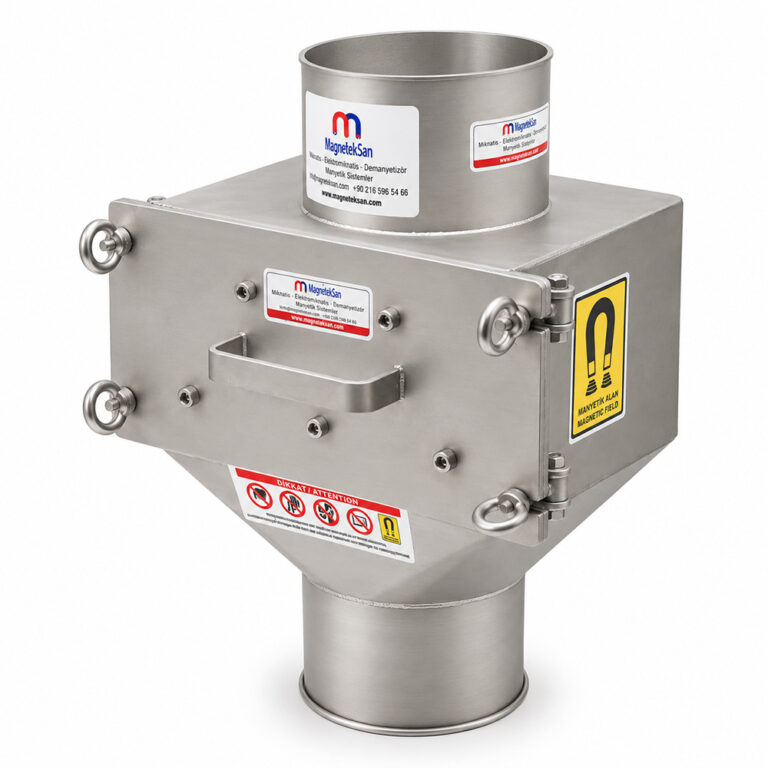
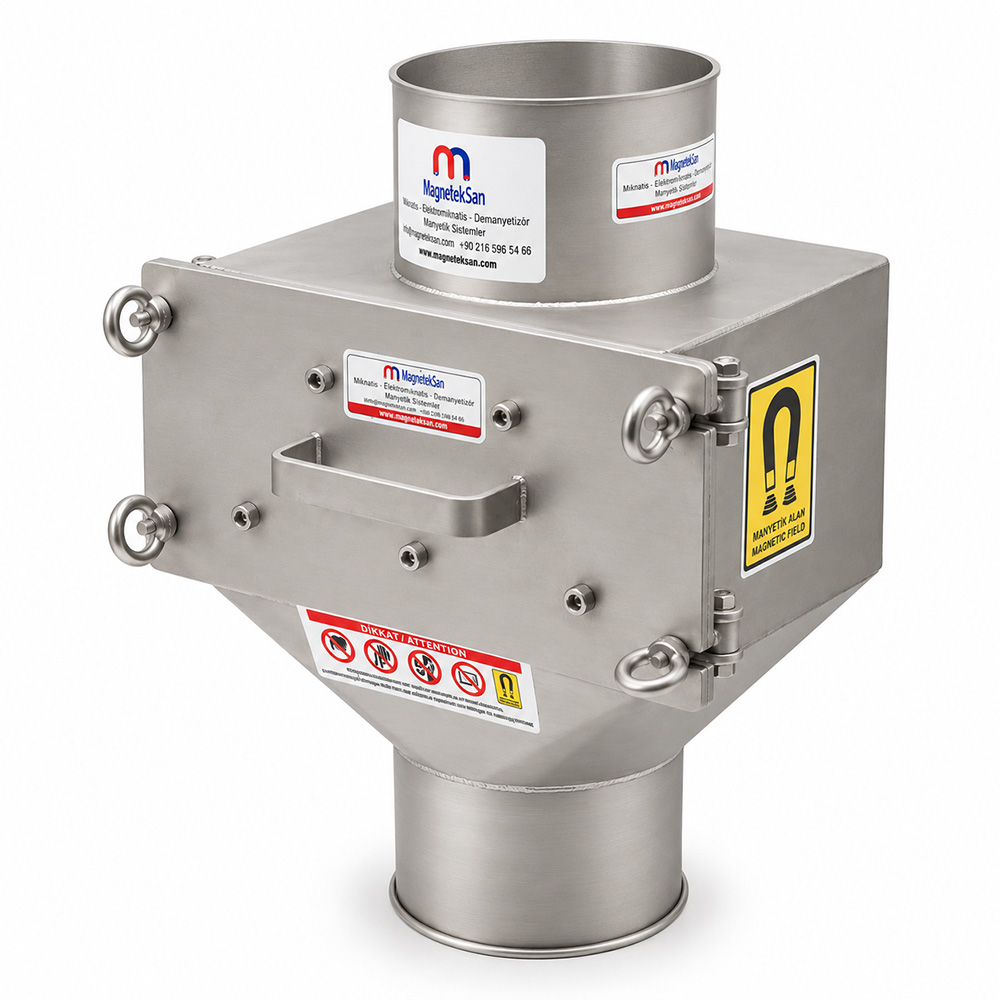
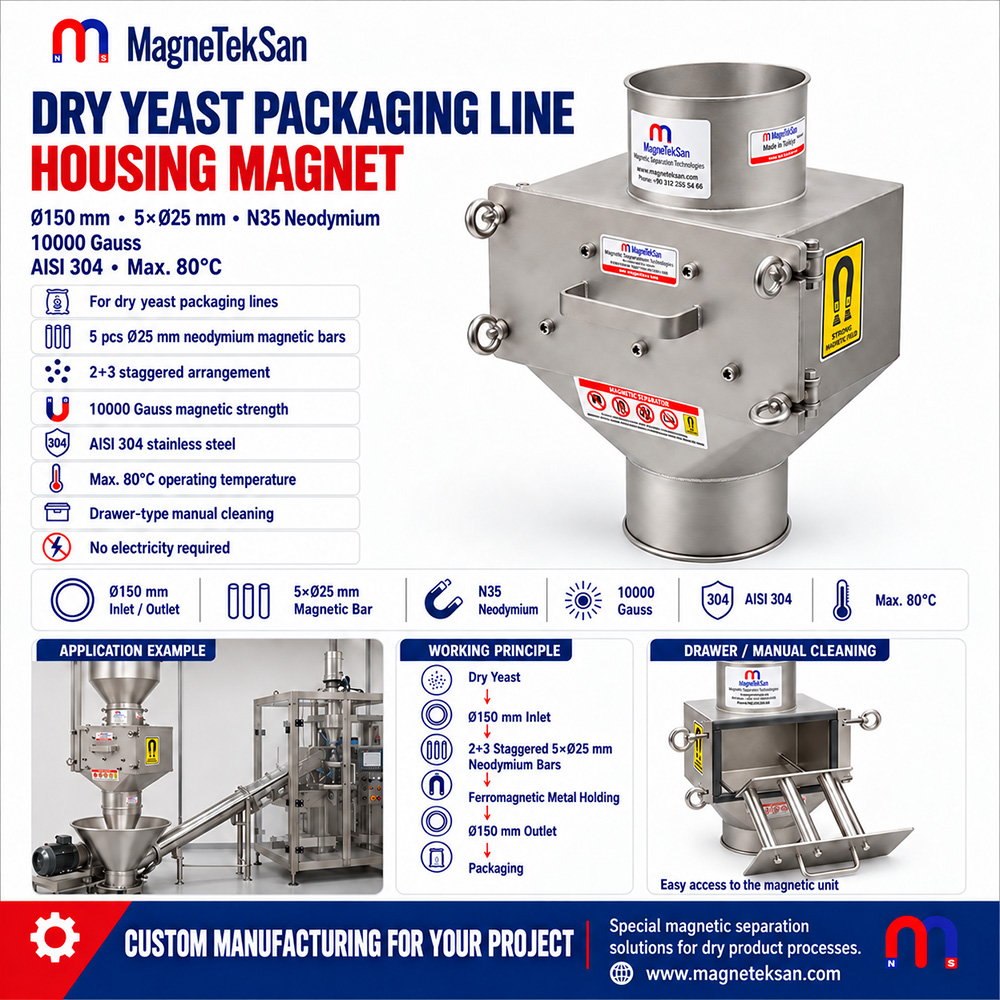
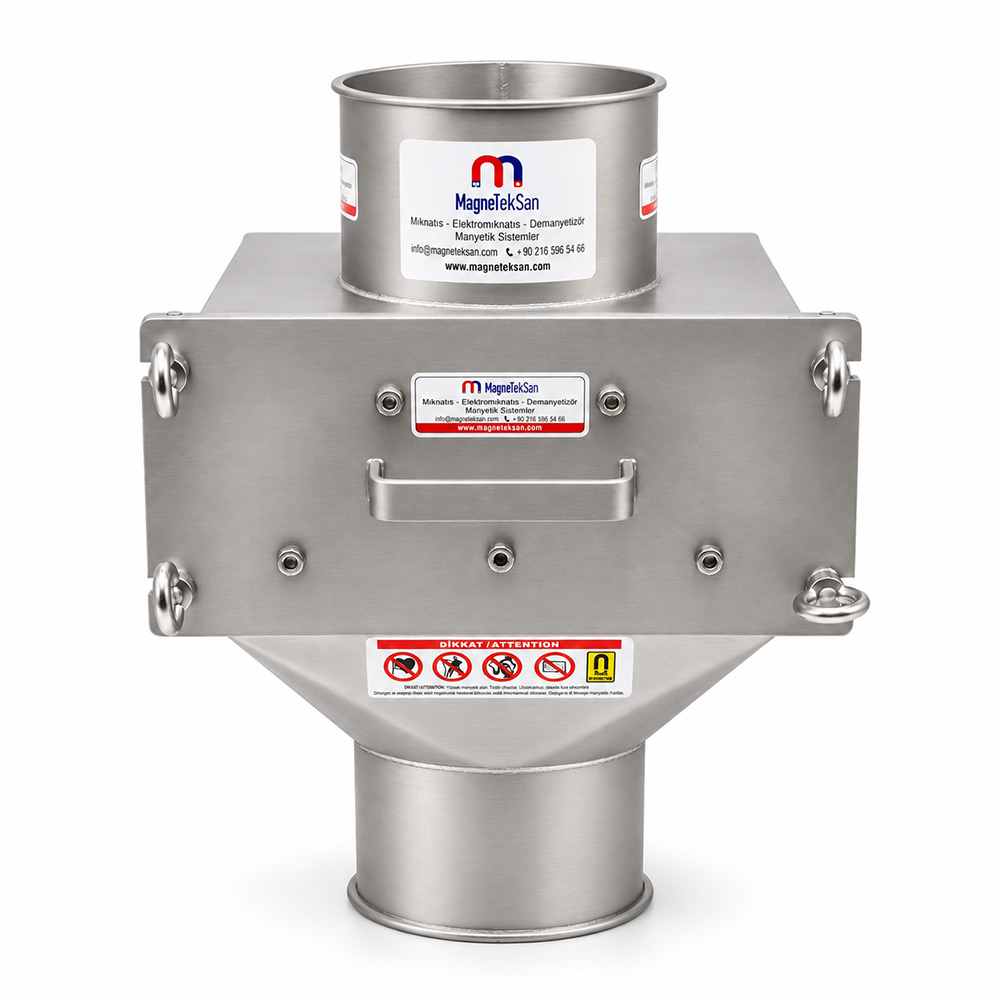
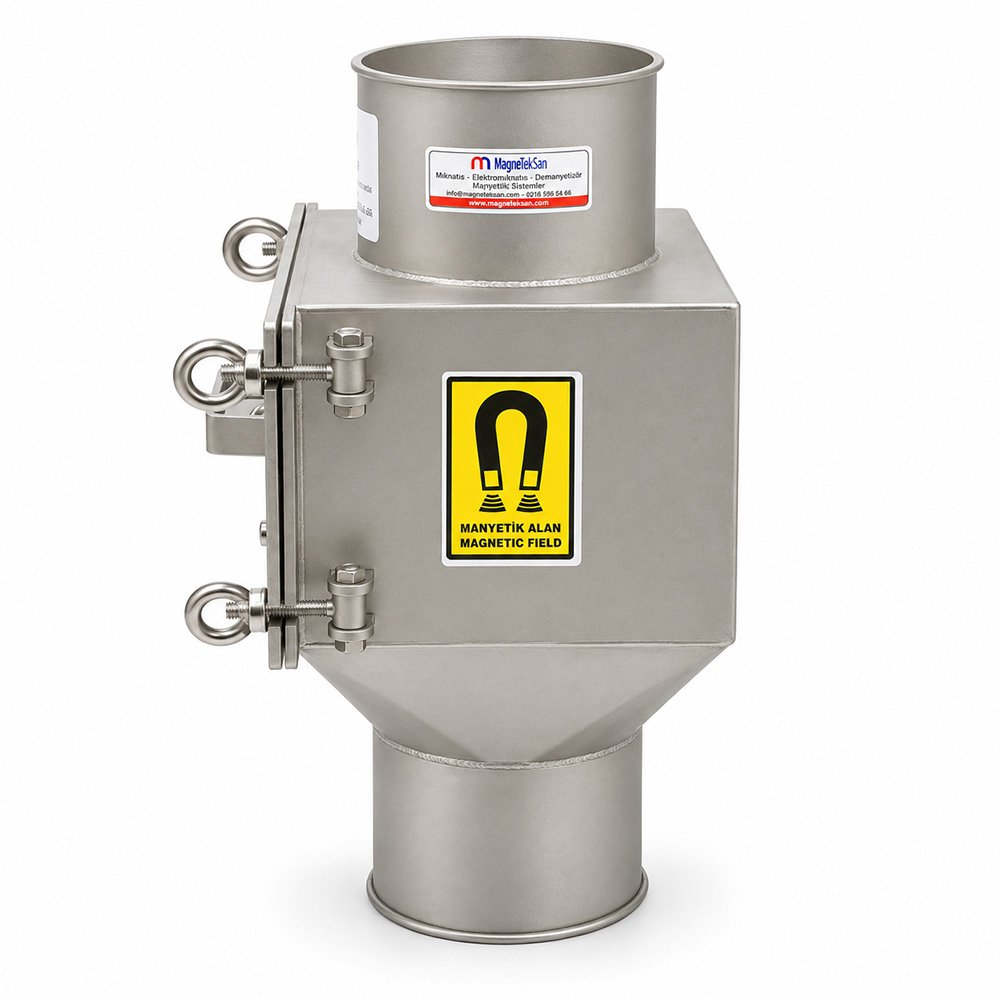
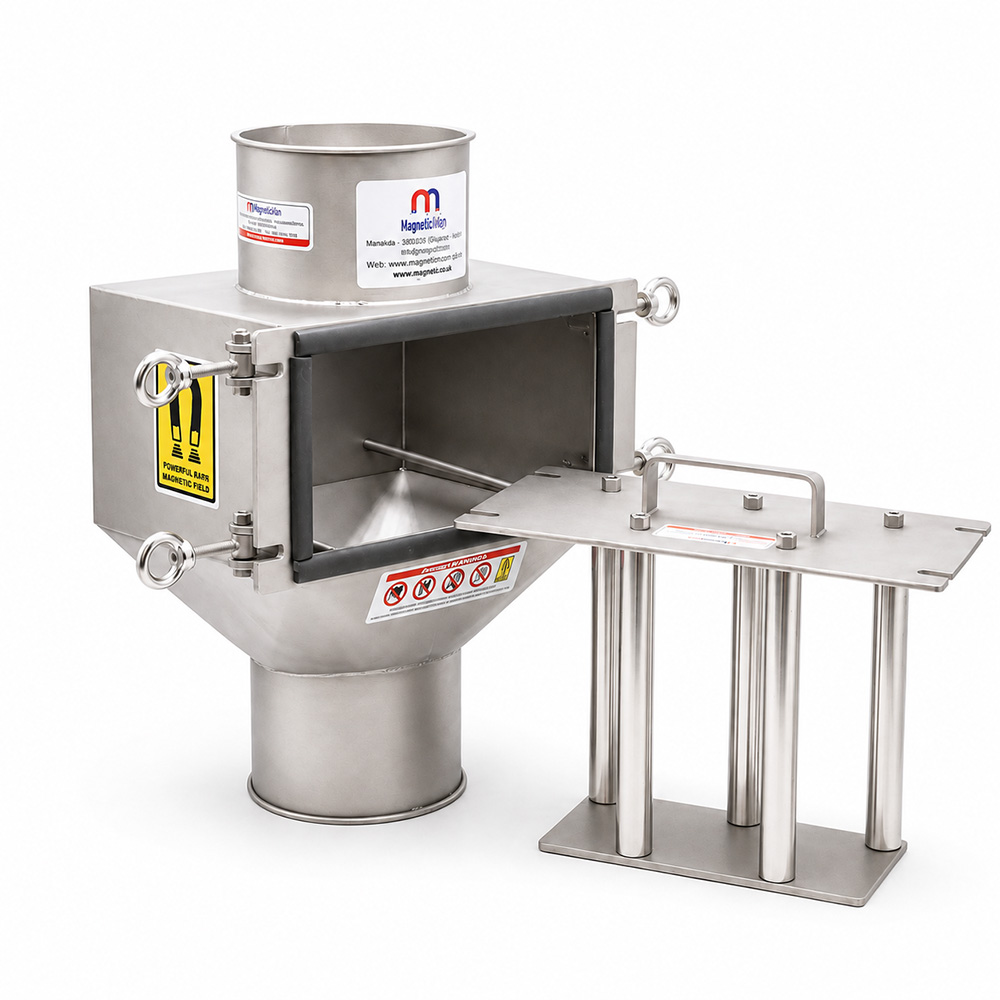
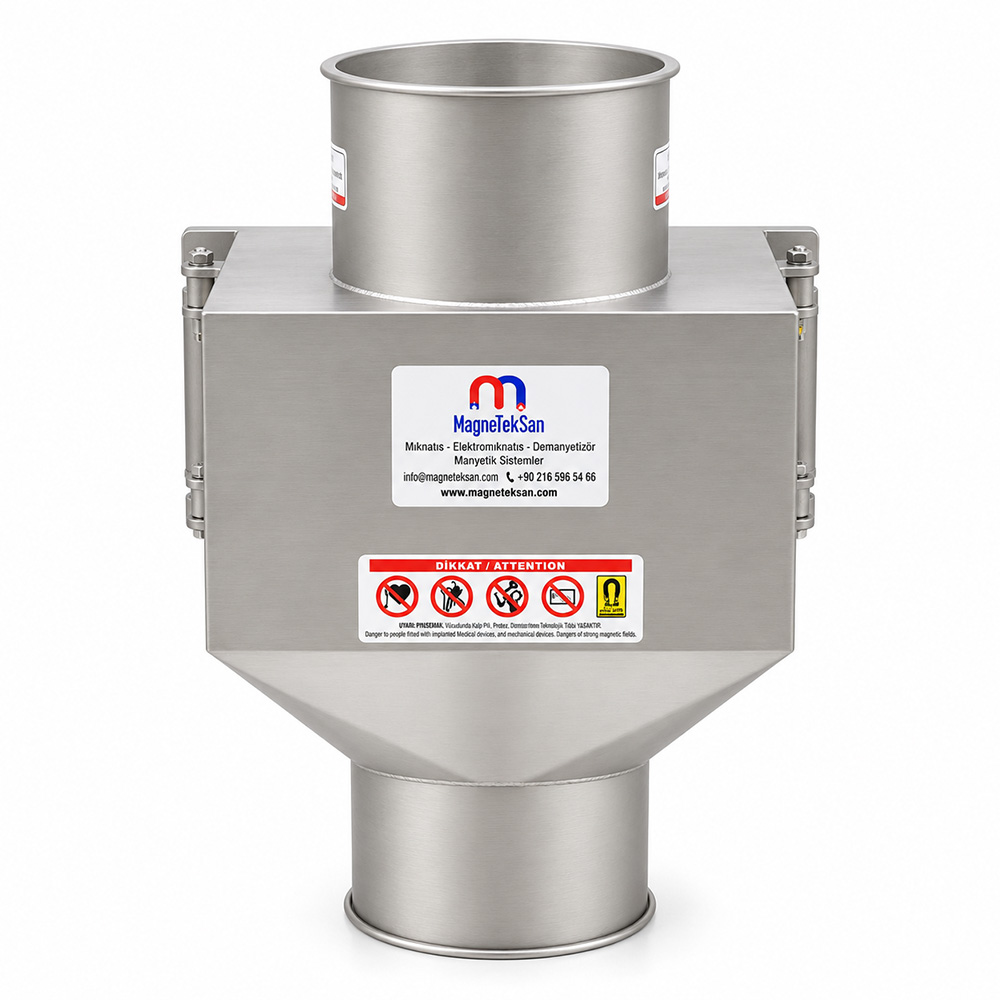
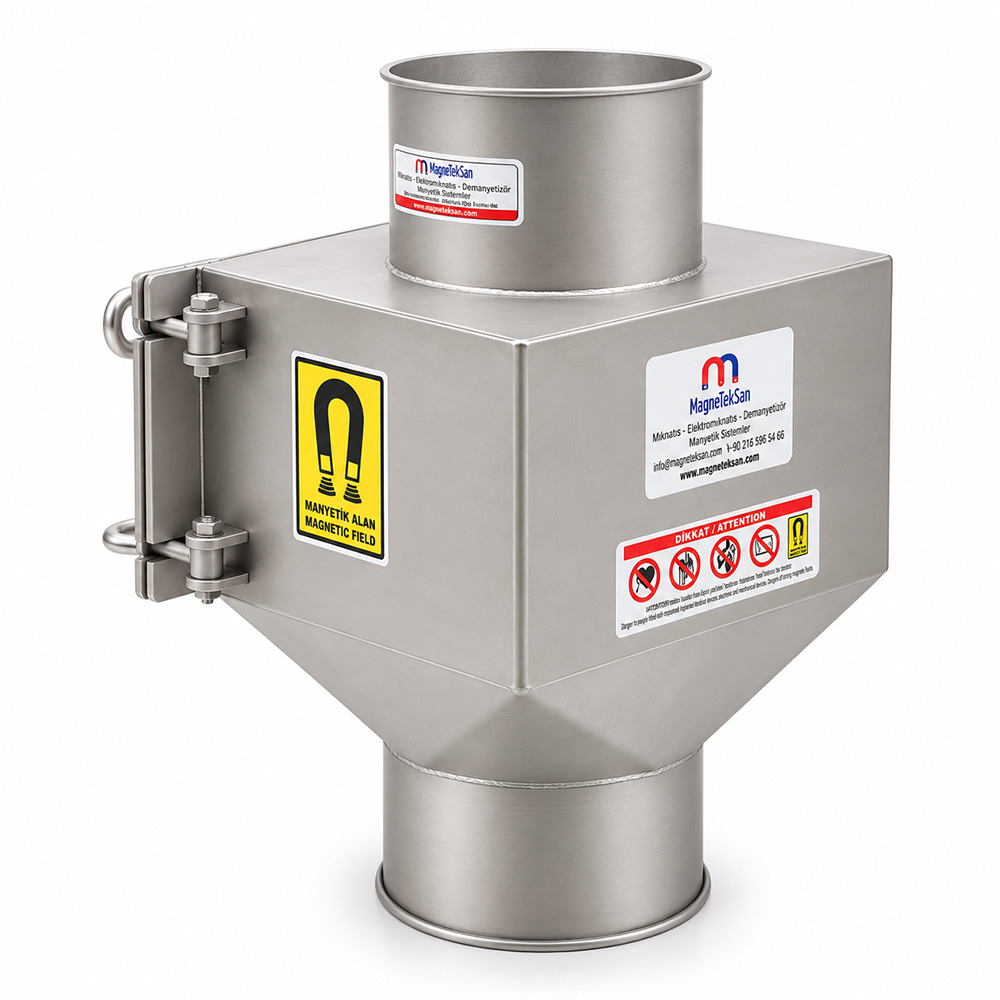
The Ø150 mm Round Inlet Drawer Magnet is designed to help remove ferromagnetic metal contamination from dry yeast during product flow before or within packaging processes. It features 5 x Ø25 mm N35 neodymium magnetic bars, 10,000 Gauss magnetic strength and an AISI 304 stainless steel body.
| Technical Specification | Value |
|---|---|
| Product Type | Round Inlet Drawer Magnet |
| Main Application | Dry Yeast Packaging Line |
| Inlet Diameter | Ø150 mm |
| Outlet Diameter | Ø150 mm |
| Number of Magnetic Bars | 5 |
| Magnetic Bar Diameter | Ø25 mm |
| Magnet Grade | N35 Neodymium |
| Magnetic Field Strength | 10,000 Gauss |
| Body Material | AISI 304 Stainless Steel |
| Target Contamination | Ferromagnetic Metal Particles |
Extra Information
What is a Round Inlet Drawer Magnet?
A Round Inlet Drawer Magnet is an in-line magnetic separation system designed to capture ferromagnetic contamination from products flowing through a pipe, chute or gravity-fed production line.
The product passes through the Ø150 mm housing and around the magnetic bars. Ferromagnetic particles that enter the effective magnetic field are attracted to the magnetic bars, while the main product continues through the system.
Why is a Round Inlet Drawer Magnet used in a dry yeast packaging line?
During production, transfer and packaging, dry yeast can potentially encounter unwanted ferromagnetic contamination originating from upstream equipment, maintenance activities or process components.
Installing a drawer magnet at an appropriate point in the product flow helps capture ferromagnetic particles before the product continues to subsequent processing or packaging stages.
What is the main application of this product?
This model is specifically configured for use in a dry yeast packaging line.
A typical process arrangement can be:
Dry Yeast
↓
Product Transfer / Feeding Line
↓
Ø150 mm Round Inlet Drawer Magnet
↓
5 x Ø25 mm N35 Neodymium Magnetic Bars
↓
Ferromagnetic Metal Separation
↓
Packaging Process
The exact installation point should be selected according to the design of the production and packaging line.
What is the inlet and outlet diameter?
The magnetic housing has:
Ø150 mm inlet
Ø150 mm outlet
This round inlet/outlet configuration allows the unit to be integrated into compatible circular product-flow connections.
How many magnetic bars are used?
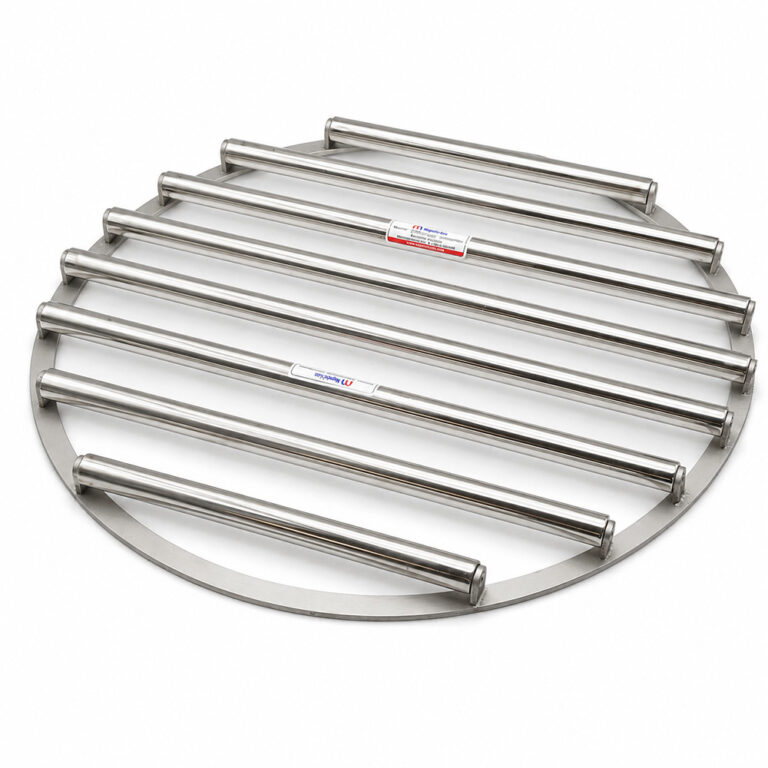
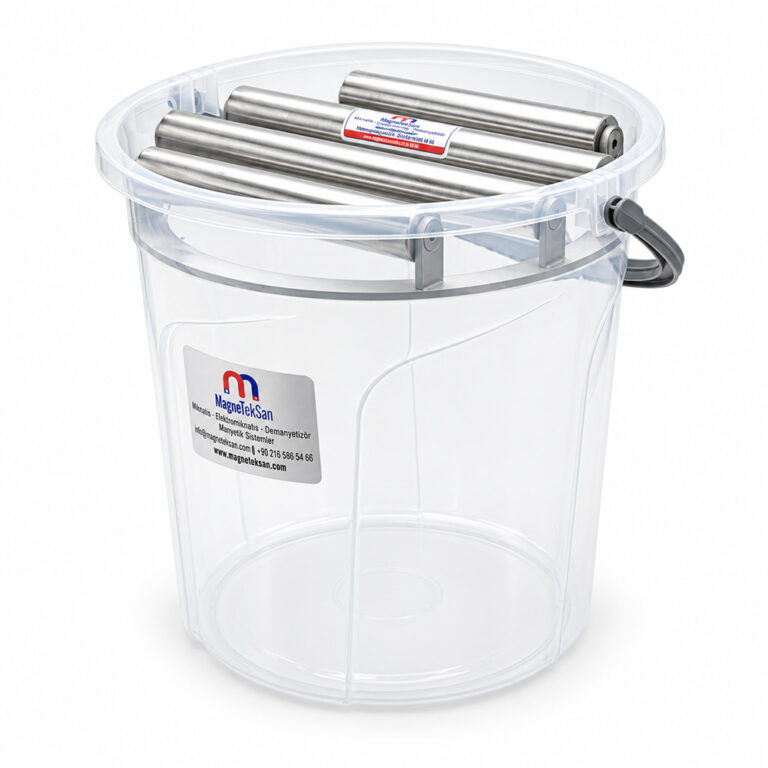
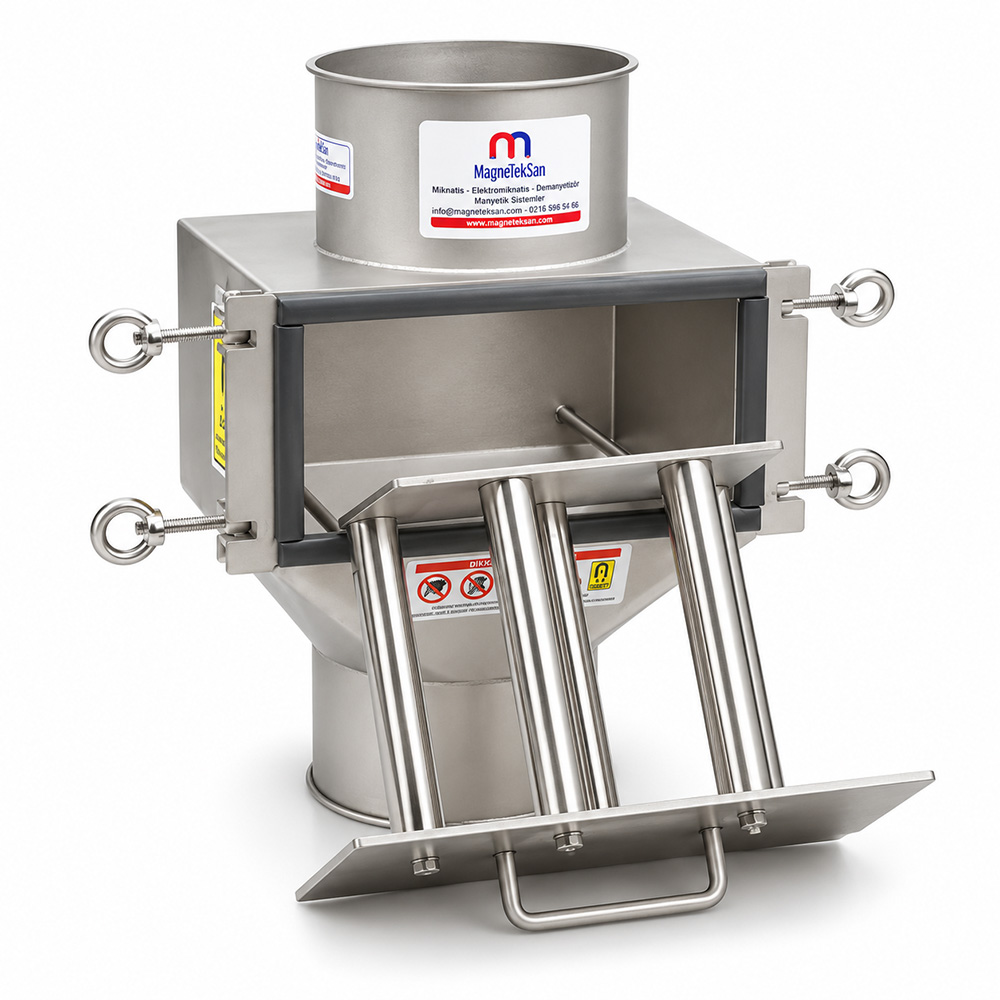
The drawer assembly contains:
5 magnetic bars
Each magnetic bar has a diameter of:
Ø25 mm
The five-bar arrangement increases the magnetic contact area available as the dry product passes through the housing.
What type of magnets are used?
The magnetic bars are manufactured using:
N35 Neodymium
Neodymium magnets provide a strong magnetic field within a compact magnetic bar structure and are widely used in industrial magnetic separation applications.
What is the magnetic strength?
The specified magnetic field strength for this product is:
10,000 Gauss
The actual ability to capture a specific contaminant also depends on factors such as the contaminant’s magnetic properties, size, shape, product flow conditions and distance from the magnetic surface.
Does 10,000 Gauss mean that every metal particle will be captured?
No.
Gauss is an important magnetic-field parameter, but separation performance cannot be determined from the Gauss value alone.
Actual capture performance can also depend on:
- magnetic properties of the contaminant
- particle size
- particle shape
- distance from the magnetic bar
- product flow rate
- product depth
- installation position
- contact or proximity to the magnetic field
The system should therefore be evaluated according to the actual product and process conditions.
What contaminants can this magnet capture?
The system is intended primarily for ferromagnetic metal contamination, including suitable particles containing iron or ferromagnetic steel.
Depending on particle properties and process conditions, these may include:
- iron particles
- steel fragments
- ferromagnetic metal dust
- small ferrous particles
- wear particles originating from suitable steel components
Capture performance varies according to the magnetic properties and physical characteristics of the contamination.
Can it capture stainless steel?
It depends on the stainless steel grade and its metallurgical condition.
Some stainless steels can respond strongly to a magnetic field, while some austenitic stainless steels have very low magnetic response.
For critical applications, the actual contaminant or representative test samples should be tested.
Can it capture aluminium?
No, not in the same way as ferromagnetic iron or carbon steel.
Aluminium is not ferromagnetic and should not be treated as a target material for conventional permanent magnetic separation.
Can it capture copper or brass?
Normally, no.
Copper and brass are not ferromagnetic materials and are therefore not normally captured by this type of permanent magnetic separator.
Why are five Ø25 mm magnetic bars used?
Using multiple magnetic bars distributes the magnetic separation area across the product-flow section.
As dry yeast passes through the housing, the arrangement helps bring the flowing material into proximity with the magnetic field generated by the five bars.
The actual separation performance still depends on the product flow characteristics and installation conditions.
What does N35 mean?
N35 identifies the grade of the neodymium magnetic material used in the magnetic bars.
The grade is a material specification and should not be interpreted as a Gauss value. In this product, the specified magnetic field strength is separately stated as 10,000 Gauss.
What material is the housing made from?
The product has an:
AISI 304 stainless steel body.
The use of stainless steel provides a corrosion-resistant and durable structure suitable for industrial processing equipment. The product listing identifies this model as AISI 304 construction.
Why is AISI 304 stainless steel used?
AISI 304 stainless steel is widely used in industrial and food-processing equipment because of its corrosion resistance, cleanable surface and mechanical durability.
The suitability of the complete installation should nevertheless be assessed according to the customer’s specific product, cleaning procedure, environment and hygiene requirements.
Is this product suitable for food processing lines?
This model is designed for a dry yeast packaging application and uses an AISI 304 stainless steel structure. Magneteksan also lists drawer-type magnetic housings among magnetic separator solutions commonly used in the food industry.
Any specific food-contact certification or regulatory requirement should be confirmed separately according to the customer’s application and required documentation.
How does the magnetic separation process work?
The operating principle is passive and does not require electrical power for the permanent neodymium magnets.
As the product flows through the housing:
Dry Product Enters
↓
Product Passes Around Magnetic Bars
↓
Ferromagnetic Particles Are Attracted
↓
Particles Remain on the Magnetic Bars
↓
Product Continues Through the Outlet
The captured contamination is subsequently removed during the cleaning procedure.
Does this magnet require electricity?
No electrical supply is required to generate the magnetic field because the system uses permanent N35 neodymium magnets.
This distinguishes the product from an electromagnet, which requires electrical power to generate its magnetic field.
Why is it called a drawer magnet?
The magnetic bars are arranged as a removable drawer-type magnetic assembly inside the housing.
This construction allows the magnetic assembly to be accessed for inspection and periodic cleaning without treating the entire housing as a single fixed magnetic element.
How should the magnetic bars be cleaned?
Cleaning should be carried out only when the production line is stopped and the equipment is in a safe condition.
The magnetic assembly can be accessed and accumulated ferromagnetic contamination removed from the magnetic bars according to the site’s operating and hygiene procedure.
Operators should remember that neodymium magnetic bars generate strong permanent magnetic attraction even when the production line is not operating.
How often should the drawer magnet be cleaned?
There is no universal cleaning interval suitable for every production line.
Cleaning frequency depends on:
- amount of ferromagnetic contamination
- production volume
- product flow rate
- operating hours
- process conditions
- internal quality-control requirements
The cleaning interval should be established through inspection during actual production.
Does product flow rate affect magnetic separation?
Yes.
If the product moves too quickly through the magnetic separation zone, the available interaction time between contaminants and the magnetic field may decrease.
Flow characteristics should therefore be considered when selecting the installation position and magnetic configuration.
Does the distance from the magnetic bar affect capture performance?
Yes.
Magnetic field strength decreases as the distance from the magnetic surface increases.
For this reason, the internal geometry and magnetic bar arrangement are important in helping the flowing product and possible ferromagnetic contaminants pass close to the magnetic bars.
Can this drawer magnet be used for products other than dry yeast?
Potentially, yes.
Round inlet drawer magnets are also used for suitable dry and free-flowing powders, granules and similar products where ferromagnetic contamination control is required.
However, suitability should be evaluated separately according to the product’s:
- flow characteristics
- particle size
- bulk density
- moisture level
- tendency to bridge or clog
- process temperature
- hygiene requirements
Can it be installed in a gravity-fed line?
Yes, this type of magnetic separator is commonly suited to gravity-fed product flow when the housing dimensions, connection arrangement and product characteristics are compatible with the application.
The installation should provide stable product flow through the magnetic separation zone.
Can it be installed directly before packaging?
Yes, when the process design allows it.
Installing a magnetic separator before packaging can provide a final magnetic control point for ferromagnetic contamination before the product enters the packaging stage.
The appropriate location should be determined according to the overall production-line design and hazard-control strategy.
Does the magnet affect dry yeast itself?
The system is designed to attract ferromagnetic contamination, not the dry yeast itself.
The dry yeast passes through the magnetic housing while suitable ferromagnetic particles are attracted toward the magnetic bars.
Does this system replace all other foreign-body control equipment?
No.
A drawer magnet is specifically intended for magnetic separation of suitable ferromagnetic contaminants.
It does not replace equipment designed to detect or remove non-ferromagnetic foreign materials. Depending on the process, other control technologies may also be required.
What maintenance is required?
Periodic inspection should include:
- magnetic bar surfaces
- drawer assembly
- housing
- inlet and outlet connections
- mechanical fasteners
- seals or connection components where applicable
- accumulation of ferromagnetic contamination
- physical damage to the magnetic bars
The cleaning and inspection frequency should be determined according to the actual production environment.
Can custom Round Inlet Drawer Magnets be manufactured?
Yes.
Magneteksan manufactures drawer-type magnetic housings in different configurations and states that custom dimensions, magnetic strengths and operating-temperature solutions can be produced according to the application.
Depending on the production line, the design can be evaluated according to:
- inlet and outlet dimensions
- number of magnetic bars
- magnetic bar diameter
- magnet grade
- required magnetic field
- body material
- product characteristics
- installation space
- process temperature
- cleaning requirements