- Magneteksan
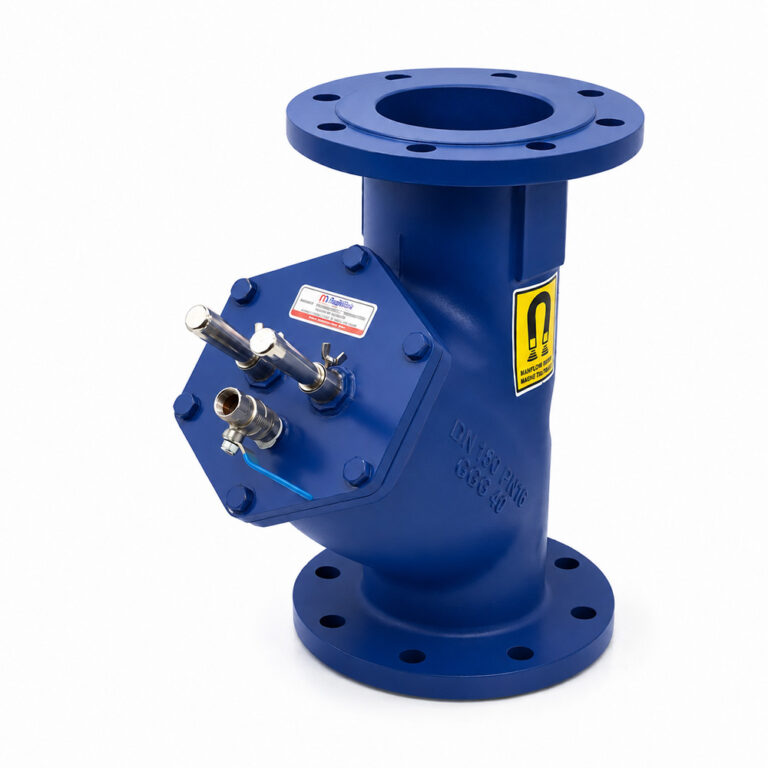
- > Y-Shaped Magnetic Cast Iron Flanged Filters
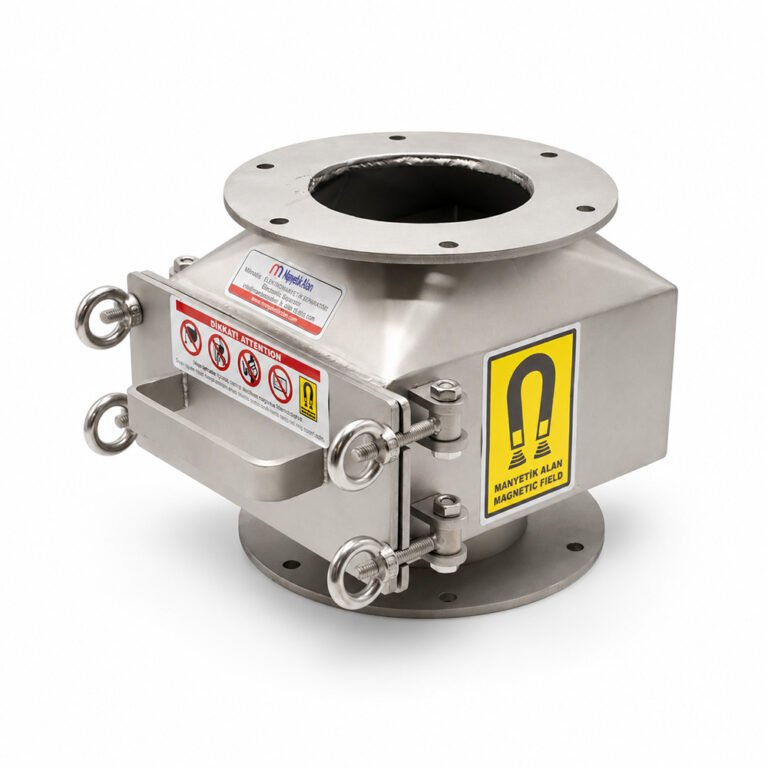
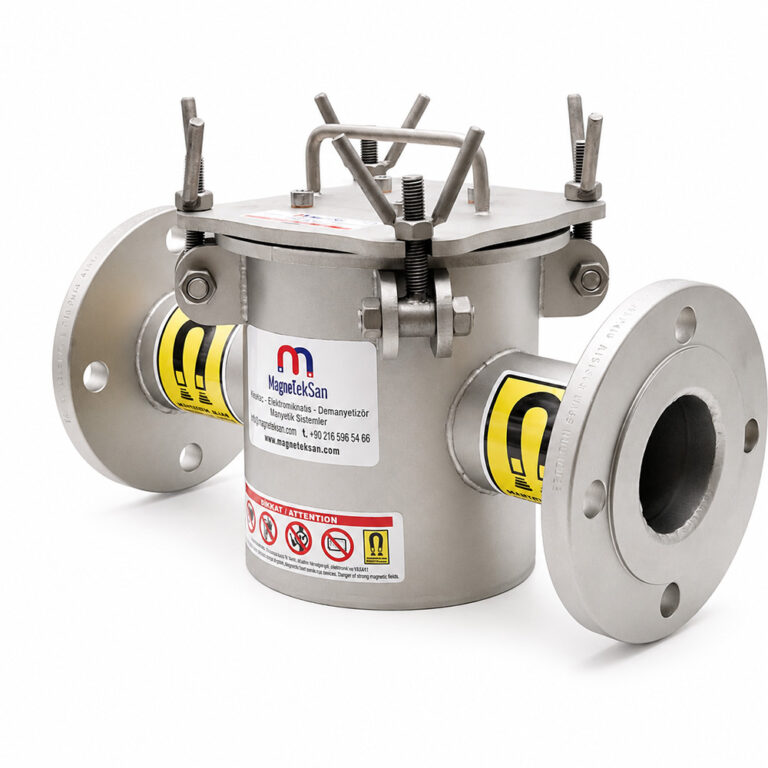
- > DN80 – Neodymium Magnetic Filter – Wet Wire Drawing Line, Ø25×220 mm
DN80 – Neodymium Magnetic Filter – Wet Wire Drawing Line, Ø25×220 mm
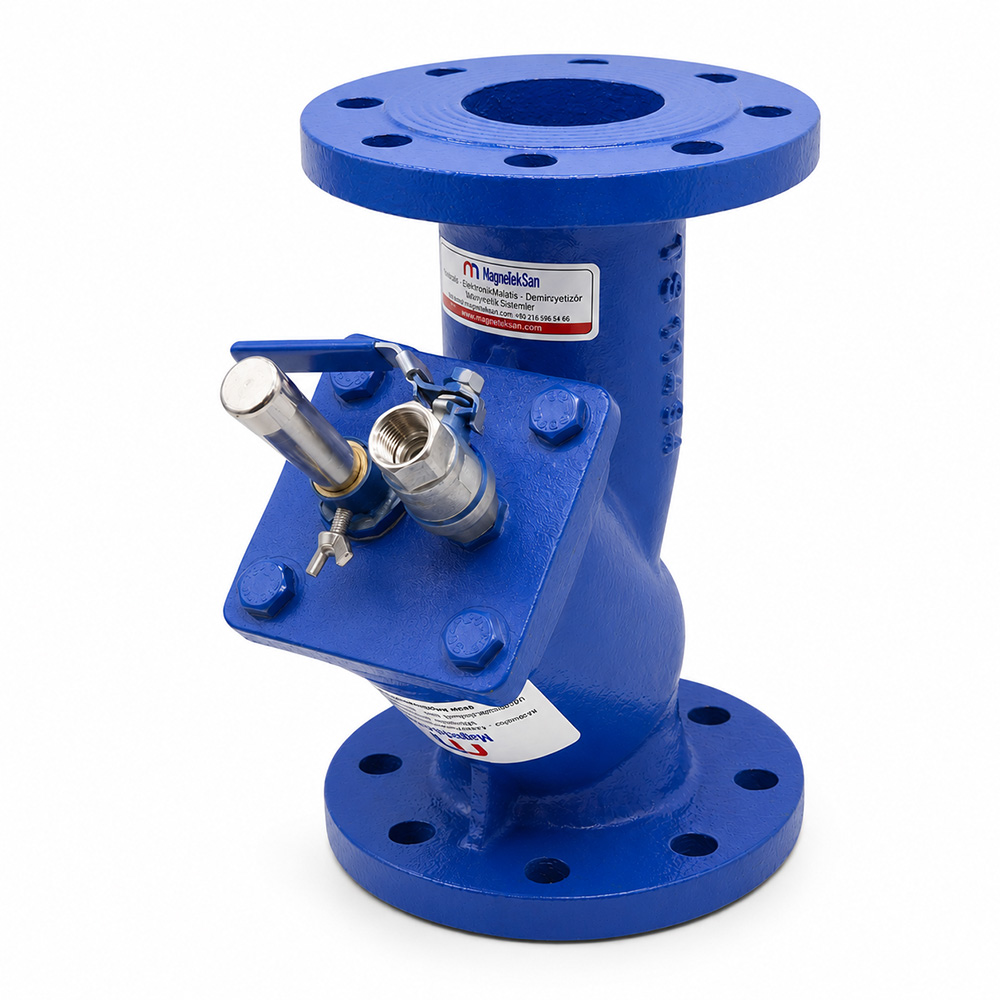
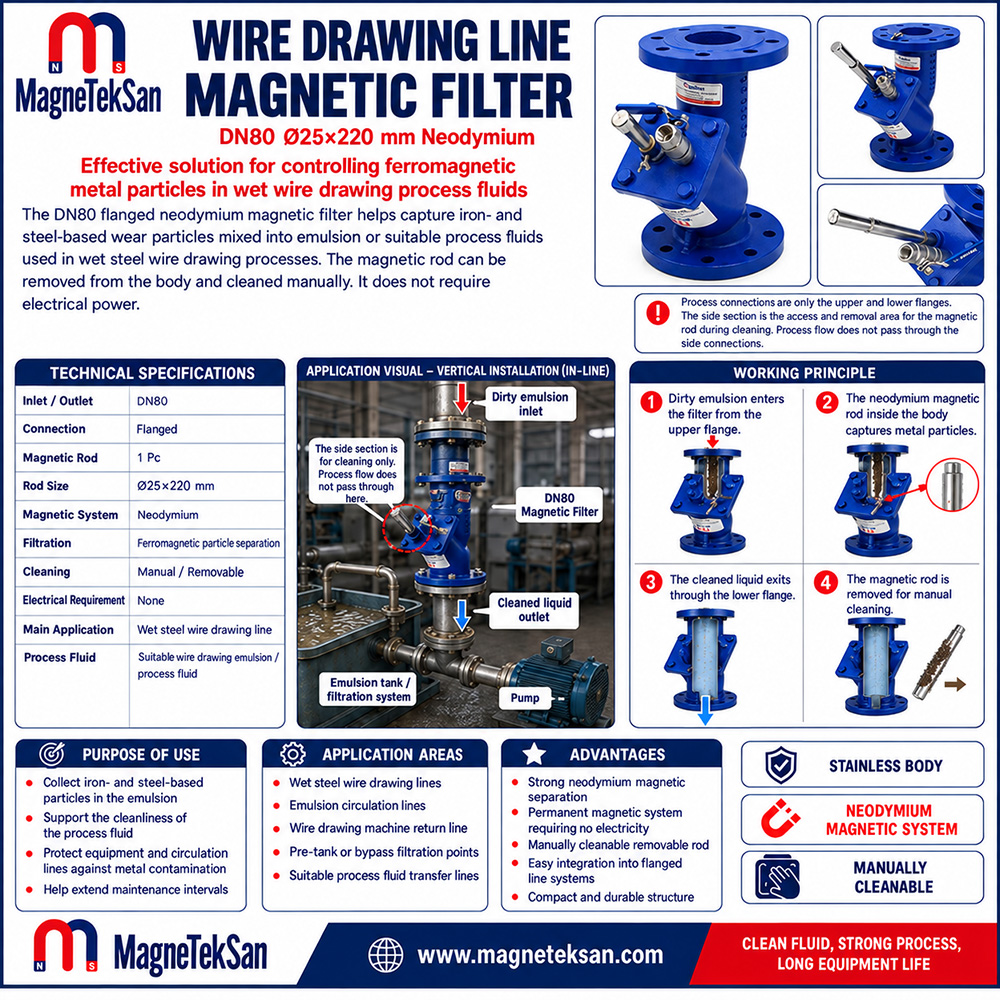
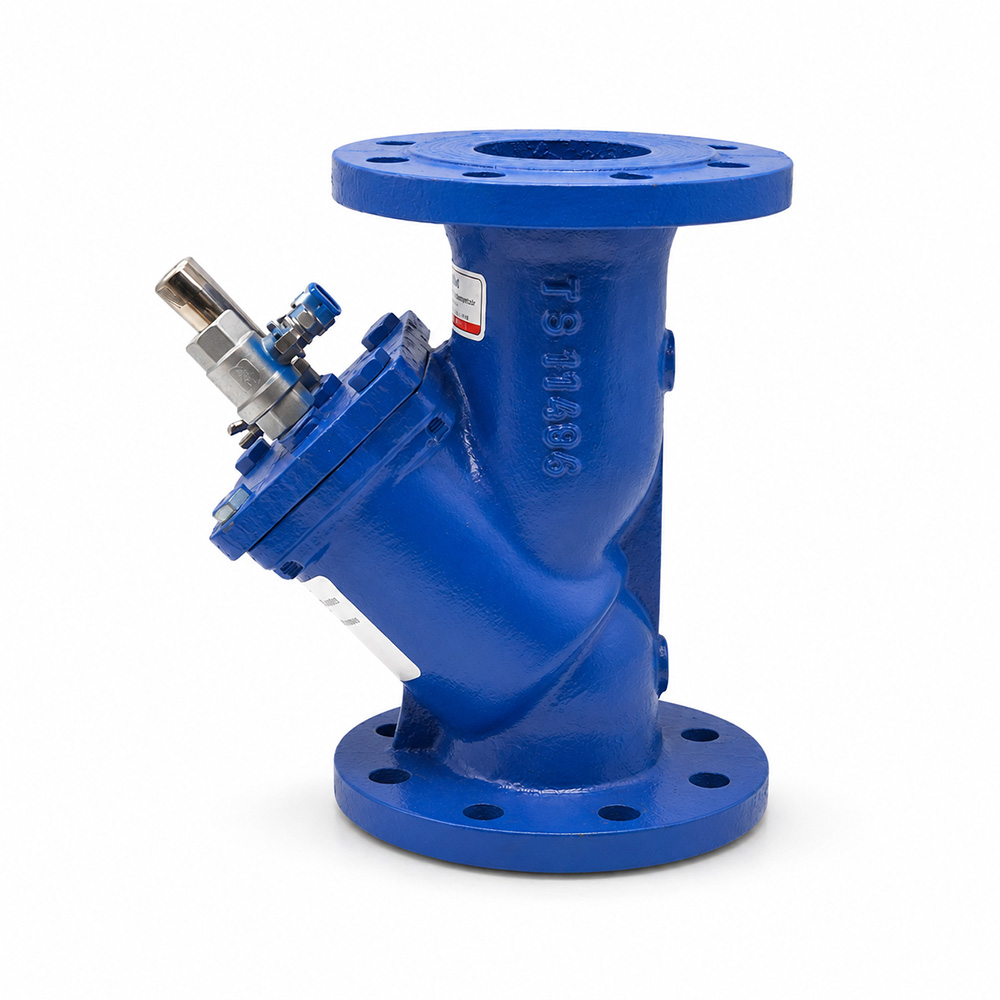
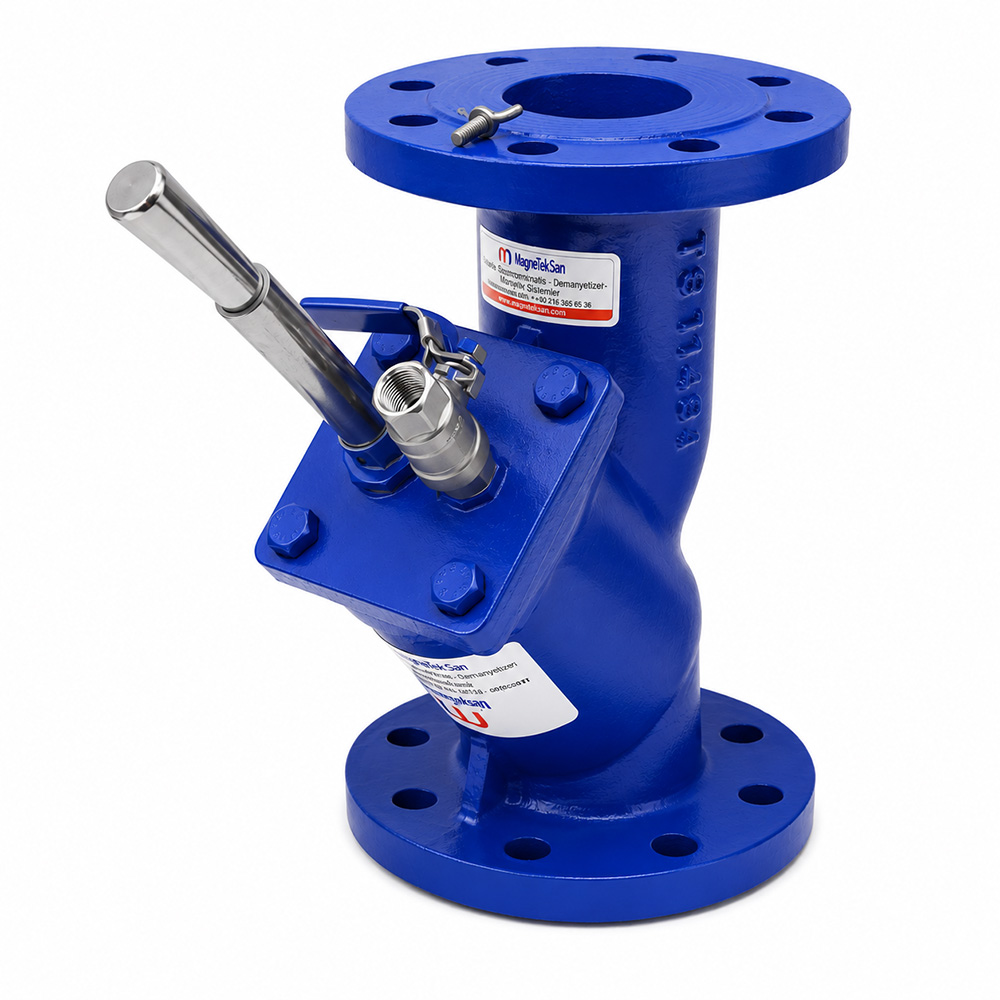
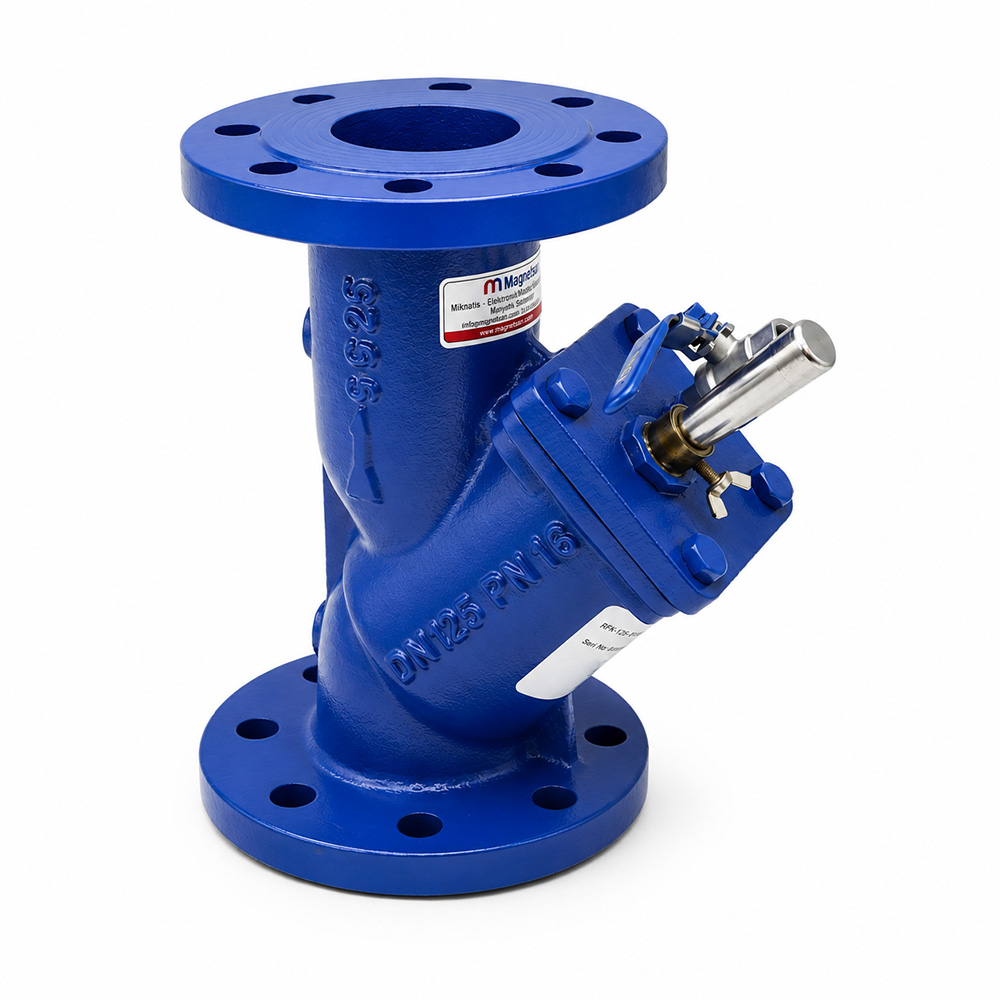
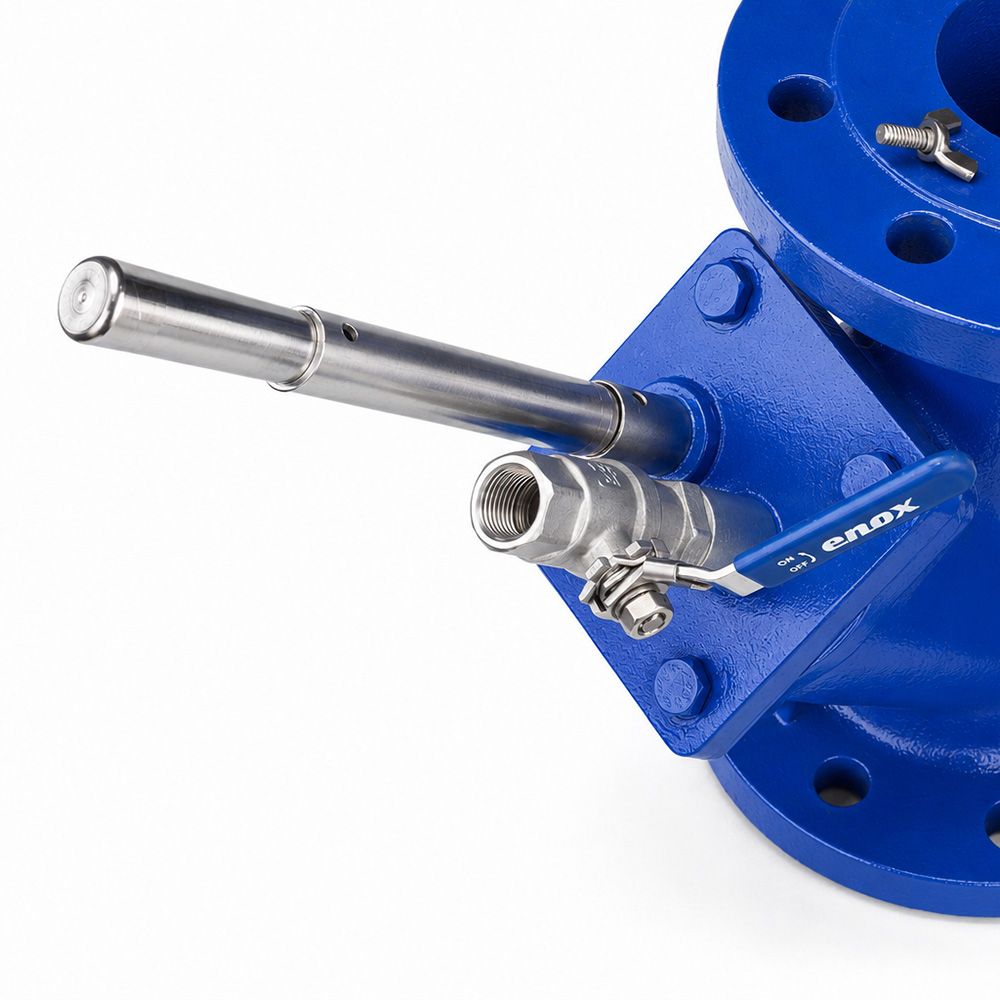
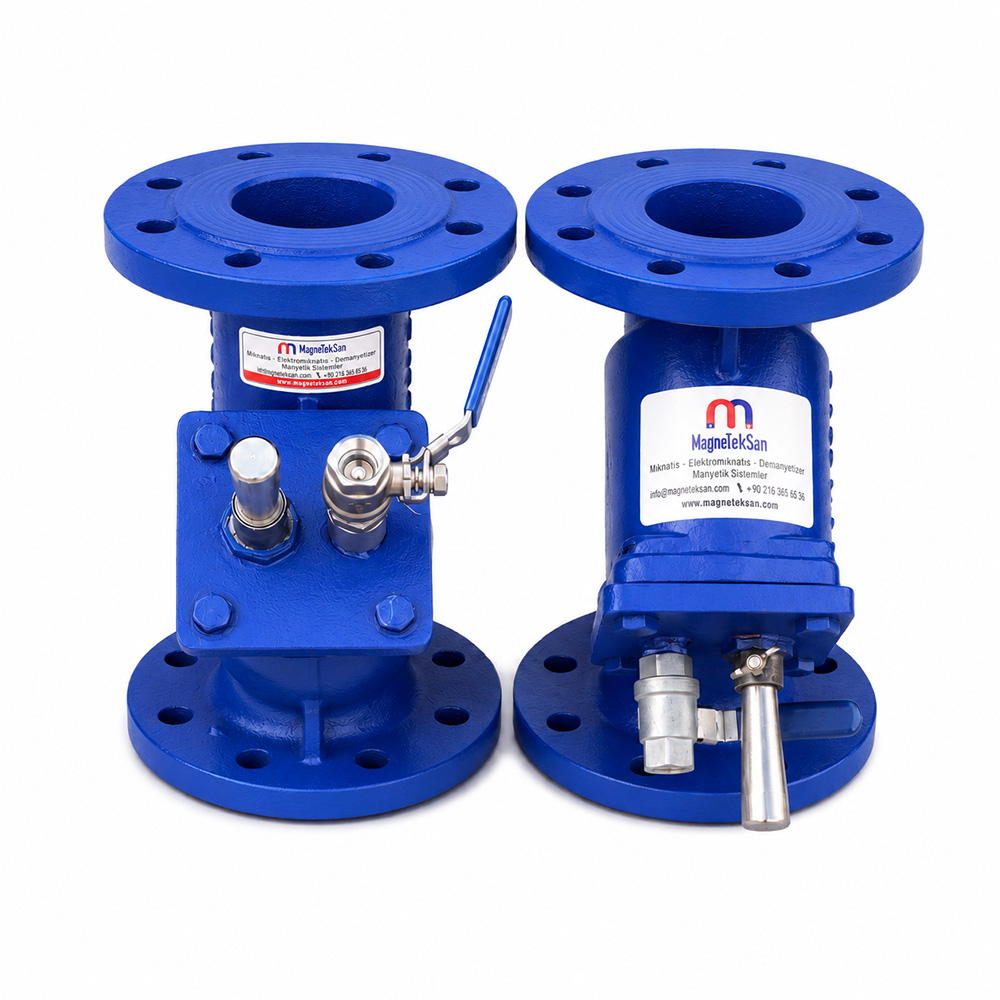
DN80 – Neodymium Magnetic Filter – Wet Wire Drawing Line, Ø25×220 mm
General Features
- Designed for magnetic separation of ferromagnetic contaminants from compatible fluids used in wet steel wire drawing lines.
- Features DN80 flanged inlet and outlet connections for inline installation in industrial fluid circulation systems.
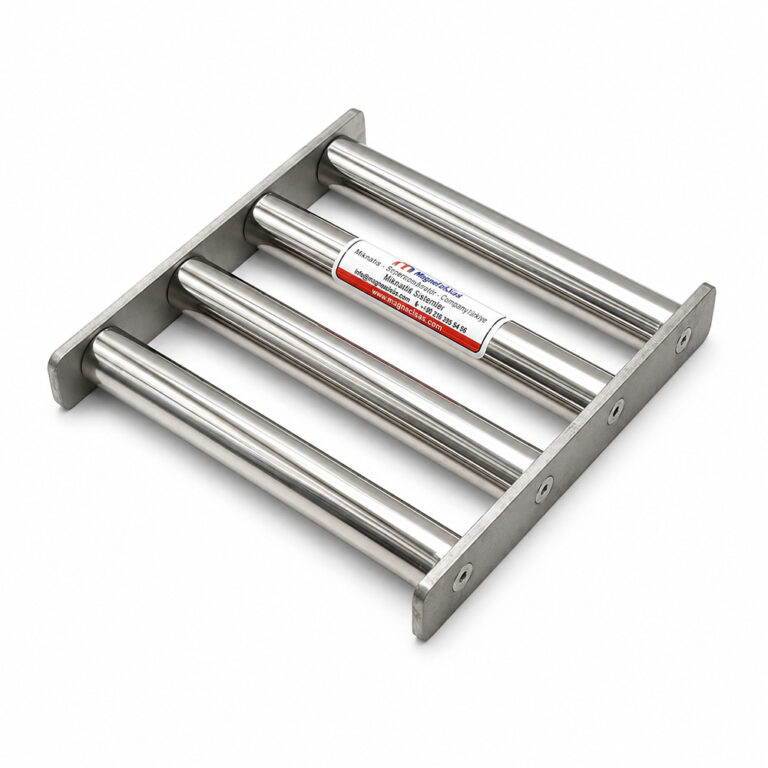
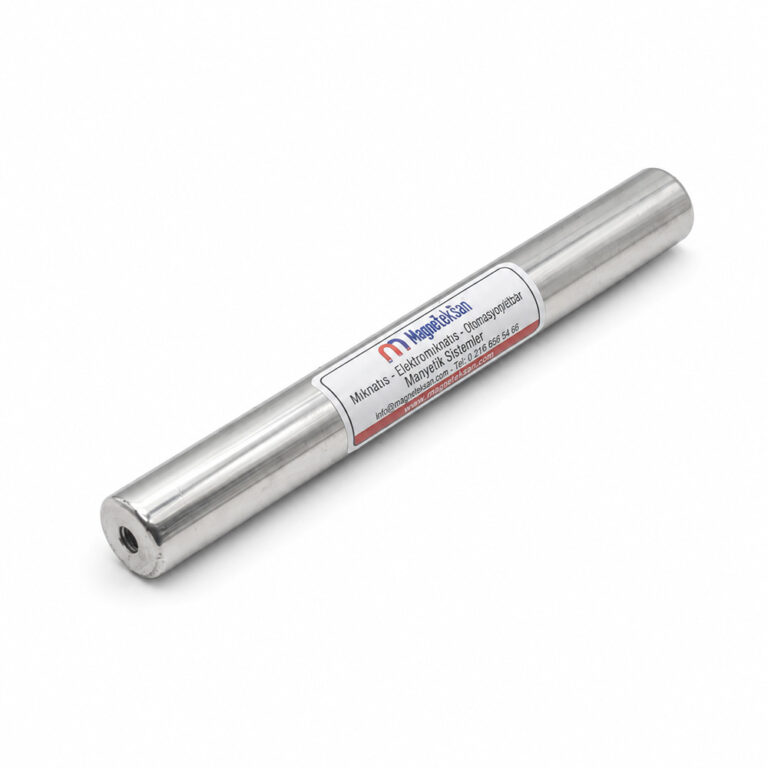
- Contains one Ø25×220 mm neodymium magnetic rod for capturing suitable ferromagnetic particles.
- Helps retain iron and steel wear particles generated during wet wire drawing operations.
- Suitable for evaluation in compatible wire drawing emulsion and coolant circulation circuits.
- Can provide supplementary magnetic separation alongside conventional mechanical filtration equipment.
- Removable magnetic rod allows manual cleaning and periodic inspection.
- Permanent neodymium magnetic system requires no electrical power to generate its magnetic field.
Technical Specifications
- Inlet / Outlet: DN80
- Connection Type: Flanged
- Number of Magnetic Rods: 1
- Magnetic Rod Dimensions: Ø25×220 mm
- Magnetic System: Neodymium
- Product Type: Inline Magnetic Filter
- Filtration Principle: Ferromagnetic Particle Separation
- Cleaning Method: Manual / Removable Rod
- Electrical Power: Not Required for Magnetic Separation
- Main Application: Wet Steel Wire Drawing Lines
- Process Fluid: Compatible Wire Drawing Emulsion / Fluid
Product Information
Extra Information
Product Information
The wire drawing magnetic filter is an inline magnetic separation device designed to capture ferromagnetic metal contaminants from compatible emulsions and process fluids used in wet steel wire drawing operations. Featuring DN80 flanged inlet and outlet connections and one Ø25×220 mm neodymium magnetic rod, it helps retain suitable iron and steel wear particles carried by the circulating fluid. Its removable magnetic rod supports manual cleaning, while the permanent magnet system requires no electricity to generate the magnetic field.
| Technical Parameter | Specification |
|---|---|
| Product Type | Neodymium Magnetic Filter |
| Main Application | Steel Wire Drawing Line |
| Process | Wet Wire Drawing |
| Inlet | DN80 |
| Outlet | DN80 |
| Connection Type | Flanged |
| Number of Magnetic Rods | 1 |
| Magnetic Rod Dimensions | Ø25×220 mm |
| Magnetic System | Neodymium |
| Operating Principle | Ferromagnetic Particle Separation |
| Cleaning Method | Manual / Removable |
| Electrical Power | Not Required |
| Target Contaminants | Iron and Steel-Based Particles |
| Process Fluid | Compatible Wire Drawing Emulsion / Fluid |
Extra Information
What Is a Wire Drawing Magnetic Filter?
A wire drawing magnetic filter is an industrial magnetic separation device designed to help reduce ferromagnetic contamination in compatible process fluids used during wet steel wire drawing.
In wet wire drawing operations, steel wire is pulled through drawing dies to reduce its diameter. Lubricating and cooling fluids are used to support the drawing process, reduce friction and manage heat generated by mechanical contact.
During operation, fine iron and steel particles may enter the circulating fluid through surface wear and contact between the wire and processing equipment.
The Magneteksan DN80 Neodymium Magnetic Filter uses one Ø25×220 mm neodymium magnetic rod to attract and retain suitable ferromagnetic contaminants.
The filter can be integrated into compatible fluid circulation systems as an additional magnetic separation stage.
What Is the Wet Wire Drawing Process?
Wire drawing is a metal forming process in which wire rod or wire is pulled through a die with a smaller opening to reduce its cross-sectional area.
Wet wire drawing uses a liquid lubricant, coolant or compatible emulsion during the drawing operation.
Depending on the process, these fluids help:
- Reduce friction between the wire and drawing die.
- Remove heat generated during drawing.
- Support lubrication of contact surfaces.
- Carry wear particles away from the working area.
- Maintain suitable operating conditions.
The process fluid may be recirculated through tanks, pumps, filters and the wire drawing equipment.
As the fluid is reused, metallic contaminants can accumulate in the circulation system.
Why Are Metal Particles Generated During Wire Drawing?
Steel wire passes through drawing dies under substantial mechanical contact and pressure.
During continuous operation, small amounts of metallic material may separate from the wire surface or processing equipment.
Potential contaminants include:
- Fine iron particles.
- Carbon steel wear particles.
- Ferromagnetic metal fines.
- Small steel fragments.
- Certain iron oxide particles.
- Ferromagnetic debris originating from mechanical contact.
These contaminants can enter the lubricant or cooling emulsion.
If the fluid is continuously recirculated, the particles may repeatedly pass through pumps, nozzles and other equipment.
Magnetic filtration provides a supplementary method of collecting suitable ferromagnetic particles from the fluid.
Why Is a Magnetic Filter Used in Wire Drawing Lines?
The primary purpose of the magnetic filter is to collect suitable ferromagnetic contaminants at a defined point in the fluid circulation system.
Reducing the quantity of circulating iron and steel particles may help limit the transfer of metallic contamination to:
- Circulation pumps.
- Drawing dies.
- Cooling and lubrication nozzles.
- Heat exchangers.
- Wire drawing machinery.
- Other components exposed to the process fluid.
Magnetic separation can support a broader fluid management and filtration strategy.
However, the filter does not replace proper lubrication, mechanical maintenance or other filtration equipment.
How Does the DN80 Wire Drawing Magnetic Filter Work?
The operating principle is based on the magnetic attraction produced by a permanent neodymium magnet.
- Contaminated drawing emulsion or compatible process fluid enters through the DN80 inlet.
- The fluid flows through the filter housing.
- The flow passes through the magnetic influence area of the Ø25×220 mm neodymium rod.
- Suitable ferromagnetic particles are attracted toward the rod surface.
- Captured contaminants remain on the magnetic element while the fluid continues through the filter.
- The fluid exits through the DN80 outlet and returns to the circulation system.
- During scheduled maintenance, the magnetic rod is removed and cleaned manually.
Actual separation performance depends on particle properties, flow velocity, fluid viscosity, magnetic field distribution and internal flow conditions.
Example of a Wet Wire Drawing Filtration Circuit
A possible process arrangement is:
Wire Drawing Machine → Contaminated Emulsion → DN80 Magnetic Filter → Emulsion Tank / Main Filtration System → Circulation Pump → Wire Drawing Machine
This example illustrates how magnetic separation can be incorporated into a wet wire drawing fluid circuit.
The final installation location and equipment sequence must be determined according to the plant’s hydraulic design.
Where Can the Magnetic Filter Be Installed?
The appropriate installation position depends on the existing fluid circulation arrangement.
Potential locations include:
- Machine fluid return lines.
- Emulsion circulation lines.
- Suitable sections before the main filtration system.
- Dedicated bypass filtration circuits.
- Other compatible liquid circulation points.
Before selecting a location, the operating pressure, required flow rate, allowable pressure drop and maintenance access must be evaluated.
Installation in the Machine Return Line
The filter may be installed in a suitable return line to help capture ferromagnetic particles before the contaminated fluid reaches the emulsion tank.
Example:
Wire Drawing Machine → Magnetic Filter → Emulsion Tank
This arrangement can provide an additional magnetic separation stage during fluid return.
Its suitability depends on the hydraulic conditions and layout of the actual installation.
Installation in the Pump Circulation Line
A magnetic filter may also be considered in a circulation circuit where fluid is pumped from a tank and returned to the process.
The installation must account for:
- Pump operating conditions.
- Available pressure.
- Allowable pressure drop.
- Fluid flow characteristics.
- Safe isolation for maintenance.
Installation on the suction or discharge side of a pump should only be selected after appropriate engineering checks.
Installation in a Bypass Filtration Circuit
A bypass arrangement allows part of the circulating fluid to pass through a separate filtration loop.
Example:
Emulsion Tank → Bypass Pump → Magnetic Filter → Emulsion Tank
This configuration may provide supplementary magnetic separation without routing the entire main process flow through the filter.
The actual arrangement must be evaluated against the required circulation rate and plant design.
Which Contaminants Can the Filter Capture?
The neodymium magnetic system is intended to attract suitable ferromagnetic contaminants.
Examples include:
- Iron dust.
- Carbon steel particles.
- Ferromagnetic metal fines.
- Steel wear fragments.
- Certain magnetic iron oxides.
The filter does not capture all metallic or non-metallic contaminants.
Its performance depends on the magnetic response of each particle and the operating conditions.
What Is the Function of the Ø25×220 mm Neodymium Magnetic Rod?
The Ø25×220 mm neodymium magnetic rod forms the magnetic collection surface inside the filter housing.
As the fluid passes through the magnetic field, suitable ferromagnetic particles can be attracted to the rod.
The captured material accumulates on the magnetic surface until it is removed during maintenance.
This separation method is based on magnetic properties rather than solely on the openings of a mechanical screen.
The rod dimensions identify the physical size of the magnetic element; they do not establish a guaranteed magnetic field strength or particle capture efficiency.
Can the Filter Capture Very Fine Iron Particles?
Fine iron particles with sufficient ferromagnetic properties may respond to the neodymium magnetic field.
However, the actual capture capability depends on:
- Particle size.
- Magnetic properties.
- Particle shape.
- Fluid velocity.
- Fluid viscosity.
- Distance from the magnetic rod.
- Amount of material already collected.
No verified minimum particle capture size has been specified for this model.
Therefore, a guaranteed filtration rating in microns should not be stated without appropriate testing.
What Are the Advantages of DN80 Flanged Connections?
The filter has DN80 flanged inlet and outlet connections.
This arrangement allows its integration to be evaluated for industrial fluid circulation pipelines with compatible nominal connection sizes.
Potential benefits include:
- Connection to suitable process piping.
- Inline installation in compatible liquid circuits.
- Integration with existing filtration systems.
- Access for planned maintenance, subject to the installation layout.
DN80 is a nominal connection size, not a guaranteed flow capacity.
The flange standard, pressure rating and installation requirements must be confirmed before installation.
What Is the Flow Capacity in m³/h?
No verified nominal flow rate has been specified for this product.
Actual allowable flow depends on:
- Fluid viscosity.
- Operating temperature.
- Pump capacity.
- Internal filter geometry.
- Fluid velocity.
- Operating pressure.
- Permissible pressure drop.
- Contamination load.
- Required magnetic separation performance.
A DN80 connection alone does not determine the filter’s capacity in m³/h.
The required flow rate should be provided during technical evaluation.
Is This Filter Suitable for Dry Wire Drawing?
The primary application of this product is wet steel wire drawing fluid filtration.
Dry wire drawing processes may use powdered soap-based lubricants rather than circulating liquid emulsions.
These dry materials require a different handling and separation arrangement.
Although magnetic separation can be relevant to certain dry lubricant recovery processes, this particular DN80 filter is designed for liquid-line applications.
It should not be presented as a standard dry powder filtration device.
Why Should Wire Drawing Emulsion Be Filtered?
The concentration of metal particles in circulating drawing emulsion can increase over time.
This may contribute to:
- Increased fluid contamination.
- Recirculation of metallic wear particles.
- Additional contaminant loading on pumps.
- Faster loading of mechanical filtration equipment.
- Accumulation of particles near drawing equipment.
Filtration is one of the measures used to manage contamination in recirculating process fluids.
Magnetic separation can support this process by targeting suitable ferromagnetic particles.
Can Magnetic Filtration Extend Emulsion Service Life?
Reducing ferromagnetic contamination may support effective management of drawing emulsions.
However, emulsion service life also depends on:
- Fluid concentration.
- pH.
- Microbiological condition.
- Operating temperature.
- Lubrication additives.
- Fluid chemistry.
- General filtration and maintenance practices.
A magnetic filter alone cannot guarantee a specific percentage increase in emulsion service life.
Any measurable improvement should be evaluated under actual operating conditions.
Can the Filter Help Protect Wire Drawing Dies?
Reducing the circulation of suitable hard metallic particles may help limit the contaminant load reaching components exposed to the process fluid.
This may be relevant to drawing dies, capstans and associated mechanical equipment.
However, die wear is influenced by many factors, including:
- Wire material.
- Drawing speed.
- Lubrication quality.
- Die geometry.
- Mechanical alignment.
- Process temperature.
- Surface condition of the incoming wire.
The magnetic filter should be regarded as supplementary contamination-control equipment rather than a device that eliminates die wear.
Can Magnetic Filtration Contribute to Wire Quality?
Clean process fluid is one factor in maintaining controlled wire drawing conditions.
Reducing circulating ferromagnetic particles may help:
- Limit the movement of metallic contamination.
- Support the overall filtration system.
- Reduce the recirculation of suitable wear particles.
Final wire surface quality also depends on the drawing dies, lubrication, wire material, drawing speed and process settings.
Magnetic filtration alone does not guarantee a particular wire surface finish or mechanical property.
Can This Filter Be Used in Aluminium Wire Drawing?
Aluminium is not ferromagnetic under normal operating conditions.
Consequently, a standard neodymium magnetic filter does not attract aluminium particles in the same way as iron or carbon steel particles.
If an aluminium wire drawing fluid contains ferromagnetic contamination from other sources, magnetic separation may be considered for those specific contaminants.
However, this product’s primary application is wet steel wire drawing.
Can the Filter Be Used in Copper Wire Drawing?
Copper is not ferromagnetic under normal conditions.
Therefore, copper wear particles are not captured by a conventional neodymium magnetic rod in the same manner as iron particles.
Depending on the contamination type, copper wire drawing processes may require:
- Mechanical filtration.
- Paper filtration.
- Bag filtration.
- Centrifugal separation.
- Other suitable fluid treatment methods.
Magnetic filtration should only be selected when the target contaminants have suitable magnetic properties.
Does a Magnetic Filter Replace a Mechanical Filter?
Not necessarily.
Magnetic and mechanical filtration use different separation principles.
A magnetic filter targets particles according to their ferromagnetic properties.
A mechanical filter retains particles according to the characteristics of its filter medium and the size of the particles.
Both technologies can be used in the same system.
Example:
Magnetic Separation → Mechanical Filtration → Emulsion Circulation
The final arrangement should be based on the process fluid and contamination requirements.
Comparison of Wire Drawing Filtration Technologies
| Filtration Technology | Separation Principle | Primary Function |
|---|---|---|
| Neodymium Magnetic Filter | Magnetic attraction | Captures suitable ferromagnetic metal particles |
| Mechanical Screen Filter | Screen openings | Retains particles according to screen size |
| Paper / Bag Filter | Filter medium | Retains contaminants according to media characteristics |
| Centrifugal Separator | Centrifugal force | Separates suitable particles based on density and flow conditions |
| Gravity / Vacuum Filtration | Filter medium and pressure conditions | Removes particles according to system design and filter media |
The most suitable technology depends on the type of process fluid, contaminant properties and required filtration performance.
How Is This Different from a CNC Coolant Magnetic Filter?
Magnetic filters for CNC machinery are generally used with compatible cutting, machining and grinding fluids.
Their applications focus on contamination generated during metal removal processes.
The DN80 wire drawing magnetic filter has a different application focus:
Wet Steel Wire Drawing → Drawing Emulsion → Ferromagnetic Wear Particles
The fluid composition, contamination sources and circulation requirements may differ from those of a CNC machining system.
How Is This Different from a DN80 Chiller Magnetic Filter?
Magnetic filters used in closed-loop heating and cooling systems are commonly intended to capture suitable magnetic corrosion products and other ferromagnetic debris from water circuits.
A wet wire drawing filter addresses a different process:
Steel Wire Drawing → Lubricating / Cooling Emulsion → Iron and Steel Wear Particles
Although two filters may share a DN80 nominal connection size, their internal magnetic arrangements and application requirements can be different.
Connection size alone does not establish equivalent performance or interchangeability.
How Is This Different from a Paint Line Magnetic Filter?
Paint and coating processes involve different fluid properties and contamination requirements.
The primary application of this product is not paint, pigments or coating raw materials.
Its intended use is the separation of suitable ferromagnetic contaminants from compatible wet steel wire drawing fluids.
How Is This Different from a Vegetable Oil Magnetic Filter?
Vegetable oil processing and filling systems operate with food-related fluids and application-specific requirements.
The DN80 wire drawing magnetic filter is intended for an industrial metal-forming process.
Its primary contamination source is iron and steel wear generated during wire drawing operations.
The suitability of a magnetic filter must always be assessed for the specific fluid and process.
How Is the Magnetic Rod Cleaned?
The magnetic rod is removable and designed for manual cleaning.
A general maintenance procedure is:
- Stop the relevant fluid circulation equipment.
- Safely isolate the filter from the process circuit.
- Confirm that the filter has been depressurized and cooled to a safe temperature.
- Open the filter according to the approved equipment maintenance procedure.
- Carefully remove the Ø25×220 mm neodymium magnetic rod.
- Remove accumulated iron and steel particles from the rod surface.
- Inspect the rod, seals and connection areas.
- Reinstall the rod, close the filter and restart the system under controlled conditions.
Maintenance must follow the actual equipment instructions and plant safety procedures.
Strong neodymium magnets can attract ferromagnetic tools and components suddenly, creating hand and finger pinch hazards.
How Often Should the Magnetic Rod Be Cleaned?
There is no universal cleaning interval for every wire drawing installation.
Maintenance frequency depends on:
- Wire production capacity.
- Amount of metallic contamination.
- Wire material.
- Drawing speed.
- Fluid circulation rate.
- Operating hours.
- Quantity of particles collected on the rod.
More frequent inspections during initial operation can help establish a suitable cleaning schedule for the specific plant.
What Happens When Too Many Metal Particles Accumulate?
Excessive accumulation of metal debris can cover part of the magnetic collection surface.
This may reduce the available area for capturing additional particles.
Regular inspection and cleaning are therefore important, especially in applications with high ferromagnetic contamination loads.
Does the Magnetic Filter Require Electricity?
The magnetic separation system does not require electricity to generate its magnetic field.
It uses a permanent neodymium magnet rather than an electromagnet.
Therefore, the magnetic element does not require:
- An electrical coil.
- A separate magnetic power supply.
- Electrical energization to maintain the magnetic field.
However, pumps and other components of the fluid circulation system may still require electrical power.
Is the Filter Self-Cleaning?
No.
This model uses a removable magnetic rod that requires manual cleaning.
It should not be described as an automatic or self-cleaning magnetic filter.
Applications requiring continuous automatic removal of captured material may need a different separation system.
What Is the Magnetic Field Strength in Gauss?
The filter contains one Ø25×220 mm neodymium magnetic rod.
However, no verified surface magnetic flux density in Gauss has been specified for this model.
Rod dimensions alone do not establish:
- A guaranteed Gauss value.
- A guaranteed magnetic capture distance.
- A guaranteed minimum particle size.
- A guaranteed separation efficiency.
If specific magnetic performance is required, the measurement conditions and acceptance criteria should be defined during technical evaluation.
What Is the Maximum Operating Pressure?
No verified maximum operating pressure has been specified for this product.
The DN80 flanged connection describes the nominal piping connection size.
The allowable pressure of the complete filter assembly depends on the housing, flanges, seals, closures and other pressure-containing components.
A pressure rating must not be assumed from DN80 alone.
What Is the Maximum Operating Temperature?
No verified maximum operating temperature has been specified for this model.
The permitted temperature depends on the magnetic system, housing materials, seals and actual process conditions.
Neodymium magnet temperature limits can vary according to magnet grade.
The normal and maximum process fluid temperatures should be confirmed before selecting or installing the filter.
Is Chemical Compatibility Important?
Yes.
Wire drawing emulsions and lubricating fluids may contain different combinations of:
- Oils.
- Emulsifiers.
- Lubrication additives.
- Corrosion inhibitors.
- pH-adjusting chemicals.
- Other process-specific components.
Compatibility with the actual fluid must be verified before installation.
The housing material and sealing materials have not been specified for this product, so universal compatibility with every wire drawing emulsion should not be assumed.
Can Magneteksan Manufacture Custom Wire Drawing Magnetic Filters?
Yes.
Magneteksan can evaluate custom magnetic filtration solutions according to the existing fluid circulation system and operating conditions of a wire drawing plant.
Possible design parameters include:
- Inlet and outlet dimensions.
- Flange requirements.
- Required hourly flow rate.
- Emulsion or process fluid type.
- Fluid viscosity.
- Operating temperature.
- Operating pressure.
- Expected ferromagnetic contamination load.
- Magnetic rod diameter and length.
- Number and arrangement of magnetic elements.
- Cleaning method.
- Installation and maintenance space.
Custom configurations should be developed according to the verified technical requirements of the application.
What Information Is Needed for a Custom Magnetic Filter Enquiry?
For technical evaluation, the following information is recommended:
- Application: Wet steel wire drawing.
- Wire Material: Carbon steel, alloy steel or another specified material.
- Process Fluid: Emulsion, coolant or compatible drawing lubricant.
- Installation Position: Return line, circulation line or bypass.
- Inlet Connection: Nominal diameter and flange standard.
- Outlet Connection: Nominal diameter and flange standard.
- Flow Rate: Required capacity in m³/h.
- Operating Pressure: Normal and maximum values.
- Operating Temperature: Normal and maximum fluid temperatures.
- Fluid Properties: Viscosity, chemical composition and relevant additives.
- Target Contaminants: Material, approximate particle size and expected quantity.
- Magnetic Requirements: Required performance and test conditions.
- Available Space: Installation dimensions and maintenance access.
- Existing Filtration: Mechanical, paper, bag, vacuum or other systems.
- Maintenance and Documentation: Cleaning requirements, inspection records and technical documents.
Providing these details supports appropriate filter selection and the development of a suitable magnetic separation arrangement.
Magneteksan – Magnetic Filtration Solutions for Wet Wire Drawing Lines
Magneteksan designs and manufactures industrial magnetic separation equipment for metal processing and fluid circulation applications.
The DN80 Wire Drawing Magnetic Filter, equipped with one Ø25×220 mm neodymium magnetic rod, provides supplementary separation of suitable ferromagnetic contaminants from compatible wet steel wire drawing emulsions and process fluids.
For new installations or upgrades to existing wire drawing lines, Magneteksan can evaluate connection dimensions, fluid properties, contamination requirements and maintenance conditions to develop an appropriate magnetic filtration solution.