Product Information
Extra Information
Product Information
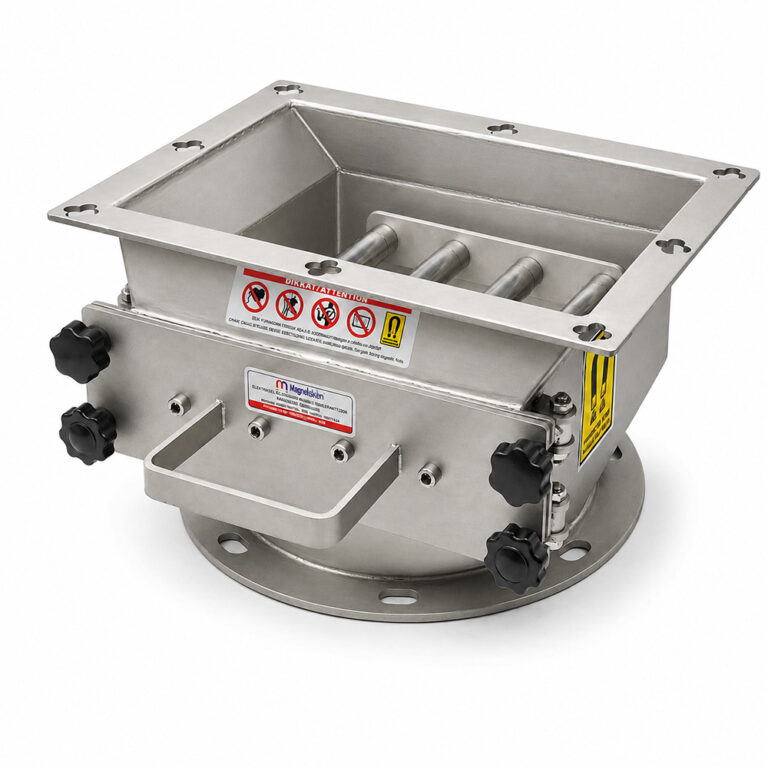
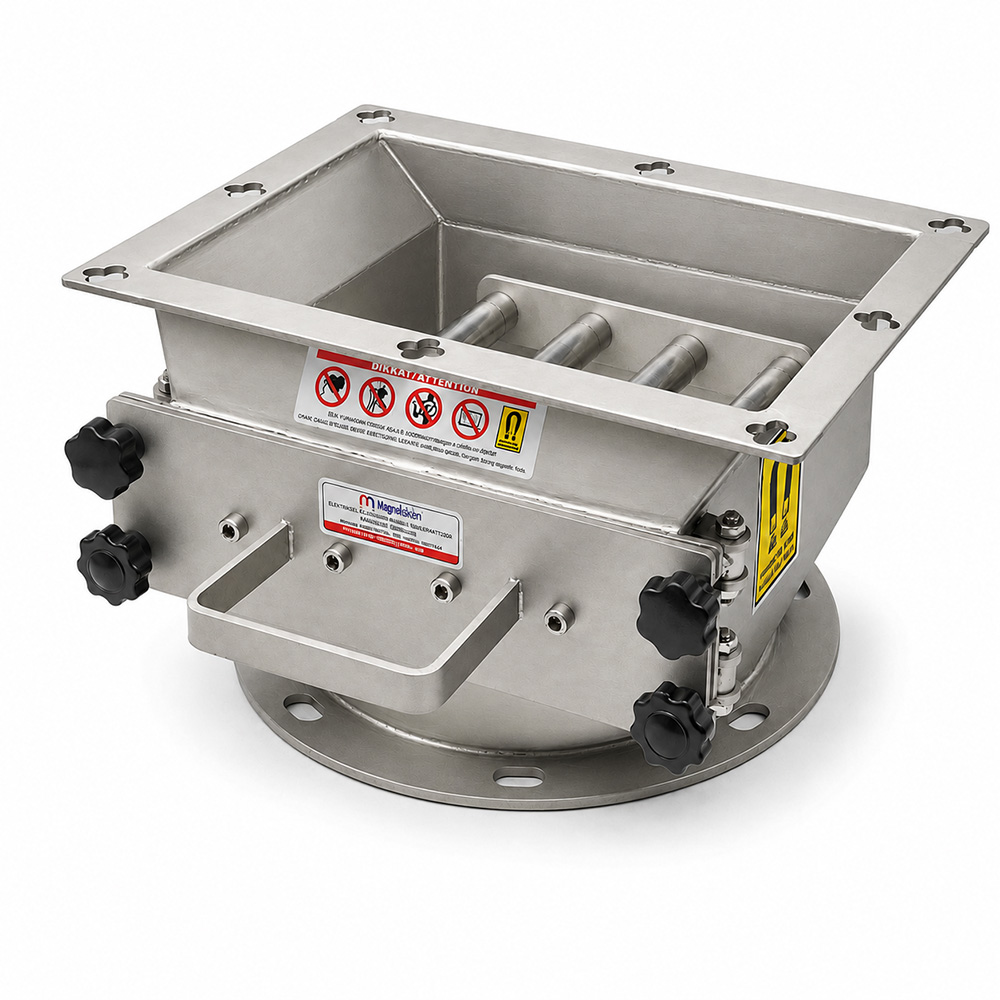
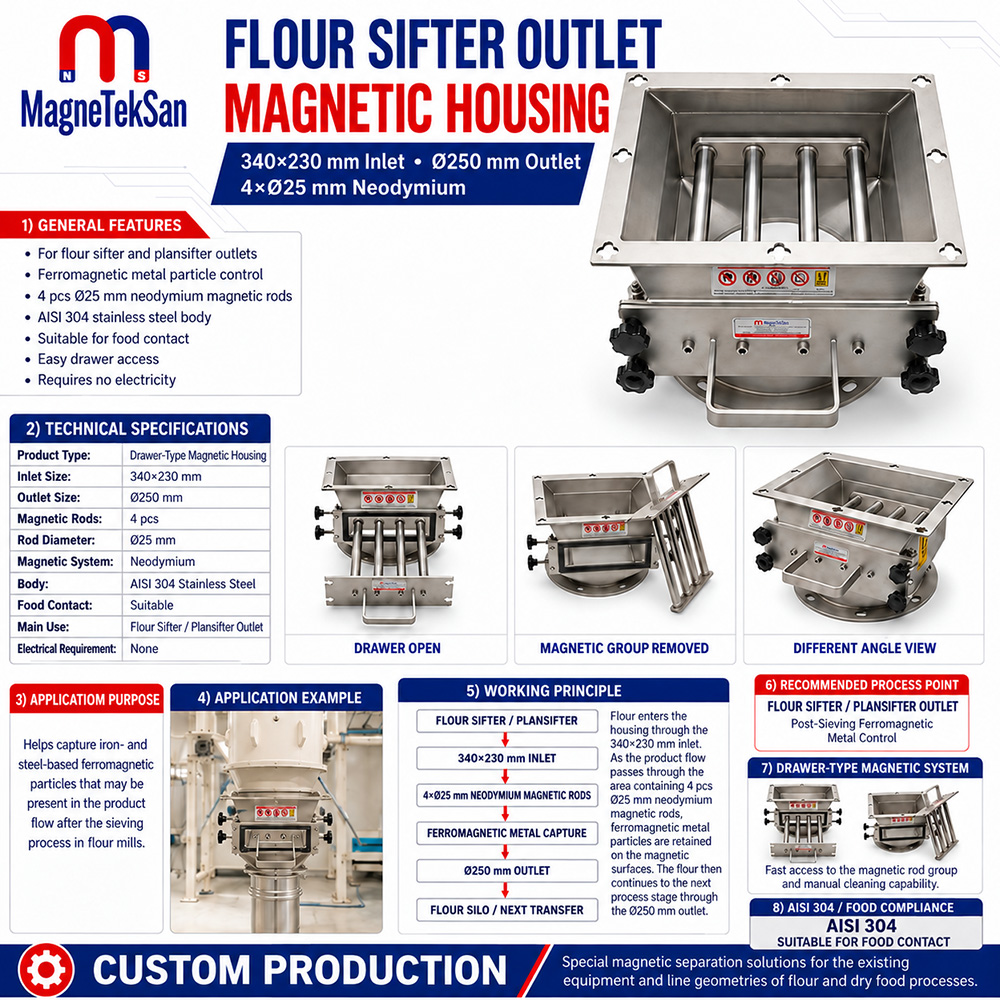
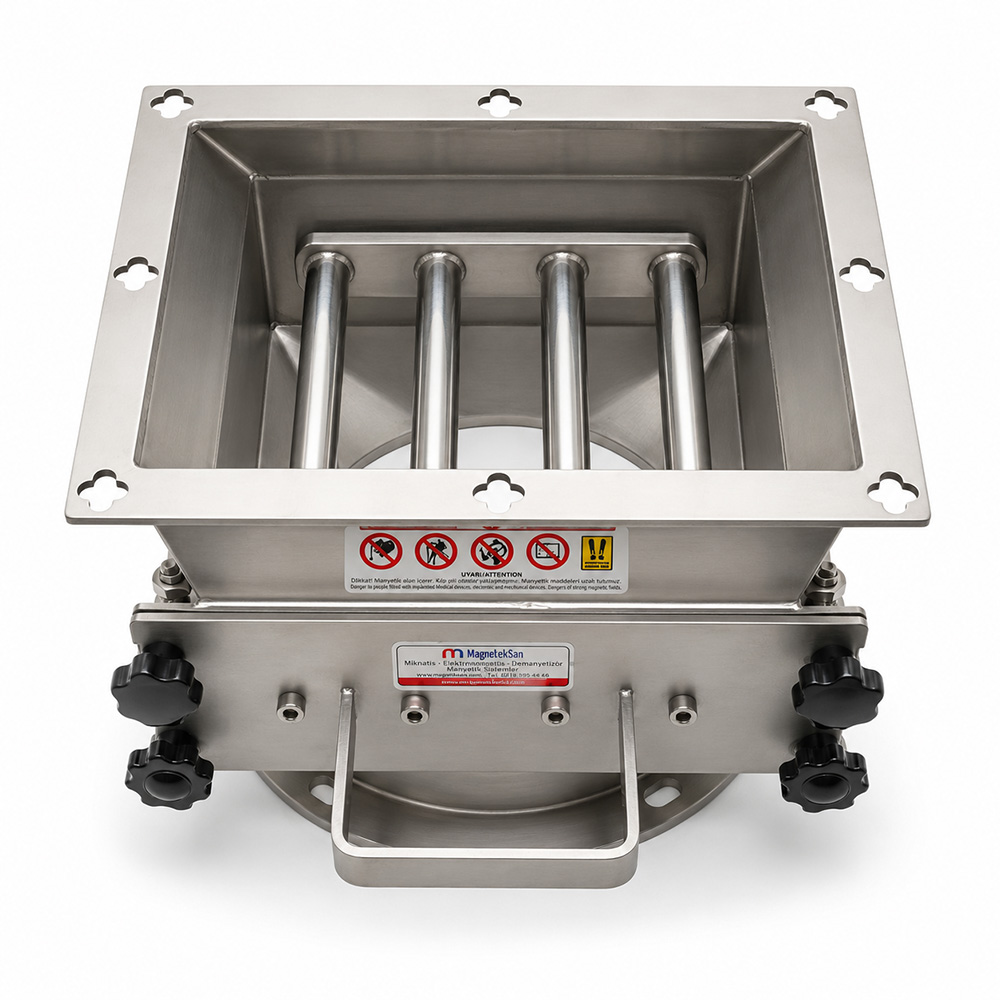
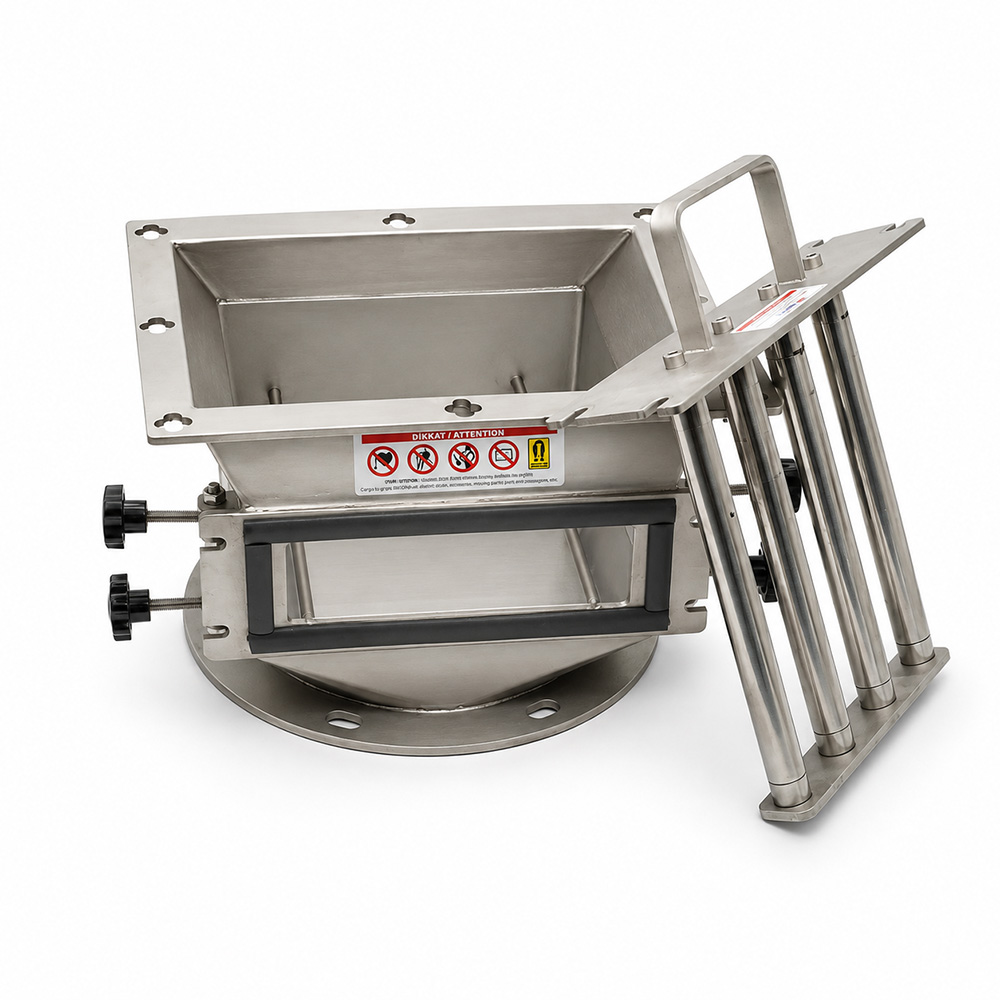
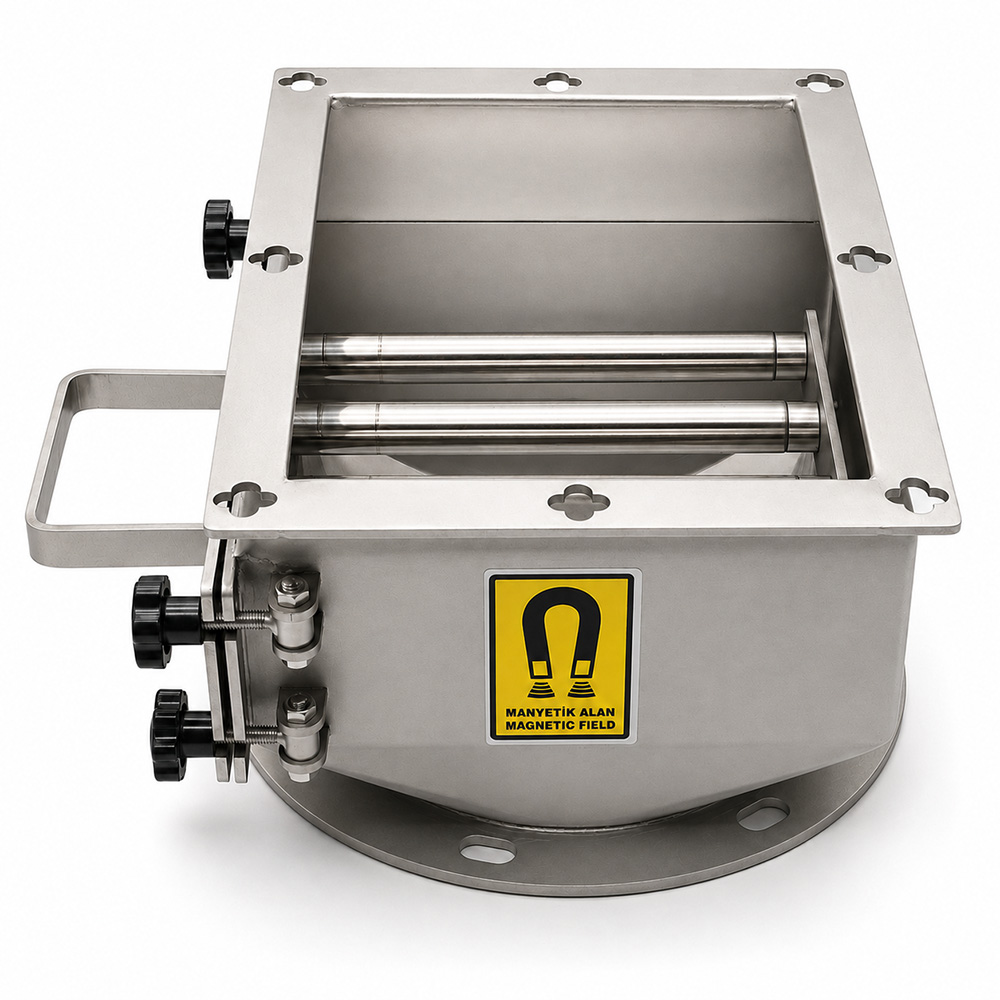
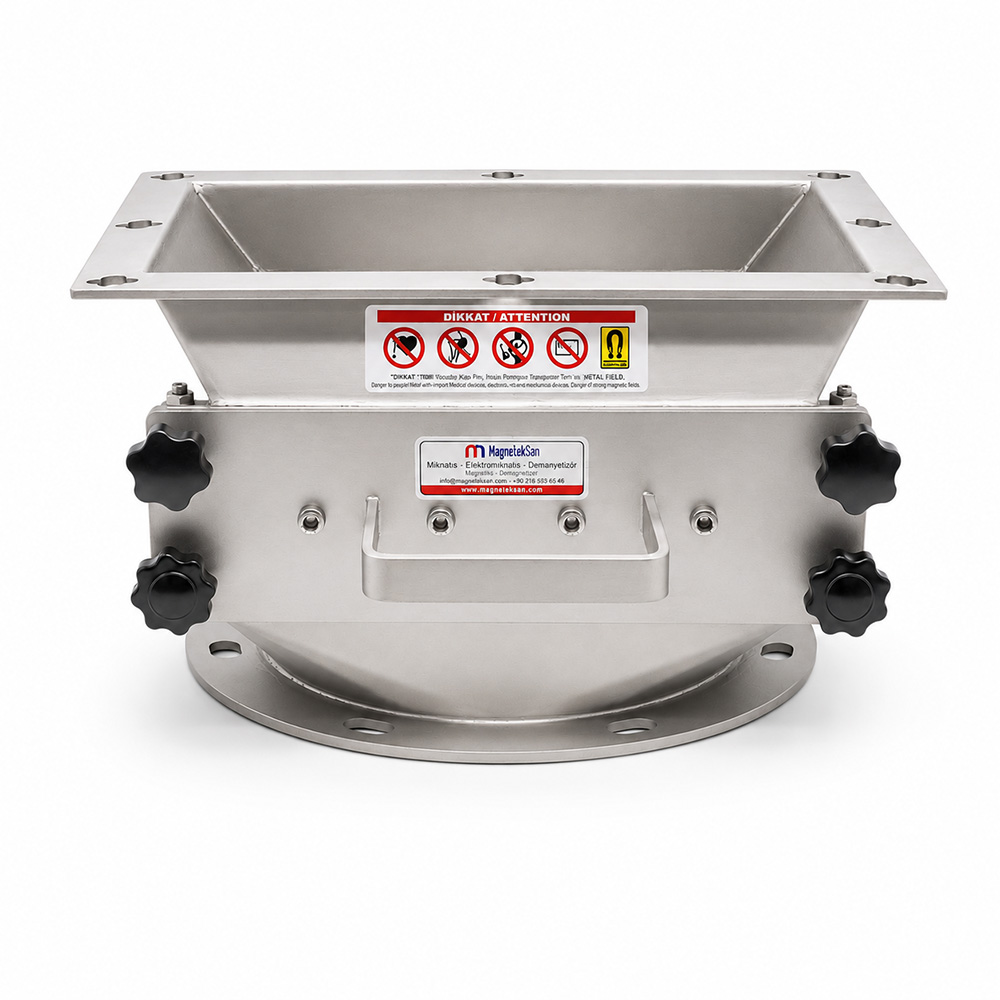
The Flour Sifter Outlet Magnet is a neodymium drawer-type magnetic separator designed to capture ferromagnetic metal contaminants after flour sifting or plansifter processing. Its specially designed housing combines a 340×230 mm rectangular inlet with a Ø250 mm circular outlet, allowing integration between compatible sifter discharge points and downstream flour transfer systems. Equipped with 4xØ25 mm neodymium magnetic rods and an AISI 304 stainless steel housing, the separator provides an additional magnetic control point in dry, free-flowing flour production lines.
| Technical Specification | Value |
|---|---|
| Product Type | Neodymium Drawer Magnetic Separator |
| Main Application | Flour Sifter / Plansifter Outlet |
| Installation Location | After Flour Sifting |
| Inlet Dimensions | 340×230 mm |
| Inlet Shape | Rectangular |
| Outlet Diameter | Ø250 mm |
| Outlet Shape | Circular |
| Number of Magnetic Rods | 4 |
| Magnetic Rod Diameter | Ø25 mm |
| Magnetic Material | Neodymium |
| Housing Material | AISI 304 Stainless Steel |
| Food Contact | Designed for Food-Contact Applications |
| Suitable Product | Dry, Free-Flowing Flour |
| Cleaning Method | Manual / Removable Drawer |
| Electrical Power | Not Required |
| Target Contaminants | Iron and Ferromagnetic Steel Particles |
| Main Function | Magnetic Metal Control After Sifting |
Extra Information
What Is a Flour Sifter Outlet Magnet?
A Flour Sifter Outlet Magnet is an industrial magnetic separator designed to capture ferromagnetic metal particles from flour after the sifting process.
It is installed at a suitable discharge point of a flour sifter or plansifter, before the flour enters the next transfer or processing stage.
This Magneteksan model features:
-
340×230 mm rectangular inlet
-
Ø250 mm circular outlet
-
4 neodymium magnetic rods
-
Ø25 mm magnetic rod diameter
-
AISI 304 stainless steel housing
-
Removable magnetic drawer
-
Manual cleaning
-
Permanent magnets requiring no electrical power
Its primary function is to provide an additional magnetic separation stage immediately after flour sifting.
Why Is Magnetic Separation Important After Flour Sifting?
Flour production involves several mechanical processing and conveying stages.
These may include roller mills, plansifters, screw conveyors, bucket elevators, piping systems and mechanical distributors.
Wear, maintenance activities or equipment damage can introduce iron or carbon steel particles into the flour stream.
Installing a magnetic separator after sifting helps capture suitable ferromagnetic contaminants before they reach downstream equipment or storage systems.
What Is a Plansifter?
A plansifter is an industrial screening system commonly used in flour mills.
It separates milled material into different particle-size fractions using multiple sieve compartments.
After passing through the plansifter, the flour may be transferred through a discharge outlet to a conveying line or another processing stage.
A magnetic drawer separator can be installed at a compatible outlet to provide additional ferromagnetic contamination control.
Why Is This Magnet Designed for Plansifter Outlets?
This model features a specific connection geometry:
Rectangular inlet: 340×230 mm
Circular outlet: Ø250 mm
This arrangement is intended for applications where flour leaves equipment through a rectangular discharge opening and continues into a circular transfer pipe.
Actual compatibility depends on the equipment dimensions, connection design and installation requirements.
Where Is the Flour Sifter Outlet Magnet Installed?
The separator is primarily installed between a flour sifter or plansifter outlet and the next flour transfer stage.
An example process sequence is:
Flour Milling ↓ Flour Sifter / Plansifter ↓ 340×230 mm Rectangular Inlet ↓ Neodymium Drawer Magnetic Separator ↓ 4xØ25 mm Magnetic Rods ↓ Ferromagnetic Metal Separation ↓ Ø250 mm Circular Outlet ↓ Flour Transfer / Storage / Next Process
The final installation arrangement must be evaluated according to the actual production line.
How Does the Magnetic Separator Work?
Flour enters the separator through its 340×230 mm rectangular opening.
Inside the housing, the product passes through an area containing four neodymium magnetic rods.
Ferromagnetic particles passing sufficiently close to the magnetic surfaces may be attracted and retained.
The captured particles can include iron fragments, magnetic steel particles and certain metallic wear debris.
The flour continues through the separator and exits through the Ø250 mm circular outlet.
What Are the Inlet Dimensions?
The inlet dimensions are:
340×230 mm
The inlet has a rectangular geometry.
This design is intended for compatible flour sifter, plansifter or similar process discharge points.
It should not be assumed that the inlet directly fits every plansifter brand or model without dimensional verification.
What Is the Outlet Diameter?
The lower outlet diameter is:
Ø250 mm
The circular outlet allows the separated flour to continue into a compatible downstream transfer system.
The exact connection method must be confirmed according to the existing equipment.
Why Does the Separator Have a Rectangular Inlet and Circular Outlet?
The two connection shapes serve different installation requirements.
The rectangular inlet accommodates suitable rectangular discharge points, while the circular outlet provides a transition toward compatible round transfer piping.
This makes the separator different from drawer magnets that have circular inlets and outlets of the same diameter.
How Many Magnetic Rods Does the Separator Contain?
The separator contains 4 neodymium magnetic rods.
Each rod has a diameter of Ø25 mm.
The rods are positioned inside the housing to provide magnetic collection surfaces within the flour flow path.
What Is the Purpose of the Ø25 mm Magnetic Rods?
The magnetic rods generate permanent magnetic fields.
When flour passes near these rods, suitable ferromagnetic particles can be attracted toward their surfaces.
The particles remain on the rods until they are removed during cleaning.
The actual capture performance depends on the particle properties, magnetic field distribution, product flow and distance from the magnetic surfaces.
Why Are Neodymium Magnets Used?
Neodymium magnets are permanent magnets capable of producing relatively strong magnetic fields in compact dimensions.
They are commonly used in magnetic separation equipment for dry food products.
An important advantage is that they do not require electrical power to generate a magnetic field.
What Is the Magnetic Strength in Gauss?
A verified Gauss value has not been specified for this particular model.
Therefore, it should not be described as a 10000 Gauss or 12000 Gauss separator without technical confirmation or measurement.
The magnetic flux density and measurement position should be established through an appropriate inspection.
What Neodymium Magnet Grade Is Used?
The product uses neodymium magnetic rods.
However, a specific magnet grade such as N35, N42 or N45 has not been confirmed for this model.
The grade should be verified before inclusion in technical specifications or purchasing documents.
Which Metal Contaminants Can the Separator Capture?
The magnetic system is designed to capture contaminants with sufficient ferromagnetic properties.
Examples include:
-
Iron particles
-
Carbon steel fragments
-
Magnetic steel filings
-
Certain metallic wear particles
-
Other suitable ferromagnetic materials
Capture performance depends on the particle’s size, shape, composition, magnetic properties and operating conditions.
Can It Capture Very Fine Iron Particles?
Fine iron particles may be captured when their magnetic properties and the operating conditions are suitable.
However, no verified minimum capture size has been specified for this model.
A guaranteed micron-level separation performance would require application-specific testing.
Can the Separator Capture Stainless Steel Particles?
This depends on the stainless steel grade and its metallurgical condition.
Some stainless steels are magnetic, while certain austenitic grades exhibit weak magnetic attraction.
Therefore, the separator cannot be guaranteed to capture every stainless steel particle.
Testing with representative contaminants is recommended when stainless steel contamination is a concern.
Can It Remove Aluminum, Copper or Brass?
Not through conventional ferromagnetic attraction.
Aluminum, copper and brass are not ferromagnetic materials.
The separator should therefore not be considered a universal system for removing all types of metals.
Can It Remove Stones, Plastic or Other Foreign Materials?
No.
Stones, plastic, wood and other nonmagnetic contaminants are not captured by permanent magnetic rods.
Mechanical sieves, metal detectors or other separation technologies may be needed to address these materials.
Is This Product a Flour Sieve?
No.
A magnetic drawer separator and a mechanical flour sieve operate according to different separation principles.
| Equipment | Separation Principle |
|---|---|
| Neodymium Drawer Magnetic Separator | Ferromagnetic properties |
| Mechanical Flour Sieve | Particle size |
Both technologies may be used within the same flour production process.
Doesn’t the Flour Sieve Already Remove Metal Particles?
A mechanical sieve can retain particles larger than its openings.
However, smaller metal particles may pass through the sieve apertures.
A magnetic separator works according to magnetic properties rather than particle size alone.
For this reason, the two systems can complement each other in a flour mill.
Can This Magnetic Separator Replace a Metal Detector?
No.
A magnetic separator physically retains suitable ferromagnetic particles on magnetic surfaces.
A metal detector electronically identifies metal contamination within its validated detection capabilities.
Both systems may be used at different points in a food production line.
Why Is the Housing Manufactured from AISI 304 Stainless Steel?
The housing is manufactured from AISI 304 stainless steel.
This material is widely used in food-processing equipment.
Its characteristics include:
-
Corrosion resistance under suitable conditions
-
Cleanable surfaces
-
Mechanical durability
-
Suitability for many food-processing applications
-
Compatibility with hygienic equipment design
Compatibility with specific cleaning chemicals and operating environments should be assessed separately.
Is the Separator Suitable for Food-Contact Applications?
Yes.
The product is designed for food-processing applications and uses an AISI 304 stainless steel housing.
It is intended for suitable dry, free-flowing flour processes.
Any required material declarations, compliance certificates or facility-specific approvals should be verified separately before installation.
How Does the Removable Drawer Work?
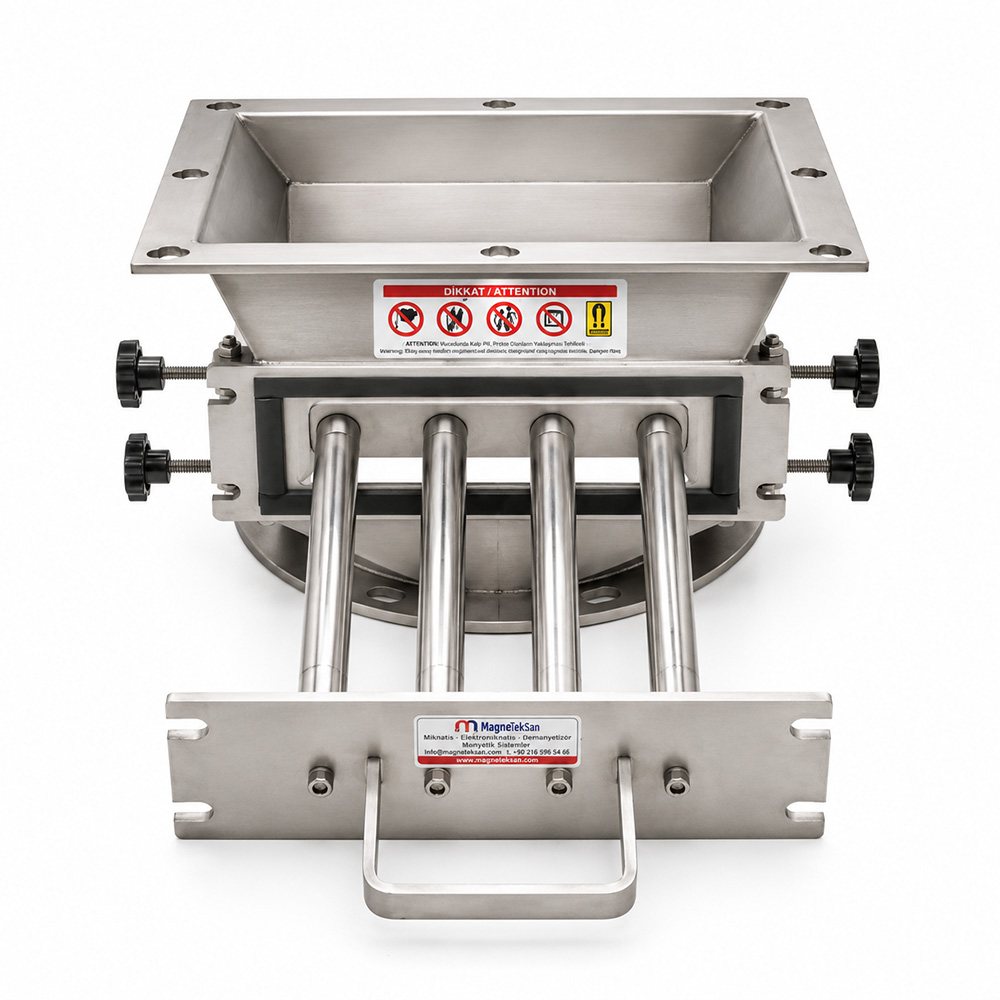
The magnetic rods are mounted within a removable drawer assembly.
During cleaning or inspection, the operator can withdraw the drawer to access the magnetic surfaces.
This arrangement makes it easier to:
-
Inspect accumulated metal particles
-
Clean the magnetic rods
-
Examine the rod surfaces
-
Reinstall the magnetic assembly
Adequate clearance must be provided around the equipment for safe drawer removal.
How Are the Magnetic Rods Cleaned?
A typical manual cleaning procedure may involve the following steps:
-
Stop the flour flow.
-
Safely isolate connected equipment and prevent accidental startup.
-
Open the drawer mechanism.
-
Withdraw the magnetic rod assembly.
-
Carefully remove accumulated ferromagnetic particles.
-
Inspect the rod surfaces for damage or wear.
-
Reinstall and secure the drawer.
-
Resume production according to approved procedures.
The facility’s food safety, hygiene and occupational safety procedures must also be followed.
How Often Should the Separator Be Cleaned?
There is no universal cleaning interval suitable for every flour mill.
Cleaning frequency depends on:
-
Flour throughput
-
Metal contamination levels
-
Operating hours
-
Particle accumulation on the rods
-
Product characteristics
-
Maintenance procedures
-
Quality control requirements
More frequent inspections during initial operation can help establish an appropriate cleaning schedule.
What Happens If the Magnetic Rods Become Covered with Metal?
Excessive accumulation of ferromagnetic particles can reduce the magnetic surface area available to capture new contaminants.
It may also affect product flow through the separator.
Regular inspection and cleaning are therefore important for maintaining the intended operating conditions.
Does the Separator Require Electricity?
No.
The system uses permanent neodymium magnets.
It does not require:
-
Electrical power
-
Electromagnetic coils
-
A magnetic control panel
-
A DC power supply
The magnetic field is generated by the permanent magnets themselves.
Does the Separator Affect Flour Flow?
The magnetic rods occupy part of the internal flow area.
Consequently, they may influence how flour moves through the housing.
Actual flow behavior depends on factors such as:
-
Flour bulk density
-
Moisture content
-
Flowability
-
Feed rate
-
Internal geometry
-
Installation orientation
A specific flow rate or blockage-free operation cannot be guaranteed without evaluating the actual process conditions.
What Is the Processing Capacity in Tons per Hour?
No verified processing capacity has been specified for this model.
The 340×230 mm inlet and Ø250 mm outlet dimensions alone are insufficient to calculate throughput in kg/h or tons/h.
Actual capacity must be assessed according to flour properties, available internal flow area and operating conditions.
Can It Be Used in Pneumatic Flour Conveying Systems?
Compatibility with pressurized pneumatic conveying systems has not been confirmed for this model.
No verified maximum operating pressure or housing pressure rating has been specified.
A separate engineering assessment is required before installation in a pressurized pneumatic system.
The primary application is magnetic separation at suitable dry-product transfer or gravity-flow points.
Can It Be Used in Gravity-Fed Flour Lines?
Installation in gravity-fed dry flour lines may be considered when the equipment geometry and flow conditions are compatible.
The installation orientation and connection details should be evaluated for the specific application.
The required flour flow rate must also be considered.
Does Magnetic Separation Change the Properties of Flour?
The separator is not designed to modify the composition or processing characteristics of flour.
Its function is to capture suitable ferromagnetic metal particles.
It does not intentionally change the flour’s protein content, moisture, chemical composition or flavor.
Should the Separator Be Installed Before or After the Flour Sifter?
This model is specifically intended for installation after the flour sifter or plansifter.
A typical arrangement is:
Plansifter → Magnetic Drawer Separator → Flour Transfer Line
This provides an additional ferromagnetic contamination control point after mechanical sifting.
Other installation locations may be appropriate for different separator designs.
Can It Be Installed Before a Flour Silo?
Yes, provided that the process geometry and operating conditions are compatible.
For example:
Flour Sifter → Magnetic Separator → Flour Silo
However, the primary application of this model remains the flour sifter or plansifter outlet, rather than a general-purpose silo inlet.
Can It Be Used Before Flour Packaging?
It may be considered at a suitable dry-product transfer point if the technical requirements are met.
However, this model is primarily designed for post-sifting applications rather than specifically for packaging machinery.
The installation location should be selected according to the actual production process.
What Is the Difference Between This Model and a Flour Silo Inlet Magnet?
The main difference is the connection geometry and intended installation point.
| Feature | Flour Sifter Outlet Magnet | Flour Silo Inlet Magnet |
|---|---|---|
| Main Application | After Flour Sifting | Before Flour Storage |
| Inlet | 340×230 mm Rectangular | Ø250 mm Circular |
| Outlet | Ø250 mm Circular | Ø250 mm Circular |
| Magnetic Rods | 4xØ25 mm | 4xØ25 mm |
| Magnetic Material | Neodymium | Neodymium |
The flour sifter outlet model provides a transition from a rectangular inlet to a circular outlet.
The silo inlet model uses circular connections on both sides.
What Is the Difference Between This Model and a Flour Blending Line Magnet?
The models are designed for different processing stages.
| Feature | Flour Sifter Outlet Magnet | Flour Blending Line Magnet |
|---|---|---|
| Main Application | After Sifting | After Flour Blending |
| Inlet | 340×230 mm | Ø200 mm |
| Outlet | Ø250 mm | Ø200 mm |
| Magnetic Rods | 4xØ25 mm | 3xØ25 mm |
| Magnetic Material | Neodymium | Neodymium |
The flour sifter outlet model focuses on magnetic separation immediately after the screening process.
The blending line model is intended for a different point in the flour production process.
Can All Three Magnetic Separators Be Used in the Same Flour Mill?
Yes, when the facility layout and contamination-control requirements justify multiple magnetic separation points.
| Separator Model | Typical Installation Point |
|---|---|
| 340×230 mm / Ø250 mm, 4xØ25 mm | Flour Sifter / Plansifter Outlet |
| Ø250 mm / Ø250 mm, 4xØ25 mm | Flour Silo Inlet |
| Ø200 mm / Ø200 mm, 3xØ25 mm | Flour Blending Line |
Using magnetic separators at different process stages may provide additional opportunities to capture ferromagnetic contaminants.
What Is the Maximum Operating Temperature?
A verified maximum operating temperature has not been specified for this model.
The allowable temperature depends on the magnet construction, process temperature and operating conditions.
A specific temperature limit should not be assumed without technical confirmation.
Does the Separator Require Periodic Inspection?
Yes.
Periodic inspections should cover:
-
Magnetic rods
-
Stainless steel housing
-
Drawer mechanism
-
Inlet and outlet connections
-
Accumulated metal particles
-
Mechanical wear
-
Potential damage
-
General cleanliness
Inspection intervals should be established according to the facility’s maintenance and food safety procedures.
What Are the Main Advantages of This Flour Sifter Outlet Magnet?
This model combines:
-
340×230 mm rectangular inlet
-
Ø250 mm circular outlet
-
4xØ25 mm neodymium magnetic rods
-
AISI 304 stainless steel housing
-
Removable magnetic drawer
-
Manual cleaning
-
Permanent magnet operation
-
Application at flour sifter and plansifter outlets
These characteristics make it a magnetic separation solution for suitable dry flour transfer points immediately after sifting.
Can a Custom Flour Sifter Outlet Magnet Be Manufactured?
Yes.
Magneteksan can manufacture customized neodymium drawer magnetic separators according to the requirements of flour mills and dry-product processing lines.
Customization options may include:
-
Inlet dimensions
-
Outlet dimensions
-
Magnetic rod quantity
-
Magnetic rod diameter
-
Magnet grade
-
Required magnetic flux density
-
Housing dimensions
-
Connection geometry
-
Drawer design
-
Cleaning mechanism
-
Operating temperature requirements
Custom designs should be based on the actual flour characteristics, contamination-control objectives and installation conditions.