Product Information
Extra Information
Product Information
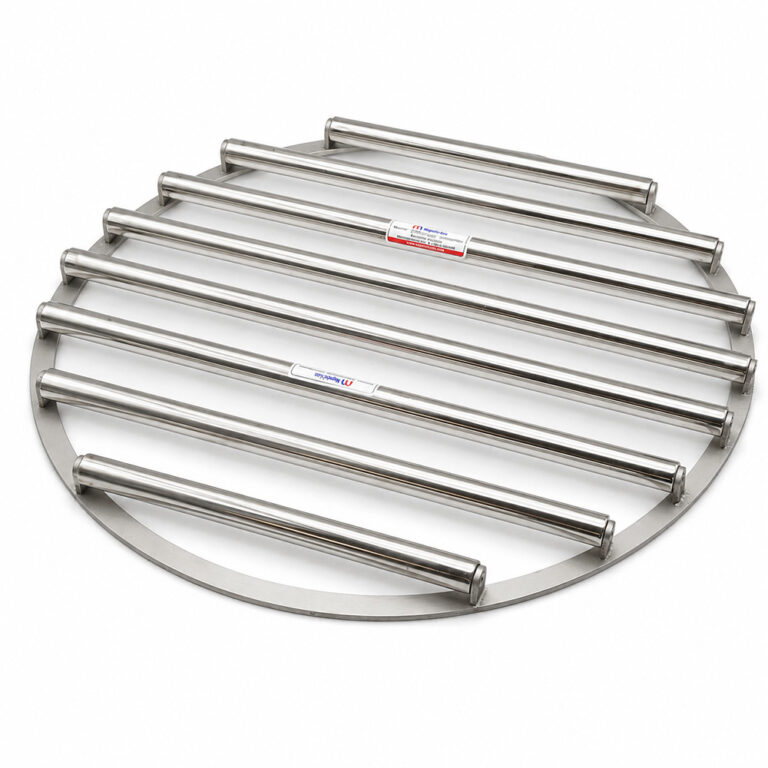
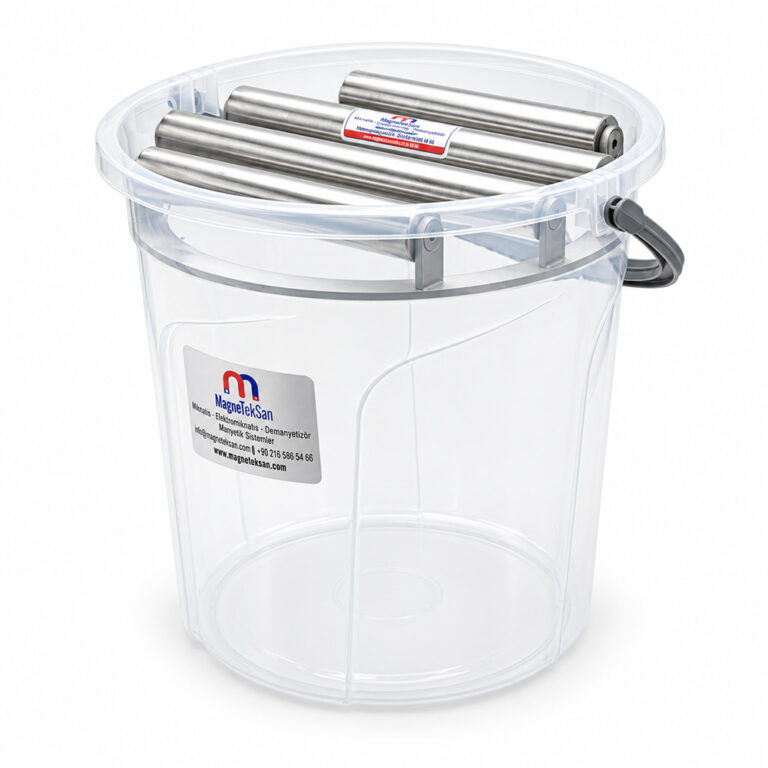
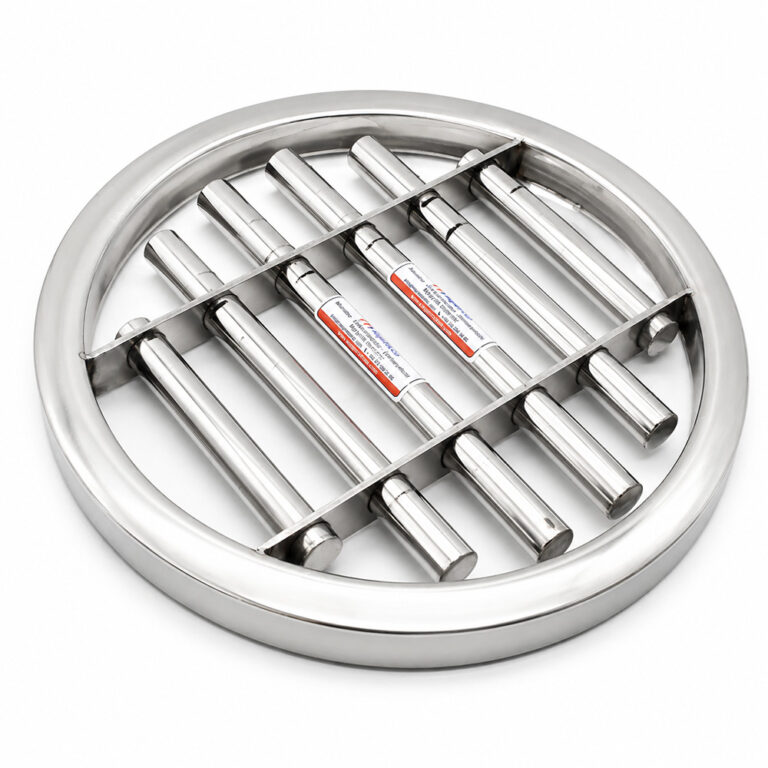
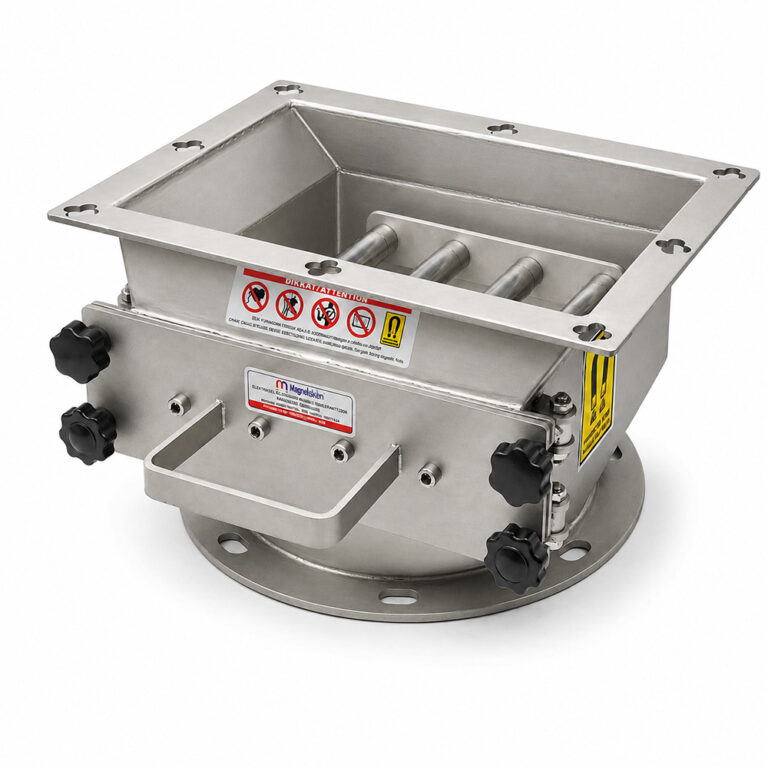
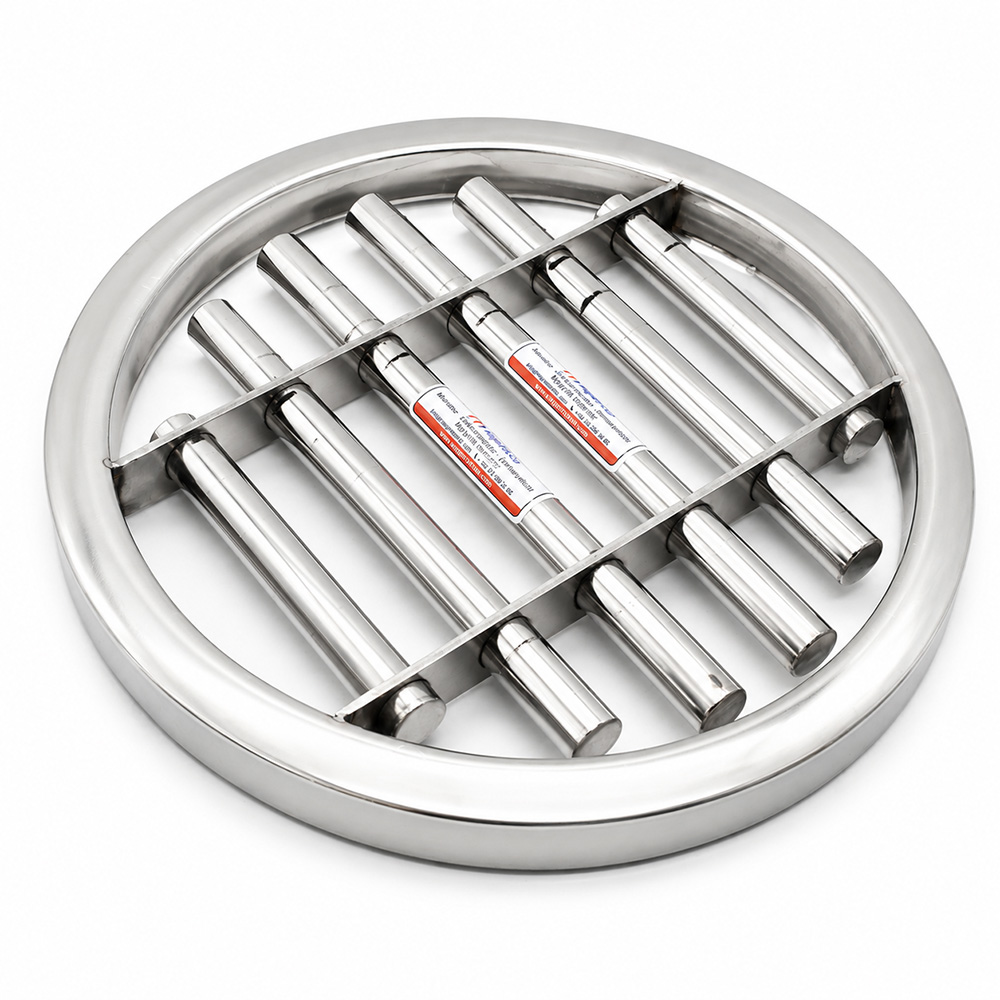
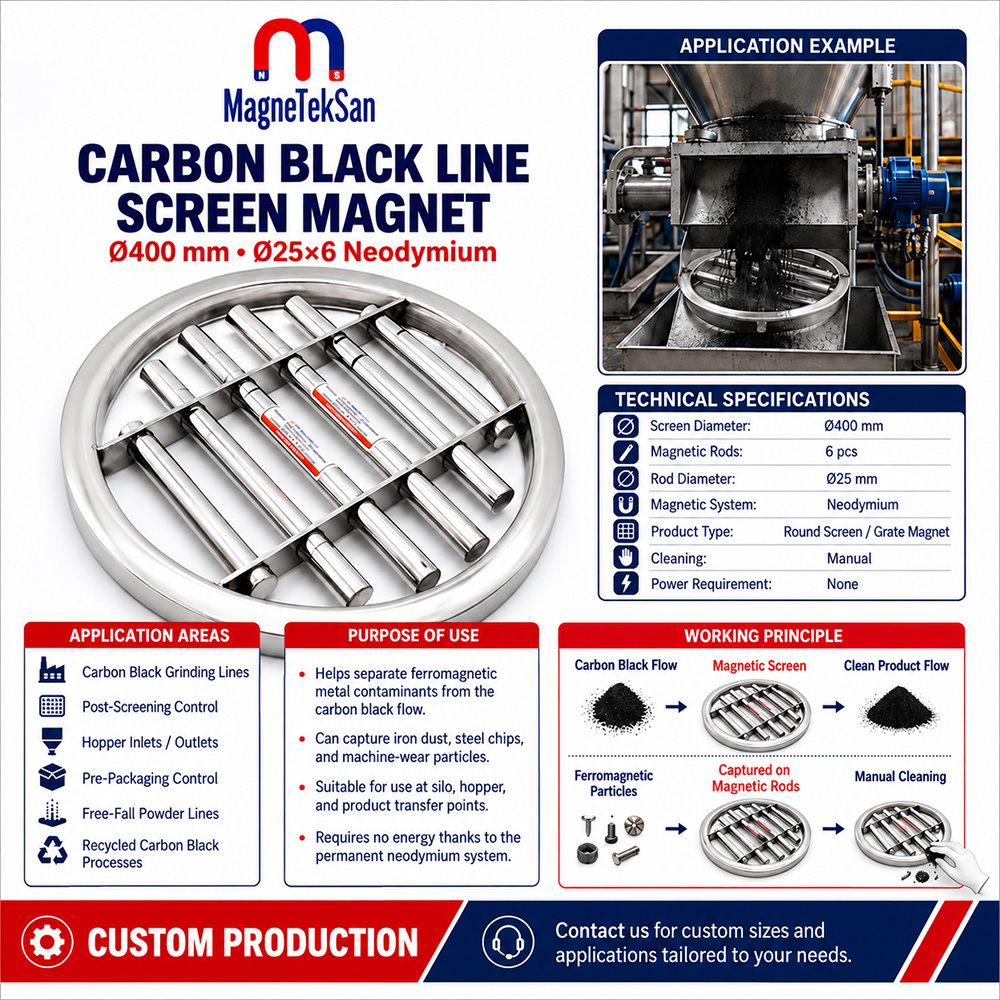
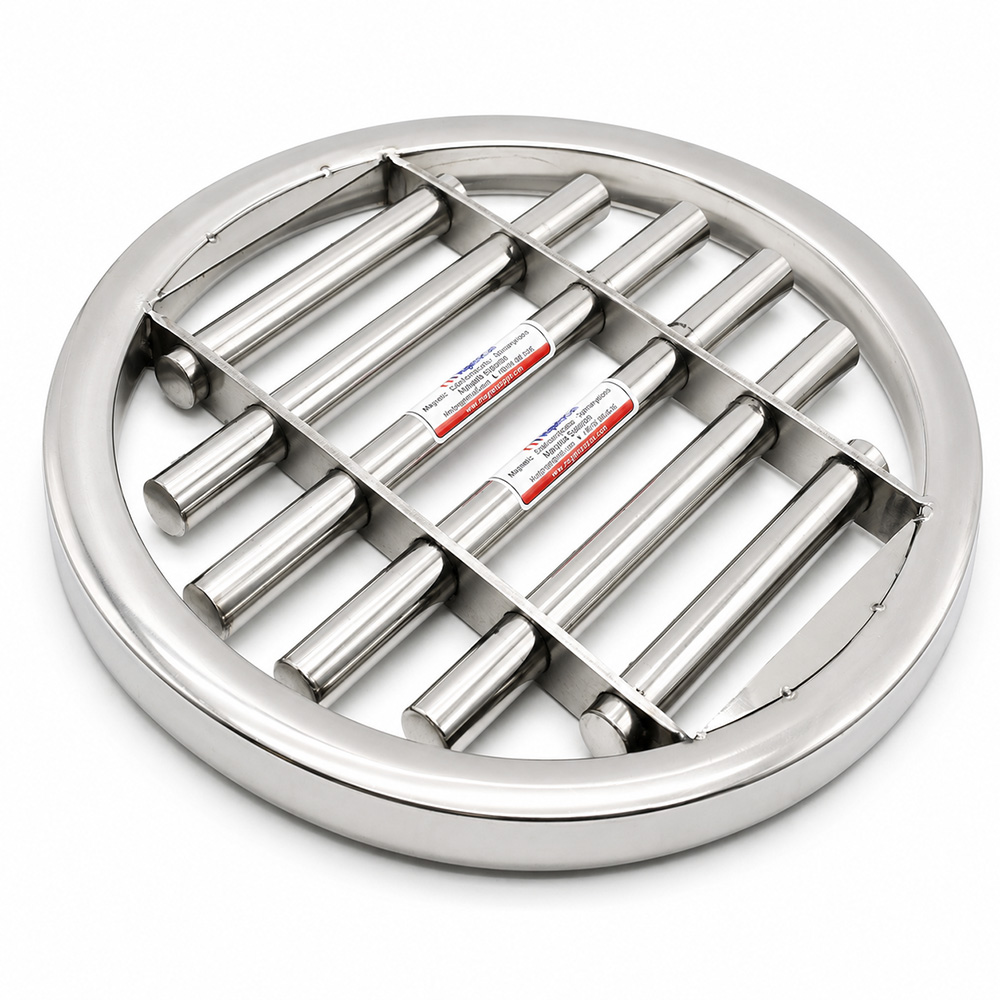
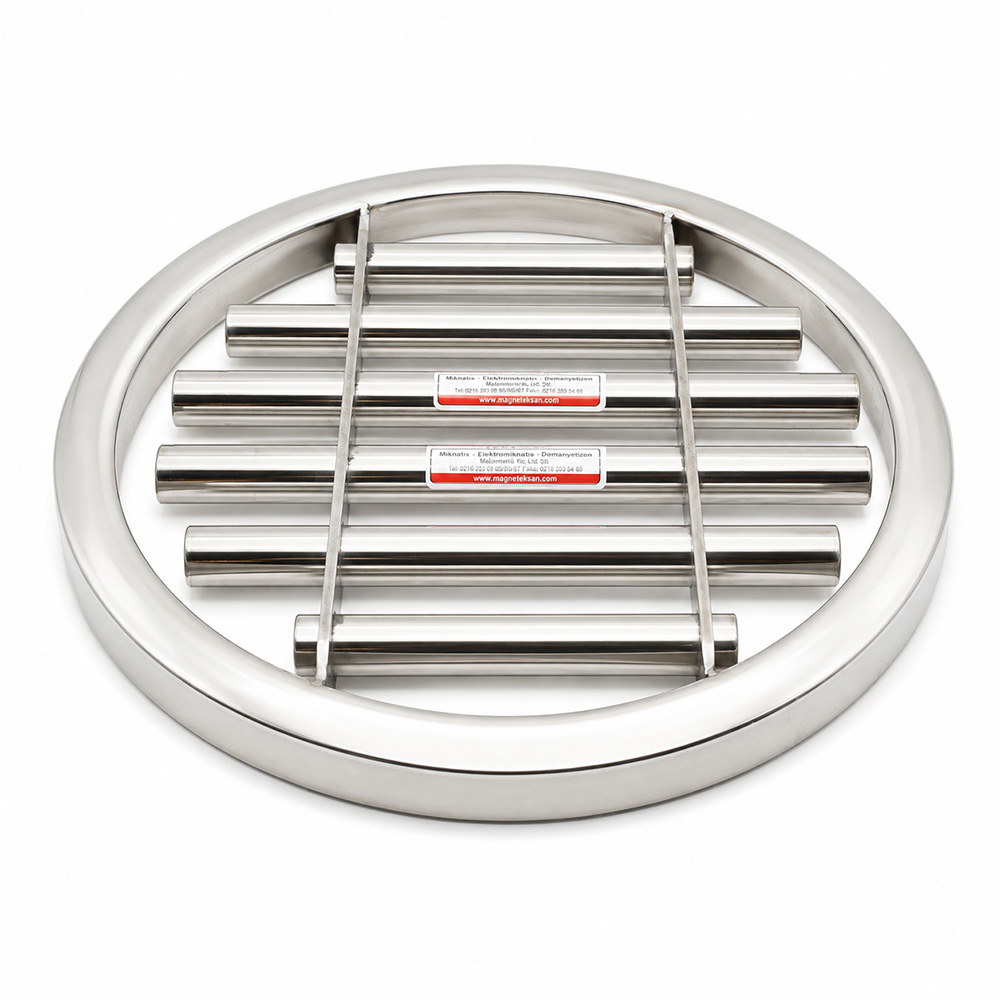
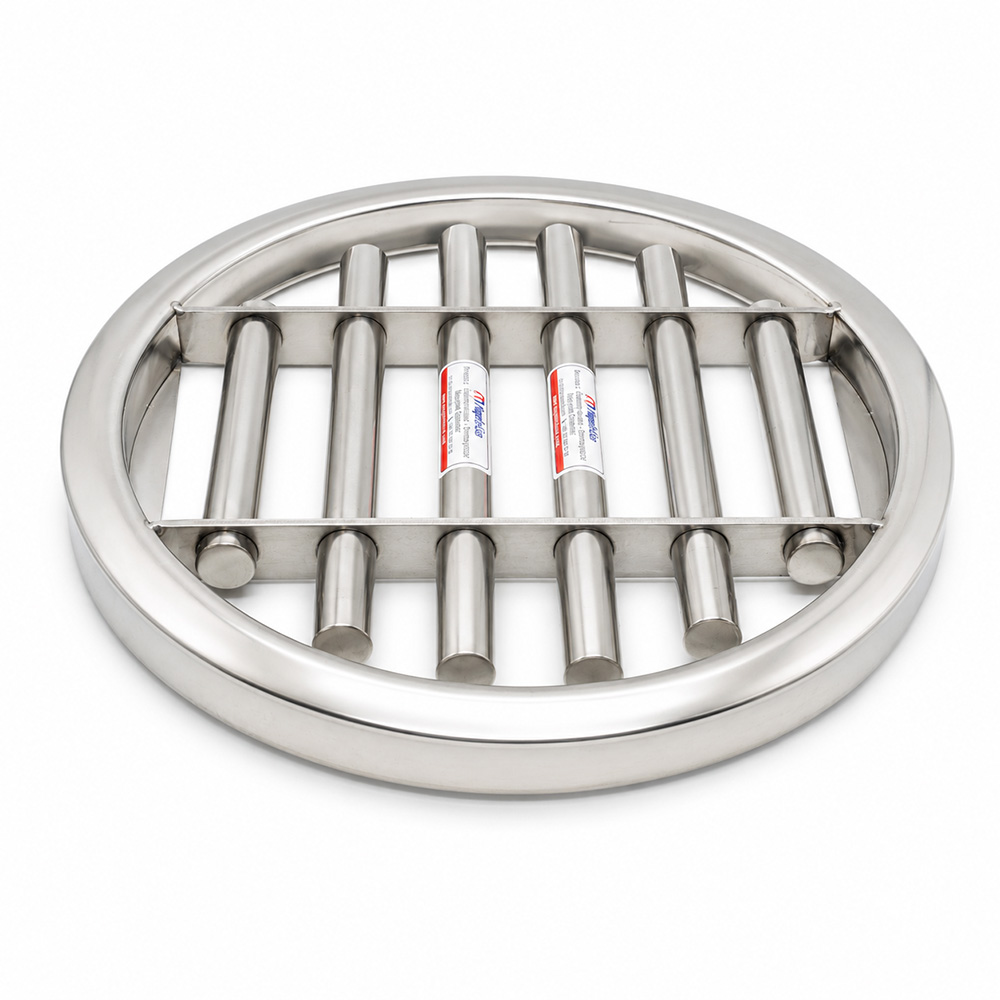
The Ø400 mm Carbon Black Grate Magnet is a round neodymium magnetic separator designed to capture ferromagnetic metal contaminants in carbon black production and processing lines. Equipped with 6xØ25 mm neodymium magnetic rods, it can be installed at compatible gravity-fed powder transfer points, including screening outlets, hoppers and packaging lines. Its permanent magnetic system operates without electricity and allows periodic manual cleaning.
| Technical Specification | Value |
|---|---|
| Product Type | Neodymium Round Grate Magnet |
| Main Application | Carbon Black Processing Line |
| Grate Diameter | Ø400 mm |
| Number of Magnetic Rods | 6 |
| Magnetic Rod Diameter | Ø25 mm |
| Magnetic Rod Configuration | 6xØ25 mm |
| Magnetic Material | Neodymium |
| Geometry | Round |
| Separation Principle | Ferromagnetic Metal Separation |
| Suitable Product | Carbon Black / Compatible Dry Powder |
| Product Flow | Suitable Gravity-Fed Dry Powder |
| Cleaning Method | Manual |
| Electrical Power Required | No |
| Target Contaminants | Iron and Ferromagnetic Steel Particles |
Extra Information
What Is a Carbon Black Grate Magnet?
A Carbon Black Grate Magnet is an industrial magnetic separator designed to capture ferromagnetic metal contaminants from carbon black during production, handling and processing.
The Ø400 mm model manufactured by Magneteksan features a round magnetic grate containing six neodymium magnetic rods, each with a diameter of Ø25 mm.
The magnetic rods provide collection surfaces for suitable iron and steel particles as carbon black passes through the separator.
This equipment can be considered for installation at compatible gravity-fed powder transfer points where additional ferromagnetic contamination control is required.
What Is Carbon Black?
Carbon black is a fine, carbon-based industrial material commonly produced through the controlled partial combustion or thermal decomposition of hydrocarbons.
It is widely used in industrial applications such as:
- Tyre manufacturing
- Rubber production
- Plastic compounding
- Pigment manufacturing
- Printing inks
- Industrial coatings
- Specialty chemical products
In rubber manufacturing, carbon black is frequently used as a reinforcing filler to improve selected material properties.
Because carbon black is handled through various mechanical processes, controlling unwanted ferromagnetic contamination can be an important part of production quality management.
Why Is Magnetic Separation Important in Carbon Black Processing?
Carbon black may come into contact with numerous metallic components throughout its production and processing stages.
Typical equipment includes:
- Industrial grinding mills
- Screw conveyors
- Bucket elevators
- Storage silos
- Discharge hoppers
- Transfer pipelines
- Screening equipment
- Packaging machinery
Mechanical wear, maintenance operations and damaged components may introduce iron or steel particles into the material stream.
A magnetic grate installed at a suitable process point provides an additional opportunity to retain ferromagnetic contamination before the material continues downstream.
Where Can a Carbon Black Magnetic Separator Be Installed?
The Ø400 mm round magnetic grate can be considered for several process locations, provided that the material flow and connection geometry are compatible.
Typical installation points include:
After Grinding
A magnetic grate installed downstream of a grinding mill can help capture suitable ferromagnetic particles introduced by mechanical wear.
After Mechanical Screening
Carbon black can pass through a magnetic contamination control point after conventional particle-size screening.
At Hopper Inlets or Outlets
A round grate magnet may be integrated into compatible hopper connections where the material flows by gravity.
Before Packaging
The separator can provide an additional ferromagnetic contamination control stage before weighing, bag filling or bulk packaging.
The final installation position should be selected according to the production process and actual material flow characteristics.
How Does a Carbon Black Grate Magnet Work?
The magnetic grate uses six permanent neodymium magnetic rods arranged within a Ø400 mm round frame.
As suitable dry carbon black passes through the magnetic collection zone, it flows around and between the rods.
Iron particles and other contaminants with sufficient ferromagnetic properties may be attracted to the rod surfaces.
The carbon black continues towards the next processing stage while captured magnetic contaminants remain on the rods until cleaning.
An example process arrangement is:
Carbon Black → Grinding → Screening → Ø400 mm Magnetic Grate → Intermediate Hopper → Packaging
The actual installation should be adapted to the plant layout and operating conditions.
Can the Magnetic Grate Be Used in Recovered Carbon Black Production?
Yes, provided the material characteristics and process conditions are suitable.
Recovered carbon black, commonly abbreviated as rCB, is produced through the recovery and processing of carbon-rich material from waste tyre pyrolysis.
Depending on the recovery process, the material may contain ferromagnetic residues originating from steel reinforcement components or processing equipment.
A magnetic separator can provide an additional stage for capturing suitable iron and steel contaminants.
A possible processing sequence is:
Tyre Pyrolysis → Cooling → Preliminary Metal Separation → Grinding → Screening → Magnetic Grate → Recovered Carbon Black
The magnetic grate should be installed at a location where the temperature, material flow and mechanical conditions are compatible with the equipment.
Can the Magnetic Grate Be Used in Tyre Pyrolysis Plants?
The separator may be suitable for selected downstream processing stages in tyre pyrolysis facilities.
Waste tyres contain steel reinforcement materials, and some ferromagnetic residues may remain in the recovered solid material.
Following cooling and suitable preliminary processing, the carbon-rich material may pass through grinding, screening and magnetic separation stages.
The Ø400 mm neodymium grate can be evaluated as part of this processing arrangement.
However, the standard magnetic grate should not be assumed suitable for direct installation inside a hot pyrolysis reactor.
The actual operating temperature must remain within the confirmed limits of the magnetic assembly.
Why Is Carbon Black Used in Rubber Manufacturing?
Carbon black is widely used as a reinforcing filler in rubber compounds.
Depending on its grade and the formulation, it can influence mechanical properties, durability, wear resistance and other characteristics of the finished rubber product.
During rubber production, carbon black is often transferred from storage silos to dosing and mixing equipment.
Ferromagnetic contamination present in the carbon black may originate from upstream handling or processing machinery.
Installing a magnetic grate at a suitable raw-material transfer point can help reduce the presence of these contaminants before mixing.
Can the Magnetic Separator Be Installed in a Tyre Factory?
Yes, if the production arrangement provides a suitable installation location.
A possible application is between the carbon black storage silo and the raw-material dosing system.
For example:
Carbon Black Silo → Ø400 mm Magnetic Grate → Dosing System → Rubber Mixer
In this arrangement, the magnetic separator provides an additional opportunity to capture ferromagnetic contaminants before the carbon black enters the rubber mixing process.
The suitability of the installation depends on the product flow, equipment geometry and process requirements.
Does Carbon Black Itself Stick to Magnets?
Carbon black is not the ferromagnetic contaminant that this separator is intended to capture.
The purpose of the magnetic grate is to retain suitable iron and steel particles that may be present within the carbon black.
The intended separation process is:
Carbon Black Flow → Neodymium Magnetic Rods → Ferromagnetic Contaminants Retained → Carbon Black Continues
Any material buildup on the rods must also be evaluated in relation to the powder’s flow and adhesion characteristics.
What Is the Function of the Six Neodymium Magnetic Rods?
The separator contains six neodymium magnetic rods, each with a diameter of Ø25 mm.
These rods form multiple magnetic collection surfaces within the Ø400 mm round frame.
As carbon black passes through the grate, suitable ferromagnetic particles may approach the magnetic rod surfaces and become retained.
The arrangement provides several magnetic collection points across the product passage.
However, the number of rods alone does not establish a guaranteed metal removal percentage.
Separation performance depends on the magnetic field, contaminant characteristics and process conditions.
Why Are Ø25 mm Magnetic Rods Used?
Ø25 mm magnetic rods are commonly used in industrial magnetic separation systems because their cylindrical construction provides practical magnetic collection surfaces.
In this application, the rods are intended to capture suitable contaminants such as:
- Iron dust
- Steel fragments
- Ferromagnetic wire particles
- Carbon steel wear debris
- Magnetic particles from processing equipment
The actual magnetic performance cannot be determined from the rod diameter alone.
A verified magnetic field measurement is required to establish a specific Gauss value.
What Is the Advantage of the Ø400 mm Round Design?
The Ø400 mm round construction allows the magnetic grate to be considered for integration into compatible circular material transfer openings.
Possible applications include:
- Silo discharge outlets
- Industrial hoppers
- Round powder transfer chutes
- Gravity-fed discharge points
- Suitable intermediate storage connections
The round frame can simplify mechanical integration where the surrounding equipment has compatible geometry.
However, the Ø400 mm diameter does not automatically establish a particular processing capacity.
The available flow area is also influenced by the internal rod arrangement.
What Is the Processing Capacity in Tonnes per Hour?
A verified processing capacity has not been specified for this model.
The throughput of a carbon black magnetic separator depends on several variables, including:
- Carbon black bulk density
- Powder grade
- Particle characteristics
- Material flowability
- Moisture content
- Tendency to form agglomerates
- Magnetic rod spacing
- Available open passage area
- Feed rate
- Hopper and discharge geometry
Therefore, a capacity such as 5 t/h, 10 t/h or 20 t/h should not be advertised without an appropriate engineering assessment.
The required throughput should be evaluated using the actual product characteristics and production conditions.
Can Fine Carbon Black Powder Cause Flow Problems?
Yes, depending on the carbon black grade and operating conditions.
Some carbon black powders have very fine particle sizes, low bulk density and cohesive flow characteristics.
These properties may increase the possibility of:
- Powder bridging
- Agglomeration
- Material accumulation
- Restricted flow between magnetic rods
- Irregular discharge from hoppers
The magnetic grate occupies part of the available product passage.
Consequently, the material’s actual flow behaviour should be assessed before selecting the final magnetic separator configuration.
For poorly flowing powders, alternative rod spacing or a different magnetic separator geometry may be required.
Is a Magnetic Grate the Same as a Mechanical Sieve?
No.
A magnetic grate and a mechanical sieve operate according to different separation principles.
| Equipment | Separation Principle |
|---|---|
| Mechanical Sieve | Particle size and screen opening |
| Neodymium Magnetic Grate | Ferromagnetic properties |
| Metal Detector | Electronic detection of detectable metal contaminants |
A mechanical sieve separates particles according to their size relative to the screen openings.
A magnetic grate captures suitable ferromagnetic particles through magnetic attraction.
These systems may be used together when the production process requires both particle-size control and ferromagnetic contamination control.
Which Metal Contaminants Can the Carbon Black Grate Magnet Capture?
The separator is intended to retain materials with sufficient ferromagnetic properties.
Potential target contaminants include:
- Iron particles
- Carbon steel fragments
- Ferromagnetic steel wire
- Iron dust
- Magnetic equipment wear particles
- Suitable steel shavings
- Other ferromagnetic metal residues
Actual collection efficiency depends on particle size, shape, composition, magnetic response and distance from the rod surfaces.
The magnetic grate should not be described as capable of removing every type of metal.
Can It Capture Very Fine Iron Particles?
Fine iron particles may be attracted to the neodymium magnetic rods if their magnetic properties and the operating conditions are suitable.
However, no verified minimum particle size is specified for this product.
The separation of fine ferromagnetic contamination depends on factors such as:
- Magnetic field strength
- Magnetic field gradient
- Particle composition
- Product flow rate
- Distance from the magnetic rods
- Thickness of the flowing product layer
Claims of guaranteed removal below a specific micron size would require appropriate testing.
Can the Magnetic Grate Capture Steel Wire Fragments?
Yes, suitable ferromagnetic steel wire fragments may be attracted to the magnetic rod surfaces.
This application can be particularly relevant in recovered carbon black processing, where steel reinforcement residues from waste tyres may be present.
Magnetic separation can provide an additional collection stage after preliminary mechanical processing.
However, capture performance depends on the dimensions, magnetic properties and position of the wire fragments.
Can It Remove Aluminium or Copper Particles?
Not through conventional ferromagnetic attraction.
Aluminium and copper are not ferromagnetic under normal operating conditions.
The neodymium grate magnet is intended primarily for iron and suitable steel contamination.
Other technologies may be required when the process must remove non-ferromagnetic metals.
Can the Magnetic Separator Capture Stainless Steel?
This depends on the stainless steel grade and metallurgical condition.
Some stainless steel grades exhibit strong magnetic properties, while others have relatively weak magnetic responses.
For example, certain ferritic and martensitic stainless steels are magnetic, whereas many austenitic grades respond much more weakly.
Therefore, the separator cannot be guaranteed to capture every stainless steel particle.
Testing with the actual contaminant material is recommended when stainless steel removal is an important requirement.
Can the Magnetic Grate Remove Mineral Ash or Silica?
No, not through conventional ferromagnetic separation.
The primary purpose of the magnetic grate is to capture suitable ferromagnetic metal contamination.
Carbon black may contain other substances, including:
- Mineral ash
- Silica
- Nonmagnetic inorganic particles
- Other non-ferromagnetic residues
These materials generally require different physical or chemical purification methods.
A magnetic separator should not be presented as a complete purification system for every type of carbon black impurity.
Does Magnetic Separation Improve Carbon Black Chemical Purity?
Magnetic separation can help reduce suitable ferromagnetic metal contamination.
However, it does not directly control the carbon black’s:
- Ash content
- Volatile matter content
- Surface area
- Carbon structure
- Chemical composition
- Other nonmagnetic impurities
Consequently, magnetic separation should be regarded as a targeted metal contamination control process rather than a complete carbon black chemical purification method.
Can the Magnetic Grate Be Installed Before Pelletising?
Yes, if the material flow and installation geometry are suitable.
In some carbon black processing systems, the powder passes through grinding and classification stages before pelletising.
A magnetic grate can be considered between powder preparation and pelletising equipment.
An example arrangement is:
Ground Carbon Black → Magnetic Grate → Pelletiser
The installation should be evaluated according to the powder’s flowability, feed rate and process layout.
Can the Magnetic Separator Be Installed Before Packaging?
Yes.
A magnetic grate can provide an additional ferromagnetic contamination control point before the final packaging stage.
For example:
Intermediate Hopper → Ø400 mm Magnetic Grate → Weighing System → Big Bag / Bag Filling
This arrangement may be suitable for compatible gravity-fed carbon black packaging lines.
The magnetic separator should be positioned where it can be inspected and cleaned safely without interfering with the packaging operation.
Is Dust Safety Important in Carbon Black Processing?
Yes.
Carbon black can generate fine airborne dust during handling, transfer and processing.
Depending on the material and operating conditions, combustible dust hazards may require specific engineering controls.
Important considerations include:
- Dust containment
- Suitable extraction and ventilation
- Housekeeping procedures
- Ignition source control
- Equipment bonding and grounding where required
- Dust explosion risk assessment
- Applicable hazardous-area requirements
The magnetic grate uses permanent magnets and does not require electricity to generate its magnetic field.
However, the absence of an electrical power requirement does not automatically make the equipment ATEX-certified or suitable for a classified hazardous area.
Any required explosion-protection assessment, certification and installation measures must be verified separately.
Does the Neodymium Magnetic Grate Require Electricity?
No.
The separator uses permanent neodymium magnets that generate a magnetic field without an external electrical power supply.
The magnetic separation function does not require:
- Electrical coils
- DC power supplies
- Electronic controllers
- External electrical connections
The carbon black must still be transported through the separator by the associated process equipment or gravity-fed flow.
How Is the Carbon Black Grate Magnet Cleaned?
The magnetic grate is designed for manual cleaning.
A typical cleaning procedure includes:
- Stop the carbon black flow.
- Safely isolate the associated processing equipment.
- Remove the magnetic grate according to the approved maintenance procedure.
- Inspect the six Ø25 mm magnetic rods for accumulated ferromagnetic particles.
- Carefully remove the captured metal contamination.
- Inspect the rods and frame for damage or abnormal wear.
- Reinstall and secure the magnetic grate.
- Restart the material flow according to the facility’s operating procedures.
Because carbon black may generate fine dust, the cleaning procedure must comply with the facility’s dust control, occupational safety and maintenance requirements.
How Often Should the Magnetic Grate Be Cleaned?
There is no universal cleaning interval suitable for every carbon black processing line.
Cleaning frequency depends on:
- Production throughput
- Carbon black grade
- Ferromagnetic contamination level
- Operating hours
- Product flow characteristics
- Accumulated material on the rods
- Plant maintenance procedures
During initial operation, more frequent inspections can help determine the rate of metal accumulation.
The facility can then establish a suitable inspection and cleaning schedule based on actual operating conditions.
What Happens When Metal Accumulates on the Magnetic Rods?
As ferromagnetic particles accumulate on the rods, the available collection surfaces may become increasingly covered.
Excessive accumulation can influence both magnetic collection performance and product flow.
In cohesive powder applications, deposited material may also contribute to localised buildup around the rods.
Regular inspection and cleaning help maintain the intended operation of the separator.
What Is the Gauss Rating of This Carbon Black Grate Magnet?
A verified numerical Gauss rating is not specified for this model.
Although the magnetic rods contain neodymium magnets, their magnetic field strength cannot be determined solely from the material type, rod diameter or number of rods.
A particular value, such as 10000 Gauss or 12000 Gauss, should not be claimed without appropriate measurement or technical confirmation.
Magnetic performance should be evaluated according to the actual separation requirements.
What Grade of Neodymium Is Used?
The product is specified as using neodymium magnetic rods.
However, a particular neodymium grade, such as N35, N42 or N45, has not been confirmed for this model.
The magnet grade should therefore not be assumed.
The appropriate magnetic grade depends on the required magnetic performance and operating conditions.
What Is the Maximum Operating Temperature?
A verified maximum operating temperature has not been specified for this model.
Neodymium magnets are available in different temperature grades, and their permissible operating temperatures vary.
For carbon black processing, the actual material temperature and the temperature of the magnetic assembly must be evaluated.
This is especially important in applications involving recently processed or cooled pyrolysis-derived materials.
The separator should not be installed in a high-temperature process without confirming its temperature compatibility.
Can the Magnetic Grate Be Used in Pneumatic Conveying Systems?
Compatibility with pressurised pneumatic conveying has not been confirmed for this model.
The primary intended application is suitable dry powder flow through compatible gravity-fed transfer points.
No verified housing pressure rating or maximum working pressure is provided.
A separate engineering assessment would be required before considering the magnetic grate for a pressurised conveying system.
Can a Custom Carbon Black Grate Magnet Be Manufactured?
Yes.
Magneteksan can develop custom neodymium magnetic grate separators for carbon black production, recovered carbon black processing and rubber raw-material handling applications.
Possible design parameters include:
- Grate diameter
- Magnetic rod quantity
- Magnetic rod diameter
- Magnetic rod spacing
- Magnetic material and grade
- Required magnetic field strength
- Installation geometry
- Powder flow characteristics
- Process temperature
- Cleaning requirements
- Target ferromagnetic contaminants
Custom configurations should be evaluated according to the actual process requirements rather than external dimensions alone.
What Information Is Required for a Custom Carbon Black Magnetic Separator?
For a custom magnetic separator, the following technical information is useful:
- Carbon black type and grade
- Virgin carbon black or recovered carbon black
- Powder or pellet form
- Bulk density
- Material flowability
- Required processing capacity
- Silo or hopper connection diameter
- Available installation space
- Preferred magnetic rod quantity and diameter
- Actual process temperature
- Type and size of ferromagnetic contamination
- Required cleaning arrangement
- Applicable plant safety and hazardous-area requirements
These details help determine the appropriate magnetic system and mechanical configuration.
Custom magnetic separation systems can be developed for carbon black processing plants, recovered carbon black facilities, tyre recycling operations, rubber manufacturing plants and suitable dry powder processing lines.