Product Information
Extra Information
Product Information
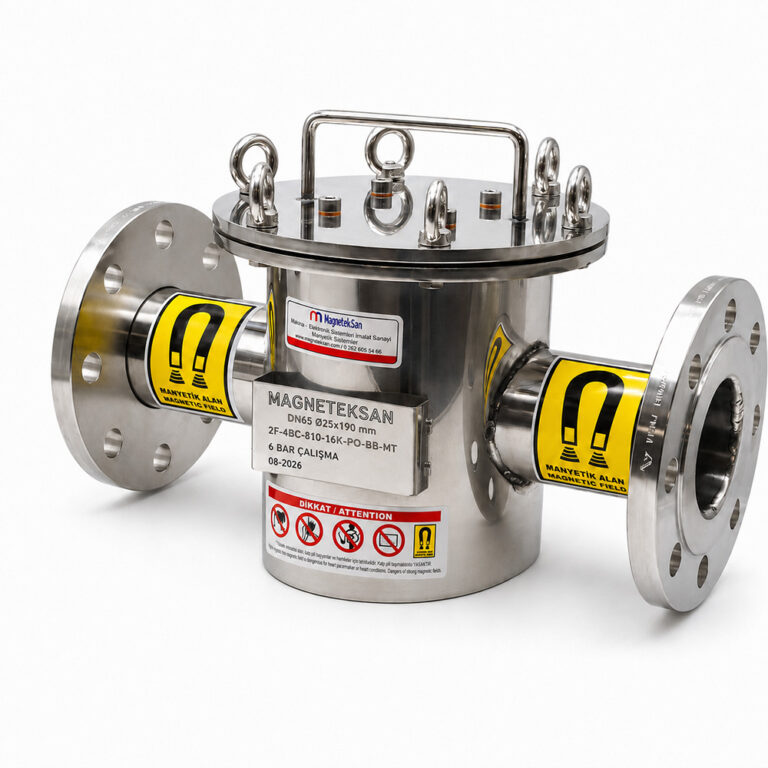
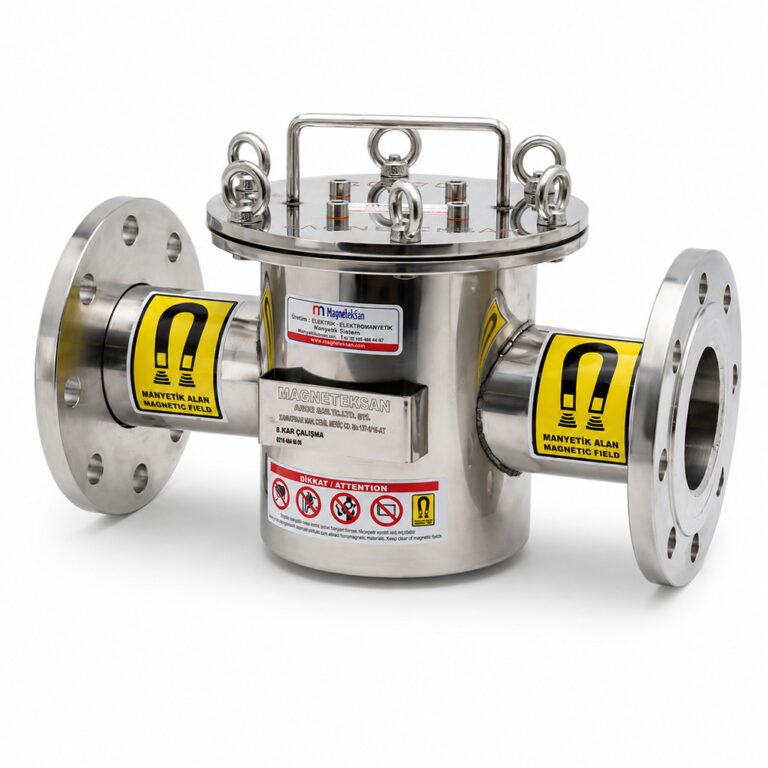
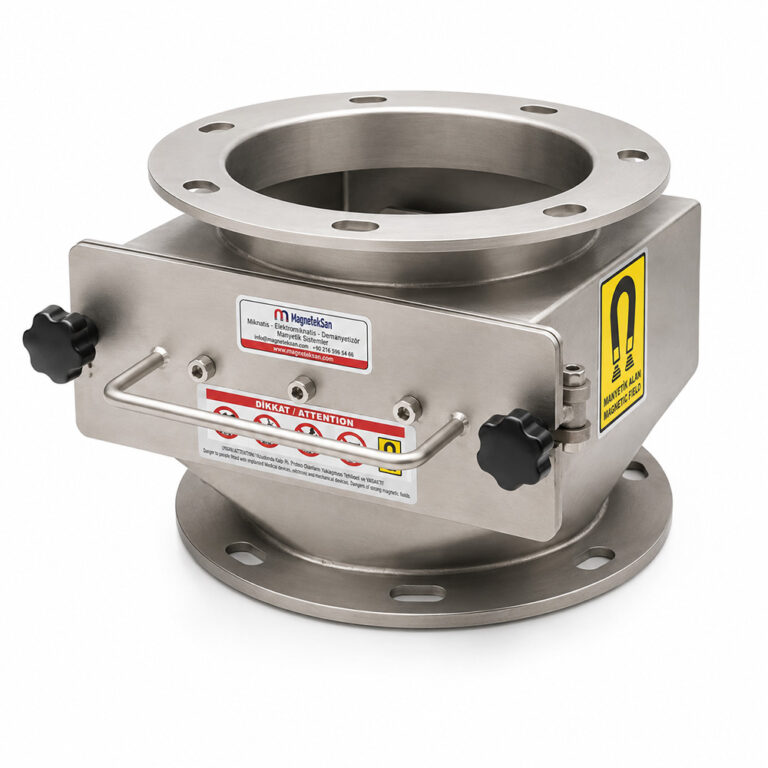
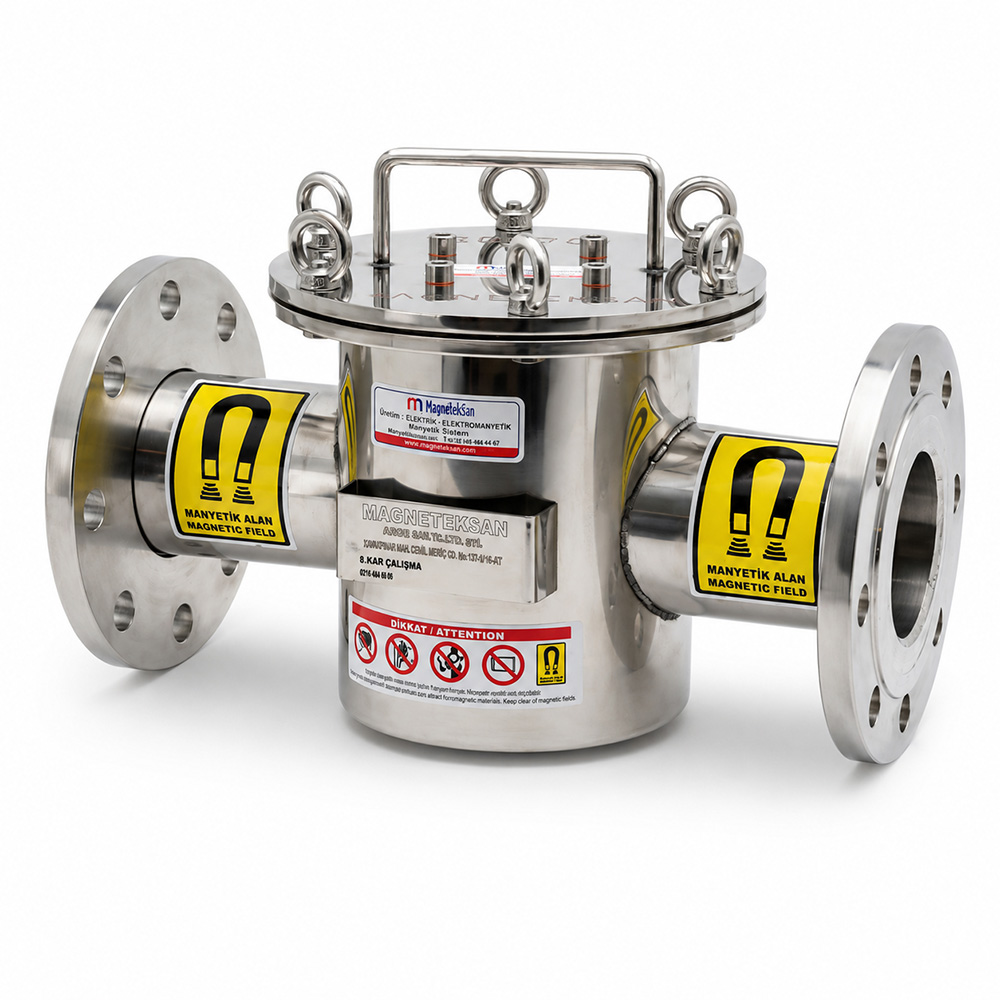
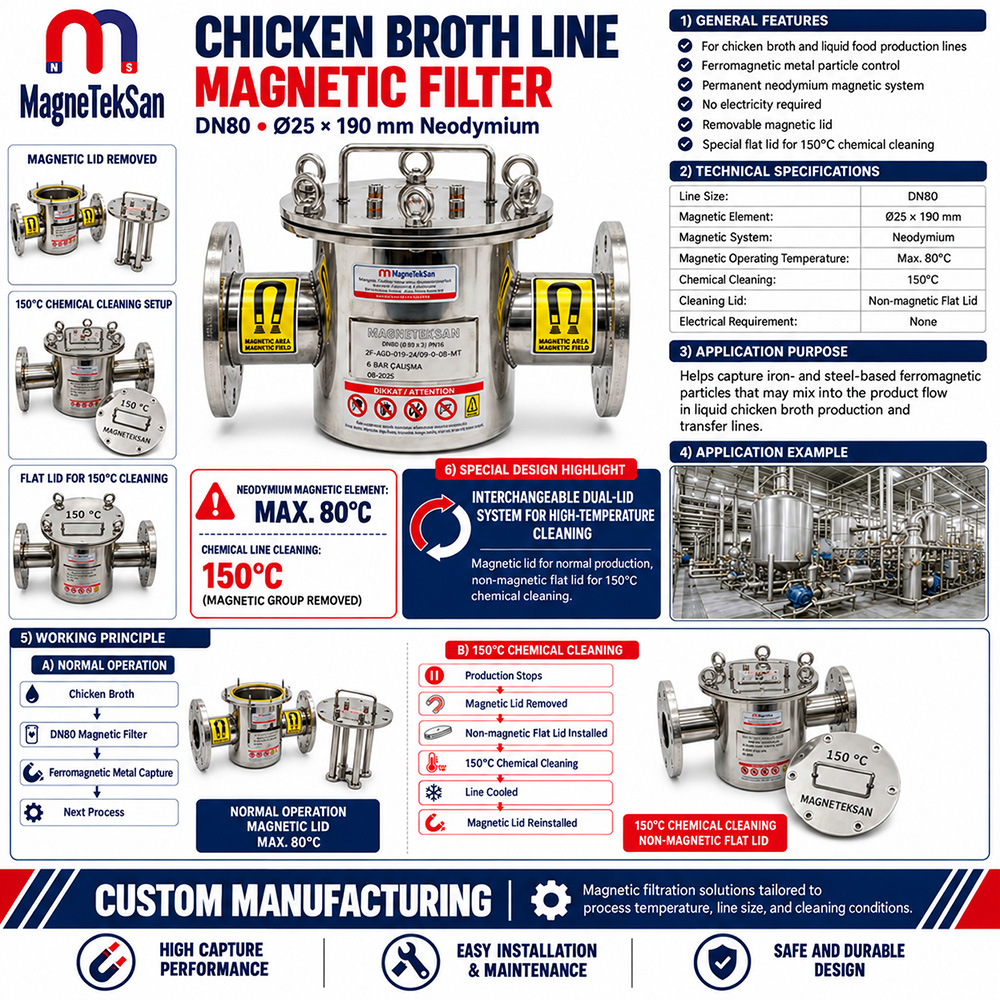
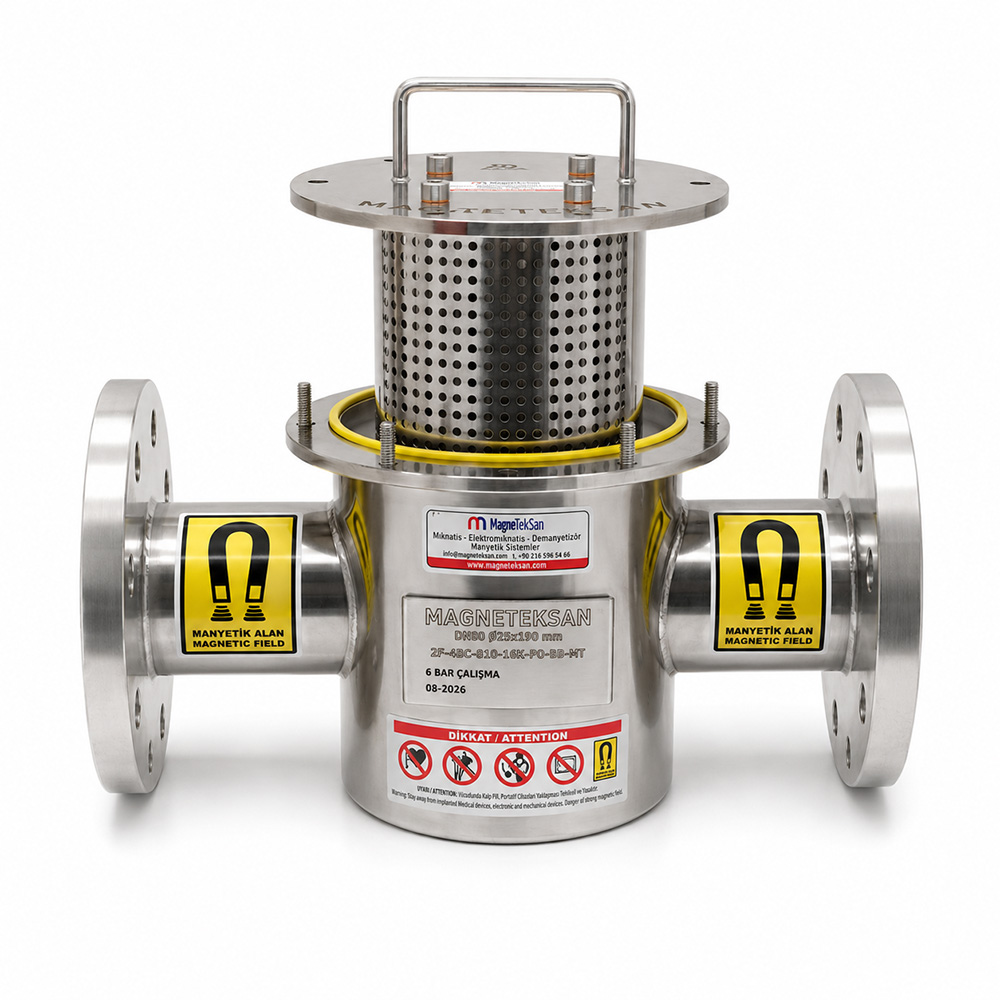
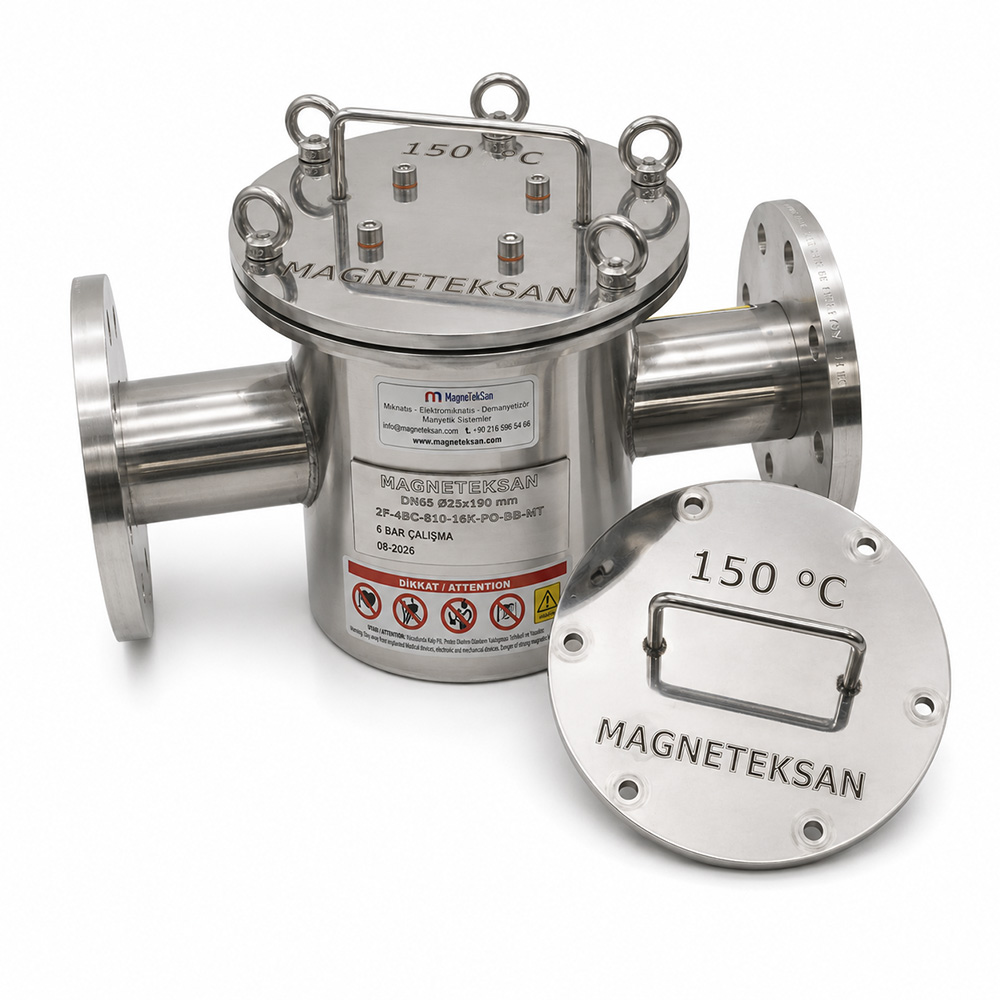
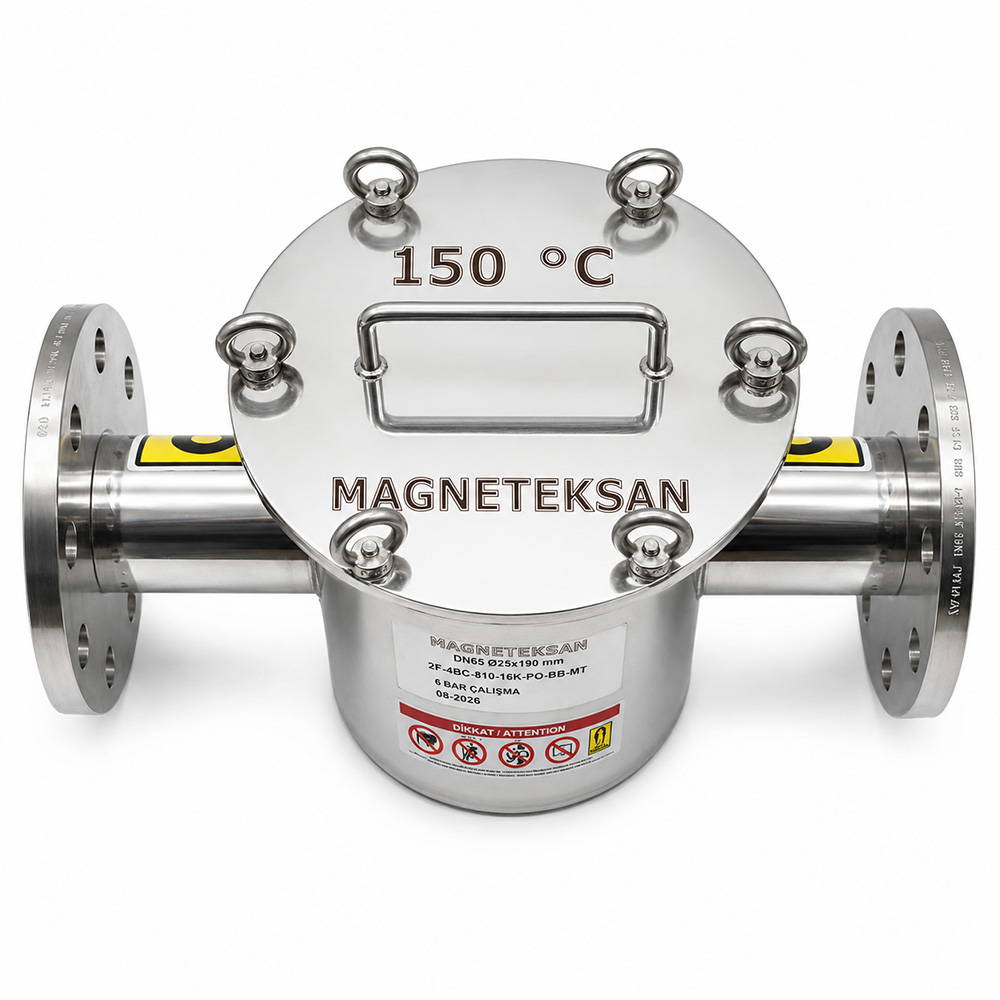
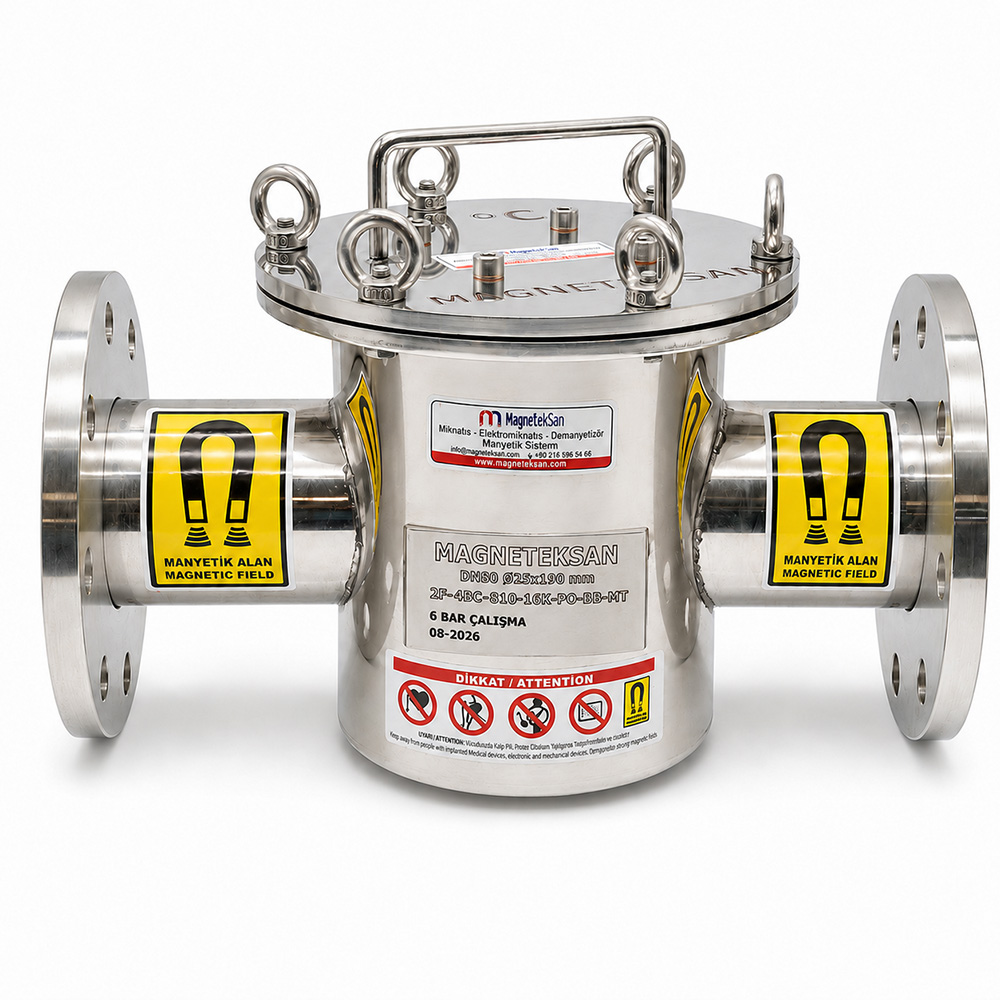
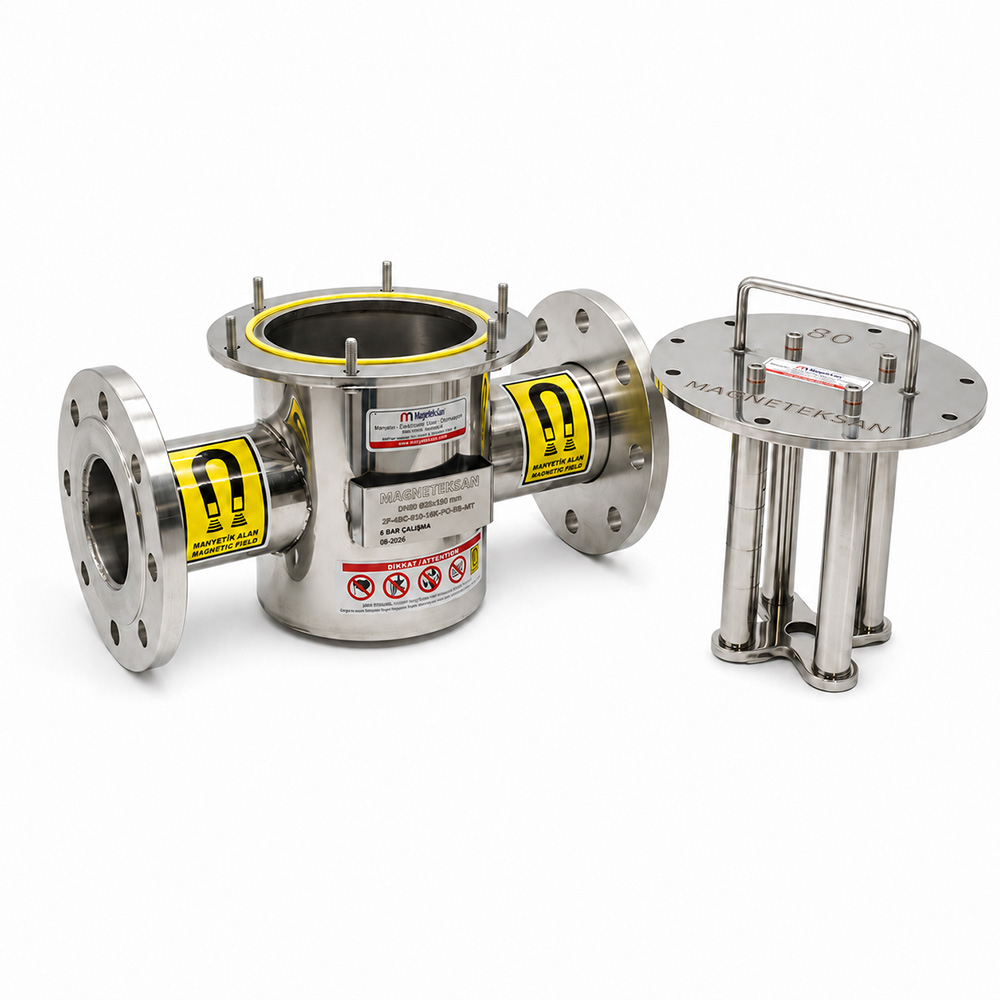
The Chicken Broth Magnetic Filter DN80 is designed to capture ferromagnetic metal contaminants from liquid chicken broth during food production and transfer processes. It features Ø25×190 mm neodymium magnetic elements with a maximum operating temperature of 80°C. For chemical pipeline cleaning at 150°C, the magnetic assembly is removed and replaced with a non-magnetic blank lid, protecting the magnets from excessive heat.
| Technical Specification | Value |
|---|---|
| Product Type | Neodymium Pipeline Magnetic Filter |
| Main Application | Liquid Chicken Broth Production Line |
| Nominal Connection Size | DN80 |
| Magnetic Element Dimensions | Ø25×190 mm |
| Magnetic Material | Neodymium |
| Maximum Magnet Operating Temperature | 80°C |
| Chemical Cleaning Temperature | 150°C with Magnets Removed |
| Lid Used During Production | Lid with Neodymium Magnetic Elements |
| Lid Used During 150°C Cleaning | Non-Magnetic Blank Lid |
| Cleaning System | Replaceable Lid System |
| Magnetic Element Cleaning | Manual / Removable Assembly |
| Magnetic System | Permanent Magnets |
| Electrical Power Requirement | None |
| Target Contaminants | Ferromagnetic Metal Particles |
| Main Function | Magnetic Separation in Liquid Food Processing Lines |
Extra Information
What Is a Chicken Broth Magnetic Filter?
A Chicken Broth Magnetic Filter is an industrial magnetic separation device designed to capture ferromagnetic metal particles that may be present in liquid chicken broth and compatible food-processing liquids.
During food production, liquid products pass through tanks, pumps, valves, pipelines, and other mechanical equipment. Equipment wear or maintenance activities may introduce iron or ferromagnetic steel particles into the product.
The magnetic filter provides an additional contamination-control stage by attracting suitable ferromagnetic particles to its magnetic elements.
The main features of this Magneteksan model include:
-
DN80 nominal pipeline connection.
-
Ø25×190 mm neodymium magnetic elements.
-
Permanent magnetic separation system.
-
Maximum magnet operating temperature of 80°C.
-
Removable magnetic lid.
-
Non-magnetic blank lid for chemical cleaning at 150°C.
-
Manual magnetic element cleaning.
-
Operation without electrical power.
Its primary application is liquid chicken broth production and transfer.
Why Is Magnetic Separation Important in Chicken Broth Production?
Chicken broth production involves several processing stages where the product may come into contact with mechanical equipment.
These can include:
-
Cooking and processing tanks.
-
Mixing vessels.
-
Transfer pumps.
-
Industrial valves.
-
Stainless steel pipelines.
-
Mechanical connections.
-
Filling equipment.
Mechanical wear, maintenance activities, or equipment damage may introduce ferromagnetic metal particles into the liquid.
A magnetic filter helps capture suitable contaminants before they reach subsequent processing stages.
It should be incorporated into a comprehensive foreign-body contamination-control program rather than treated as a replacement for other inspection methods.
Where Can the Magnetic Filter Be Installed?
The installation location depends on the production line configuration.
At the Processing Tank Outlet
Liquid chicken broth can pass through the magnetic filter before being transferred to another processing stage.
In the Liquid Transfer Pipeline
The filter can be installed between two production stages when the pipeline connections and operating conditions are compatible.
Before Intermediate Storage
A magnetic separation stage can be added before the product enters a storage or holding tank.
Before Filling or Packaging
If the process design allows, an additional magnetic control point can be installed before filling operations.
The final installation location should be determined according to the actual processing conditions.
How Does the Chicken Broth Magnetic Filter Work?
During normal production, liquid chicken broth flows through the DN80 magnetic filter.
The Ø25×190 mm neodymium magnetic elements inside the filter generate permanent magnetic fields.
Ferromagnetic particles carried by the liquid may be attracted to the magnetic surfaces when they pass sufficiently close to them.
Captured contaminants remain on the magnetic elements until removed during cleaning.
Typical process sequence:
Liquid Chicken Broth Preparation
↓
Product Transfer Pipeline
↓
DN80 Neodymium Magnetic Filter
↓
Ferromagnetic Metal Particle Capture
↓
Next Production Stage
Actual separation performance depends on product properties, contaminant characteristics, and operating conditions.
What Is the Most Important Feature of This Magnetic Filter?
The most important feature is its interchangeable magnetic lid and non-magnetic blank lid system.
The filter is designed for two different operating conditions.
| Operating Condition | Temperature | Lid Used |
|---|---|---|
| Normal Production | Up to 80°C | Magnetic Lid |
| High-Temperature Chemical Cleaning | 150°C | Non-Magnetic Blank Lid |
During production, the neodymium magnetic elements remain installed and perform magnetic separation.
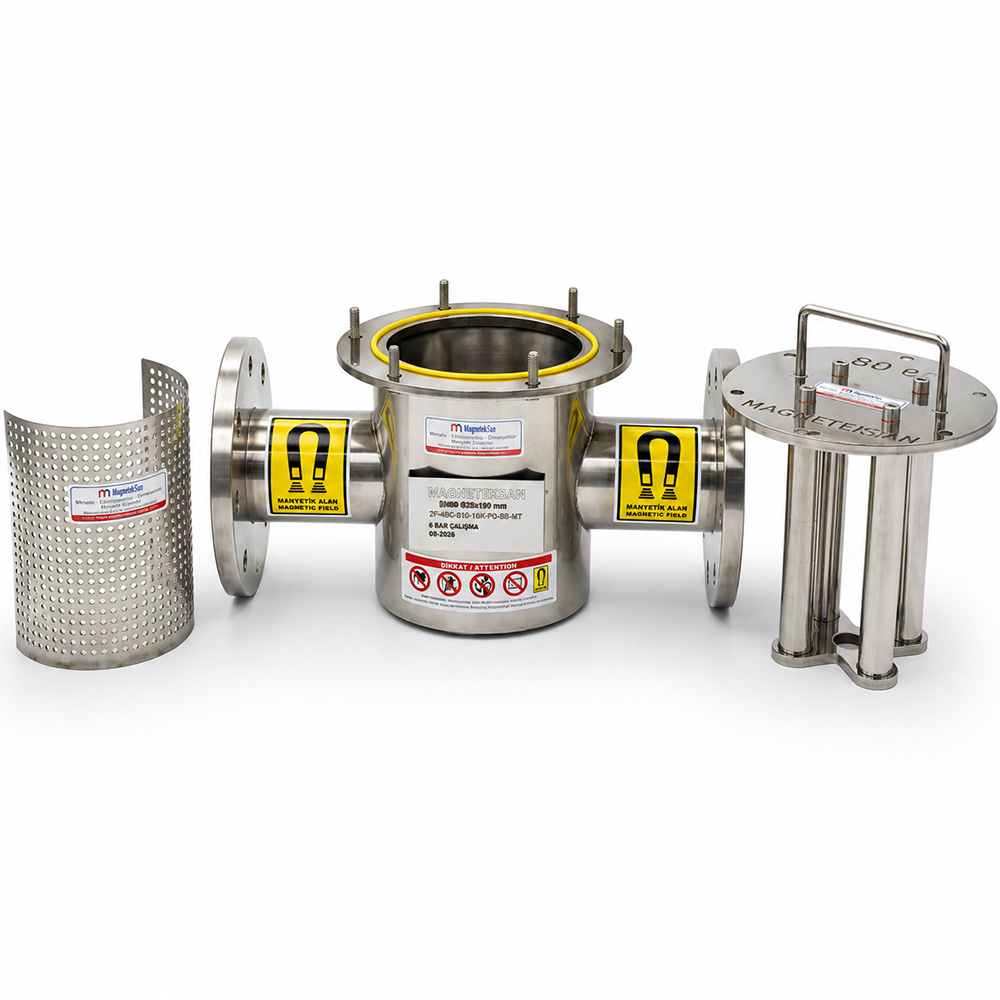
Before chemical cleaning at 150°C, the complete magnetic assembly is removed from the filter.
This protects the magnets from temperatures exceeding their permitted operating limit.
Why Are Two Different Lids Used?
The neodymium magnetic elements in this product have a maximum operating temperature of 80°C.
However, the production facility may require periodic chemical pipeline cleaning at 150°C.
Exposing magnets to temperatures above their permitted operating range may cause permanent loss of magnetic performance.
For this reason, the magnetic lid is removed before high-temperature cleaning and replaced with a non-magnetic blank lid.
| Operation | Lid Used |
|---|---|
| Normal Chicken Broth Production | Magnetic Lid |
| Ferromagnetic Metal Separation | Magnetic Lid |
| Magnetic Element Inspection | Magnetic Lid Removed |
| Chemical Cleaning at 150°C | Non-Magnetic Blank Lid |
| Production Restart | Magnetic Lid After Cooling |
Can the Neodymium Magnets Operate at 150°C?
No.
It is essential to distinguish between the magnet operating temperature and the chemical cleaning temperature.
Maximum magnetic element operating temperature: 80°C
Chemical cleaning temperature: 150°C
During cleaning at 150°C, the neodymium magnetic elements must not remain inside the filter.
The complete magnetic assembly must be removed.
The correct technical description is:
Magnetic filter with an interchangeable non-magnetic blank lid for chemical cleaning at 150°C.
The product should not be described as a magnetic filter whose neodymium magnets operate at 150°C.
How Is Chemical Cleaning Performed at 150°C?
The system uses a lid replacement procedure.
The typical sequence is:
-
Stop normal production.
-
Isolate the pipeline and secure the equipment.
-
Release residual pressure and ensure safe access.
-
Open the lid containing the magnetic elements.
-
Remove the complete magnetic assembly.
-
Install the non-magnetic blank lid.
-
Check the connections and sealing surfaces.
-
Perform the approved chemical cleaning cycle at 150°C.
-
Complete the cleaning and rinsing stages.
-
Allow the pipeline to cool to an appropriate temperature.
-
Remove the non-magnetic blank lid.
-
Reinstall the magnetic lid.
-
Inspect the system before restarting production.
The filter housing, blank lid, seals, and all components remaining in the pipeline must be compatible with the actual cleaning temperature, pressure, and chemicals.
Does the Main Filter Housing Need to Be Removed During Cleaning?
The interchangeable lid system is designed so that the main filter housing can remain installed in the pipeline during cleaning.
Only the lid containing the magnetic elements is removed.
The non-magnetic blank lid is installed in its place.
This arrangement can simplify the cleaning procedure by avoiding complete removal of the filter housing.
Compatibility with the cleaning conditions must still be verified.
What Is the Function of the Non-Magnetic Blank Lid?
The non-magnetic blank lid closes the filter opening after the magnetic assembly has been removed.
It allows the intended chemical cleaning procedure to take place without exposing the neodymium magnets to excessive temperatures.
The blank lid does not perform magnetic separation.
Its function is to provide suitable closure of the filter during the cleaning cycle.
Can the Magnetic Lid Be Reinstalled Immediately After Cleaning?
No.
The magnetic assembly should only be reinstalled after the pipeline has cooled sufficiently.
Before reinstallation:
-
Confirm that the temperature is within the permitted magnet operating range.
-
Inspect the sealing surfaces.
-
Check the condition of the gaskets.
-
Verify that the magnetic elements are clean.
-
Reinstall and secure the magnetic lid correctly.
The system should be inspected before production resumes.
Why Not Use High-Temperature Magnets Instead?
If normal production occurs below 80°C and higher temperatures are encountered only during periodic chemical cleaning, a removable magnetic assembly may be a practical engineering solution.
This approach allows neodymium magnets to be used during production while protecting them during high-temperature cleaning.
The most suitable solution depends on process requirements, cleaning frequency, and operating conditions.
Is the Filter Suitable for Liquid Chicken Stock?
Yes, subject to compatibility with the actual process conditions.
The filter is specifically intended for liquid chicken broth or chicken stock processing applications.
Important operating parameters include:
-
Product temperature.
-
Viscosity.
-
Flow rate.
-
Pipeline connections.
-
Cleaning requirements.
-
Operating pressure.
Each installation should be evaluated individually.
Can It Be Used for Concentrated Chicken Broth?
Potentially, yes.
Concentrated chicken broth may have different viscosity and flow characteristics from standard liquid stock.
The filter can be considered when the product can flow through its internal geometry without unacceptable restriction.
The application should be assessed based on the actual viscosity, temperature, flow rate, and process conditions.
Can the Filter Be Used for Beef or Vegetable Stock?
Yes, if the liquid product and operating conditions are compatible.
The magnetic separation principle depends on the ferromagnetic properties of the contaminants rather than the flavor or recipe of the liquid.
Potential applications include:
-
Beef stock.
-
Vegetable broth.
-
Meat-based liquid stock.
-
Liquid soup bases.
-
Compatible liquid seasoning preparations.
Product viscosity, temperature, and installation requirements must be considered.
Is the Filter Suitable for Soup Powder?
This is not its primary application.
The product is designed for liquid chicken broth processing lines.
Dry soup powders generally require different magnetic separation equipment, such as:
-
Magnetic grates.
-
Magnetic sieves.
-
Drawer magnetic separators.
-
Hopper magnets.
Equipment selection should be based on the physical characteristics of the processed material.
Does the Magnetic Filter Remove Chicken Meat or Food Particles?
No.
The filter is not designed to separate ordinary food ingredients such as:
-
Chicken meat.
-
Vegetable pieces.
-
Fat.
-
Spices.
-
Proteins.
-
Starch.
-
Other non-magnetic food components.
Its main function is to capture suitable ferromagnetic metal contaminants.
It should not be considered a mechanical strainer for removing food particles.
Can the Filter Remove Bone Fragments?
No.
Bone fragments are not ferromagnetic and cannot be reliably captured by this magnetic separation method.
If bone fragments or other non-magnetic solid particles need to be removed, an appropriate mechanical filtration or screening system should be used.
Which Metals Can the Magnetic Filter Capture?
The magnetic elements can attract contaminants with sufficient ferromagnetic properties.
Examples include:
-
Iron particles.
-
Carbon steel fragments.
-
Ferromagnetic steel wear particles.
-
Small ferromagnetic metal debris.
Actual separation performance depends on the magnetic properties, size, shape, and proximity of the particles to the magnetic surfaces.
Can the Filter Capture Stainless Steel Particles?
Some stainless steel grades exhibit magnetic properties, while others respond weakly to magnetic fields.
Magnetic behavior depends on the alloy, manufacturing process, and metallurgical condition.
Therefore, the filter cannot be guaranteed to capture every type of stainless steel particle.
Application-specific testing is recommended where stainless steel contamination is a significant concern.
Can the Filter Remove Aluminum, Copper, or Brass?
No, not through conventional ferromagnetic attraction.
Aluminum, copper, and brass are not ferromagnetic materials.
Consequently, the magnetic filter is not a universal solution for removing every type of metal.
Other technologies may be required to detect or control non-ferromagnetic metal contamination.
Can Very Fine Iron Particles Be Captured?
Fine iron particles may be attracted by the neodymium magnetic elements when their magnetic properties and the process conditions are suitable.
However, no verified minimum particle size has been specified for this particular product.
A guaranteed separation limit expressed in micrometers would require application-specific testing.
What Is the Magnetic Field Strength in Gauss?
A verified Gauss measurement has not been specified for this particular model.
Magnetic flux density should be confirmed through appropriate measurement.
The dimensions of the magnetic elements alone are insufficient to determine surface Gauss values or separation efficiency reliably.
What Is the Function of the Ø25×190 mm Neodymium Magnetic Elements?
The Ø25×190 mm neodymium magnetic elements provide the magnetic surfaces used to attract and retain suitable ferromagnetic contaminants.
As liquid passes through the filter, metal particles that approach these elements sufficiently closely may be captured.
Actual performance depends on:
-
Magnetic field distribution.
-
Particle size and composition.
-
Liquid viscosity.
-
Flow velocity.
-
Distance between particles and magnetic surfaces.
-
Accumulation of captured contaminants.
The allowable flow rate or capture efficiency cannot be determined from magnetic element dimensions alone.
How Many Magnetic Elements Does the Filter Contain?
The confirmed technical specification for this DN80 product identifies the magnetic element dimensions as Ø25×190 mm.
The exact number of elements should be verified against the approved product drawing or technical documentation.
The element count should not be inferred from the DN80 nominal connection size.
What Does DN80 Mean?
DN80 indicates the nominal connection size of the process pipeline.
It is a nominal dimensional designation rather than a direct indication of flow capacity.
DN80 alone does not determine:
-
Flow rate.
-
Maximum operating pressure.
-
Processing capacity.
-
Pressure drop.
-
Internal fluid velocity.
These parameters depend on the complete filter geometry and operating conditions.
What Is the Flow Capacity of the Filter?
A verified nominal flow capacity has not been provided.
Actual capacity depends on several factors:
-
Viscosity.
-
Density.
-
Temperature.
-
Process flow rate.
-
Internal flow passage geometry.
-
Pressure drop.
-
Operating conditions.
An exact value in liters per minute or cubic meters per hour should only be stated after technical verification.
Can the Filter Be Used in Pressurized Pipelines?
Suitability for pressurized pipelines depends on the mechanical design and verified allowable operating pressure.
No confirmed maximum pressure rating has been specified for this particular product.
Before installation, the operating pressure, connection type, seals, and lid fastening system should be evaluated.
Does the Magnetic Filter Require Electricity?
No.
The system uses permanent neodymium magnets.
It does not require:
-
Electrical power.
-
Electromagnetic coils.
-
A magnetic control panel.
-
A DC power supply.
The magnetic field is generated directly by the permanent magnets.
How Are the Magnetic Elements Cleaned During Normal Production?
When ferromagnetic particles accumulate on the magnetic surfaces, manual cleaning may be required.
A typical procedure includes:
-
Stop production.
-
Safely isolate the pipeline and release pressure where necessary.
-
Remove the magnetic lid assembly.
-
Inspect the Ø25×190 mm magnetic elements.
-
Remove captured ferromagnetic particles.
-
Inspect magnetic surfaces for damage or wear.
-
Check sealing surfaces and connections.
-
Reinstall and secure the magnetic lid.
-
Restart the system according to the approved procedure.
This operation is different from chemical pipeline cleaning at 150°C.
How Often Should the Magnetic Filter Be Cleaned?
There is no universal cleaning interval suitable for every chicken broth production line.
Cleaning frequency depends on:
-
Contamination levels.
-
Operating hours.
-
Product flow rate.
-
Quantity of captured metal.
-
Production schedules.
-
Food safety requirements.
-
Maintenance procedures.
Regular inspections during initial operation help establish an appropriate cleaning interval.
What Happens If Too Much Metal Accumulates on the Magnets?
Excessive accumulation of ferromagnetic material may reduce the available magnetic surface for capturing additional contaminants.
It may also affect product flow.
Regular inspection and cleaning help maintain the intended operating conditions.
Can the Magnetic Filter Replace a Mechanical Filter?
No.
The two systems operate according to different separation principles.
| System | Separation Principle |
|---|---|
| Neodymium Magnetic Filter | Ferromagnetic properties |
| Mechanical Filter or Strainer | Particle size |
A magnetic filter captures suitable ferromagnetic particles, while a mechanical filter retains particles according to its opening size.
The two systems can complement one another within the same production line.
Is the Magnetic Filter the Same as a Metal Detector?
No.
A magnetic filter physically captures suitable ferromagnetic metal particles from the product flow.
A metal detector electronically detects metal contamination within its validated sensitivity limits.
These devices perform different functions and may be installed at different process points.
Does Magnetic Filtration Replace Other Food Safety Controls?
No.
Magnetic separation should form part of the facility’s overall food safety and contamination-control system.
It does not eliminate the need for inspections, maintenance, process validation, or other foreign-body control measures.
Is the Filter Suitable for Food Processing?
The product is intended for liquid food-processing applications.
However, the exact materials of all product-contact components, surface finishes, sealing materials, and required compliance documentation should be verified for each installation.
Food-contact compliance should not be assumed solely because the equipment contains a magnetic separation system.
Is the Filter Compatible with CIP Cleaning?
The product design allows high-temperature chemical cleaning by replacing the magnetic lid with a non-magnetic blank lid.
This feature is particularly relevant to facilities using CIP (Cleaning in Place) systems.
However, actual compatibility must be assessed based on:
-
Cleaning chemical composition.
-
Cleaning temperature.
-
Pressure.
-
Exposure duration.
-
Gasket materials.
-
Filter housing material.
-
Connection design.
-
Approved cleaning procedures.
The magnetic elements must be removed before the 150°C cleaning cycle.
What Is the Difference Between Operation at 80°C and Cleaning at 150°C?
These temperatures refer to two different operating conditions.
| Feature | Normal Production | Chemical Cleaning |
|---|---|---|
| Temperature | Up to 80°C | 150°C |
| Magnetic Elements | Installed | Removed |
| Lid | Magnetic | Non-Magnetic Blank |
| Magnetic Separation | Active | Inactive |
| Main Function | Liquid Food Processing | Pipeline Cleaning |
The 150°C cleaning temperature must not be interpreted as the allowable operating temperature of the neodymium magnets.
Can the Filter Remain Installed During High-Temperature Cleaning?
The main filter housing is designed to remain in the pipeline while the magnetic assembly is removed.
The non-magnetic blank lid is installed in place of the magnetic lid.
This arrangement can allow cleaning without completely dismantling the filter housing.
All components remaining in the pipeline must be suitable for the intended cleaning conditions.
How Does This Product Differ from a Conventional Pipeline Magnetic Filter?
The key distinction is its combination of:
DN80 + Ø25×190 mm Neodymium Magnetic Elements + Liquid Chicken Broth Processing + 80°C Magnet Operation + Separate Non-Magnetic Lid for 150°C Chemical Cleaning
The interchangeable lid system is especially useful when the normal production temperature is lower than the temperature required for periodic chemical cleaning.
What Is the Difference Between the Chicken Broth Filter and the Soup Base Filter?
Magneteksan offers related magnetic filtration solutions for liquid food production lines.
| Feature | Chicken Broth Magnetic Filter | Soup Base Magnetic Filter |
|---|---|---|
| Main Application | Liquid Chicken Broth | Liquid Soup Bases |
| Nominal Connection | DN80 | DN65 |
| Magnetic Element Dimensions | Ø25×190 mm | Ø25×190 mm |
| Magnetic Material | Neodymium | Neodymium |
| Maximum Magnet Operating Temperature | 80°C | 80°C |
| Chemical Cleaning Temperature | 150°C | 150°C |
| Cleaning Arrangement | Replaceable Non-Magnetic Blank Lid | Replaceable Non-Magnetic Blank Lid |
| Electrical Power | Not Required | Not Required |
The primary differences are the nominal pipeline connection size and intended application. Both use a removable magnetic assembly to protect the neodymium elements during high-temperature chemical cleaning.
Can This Magnetic Filter Be Custom Manufactured?
Yes.
Magneteksan can develop customized magnetic separation solutions according to the requirements of liquid food-processing lines.
Customization options may include:
-
Nominal pipeline diameter.
-
Connection dimensions.
-
Magnetic element dimensions.
-
Magnetic element arrangement.
-
Magnet material and grade.
-
Required magnetic flux density.
-
Filter housing geometry.
-
Lid configuration.
-
Cleaning system.
-
Operating temperature requirements.
-
Chemical cleaning conditions.
-
Process pressure requirements.
The final design should be based on actual operating parameters and application requirements.
What Information Is Required for a Custom Magnetic Filter?
For technical evaluation of a customized project, the following information is useful:
-
Type of liquid product.
-
Pipeline diameter.
-
Flow rate.
-
Viscosity.
-
Normal operating temperature.
-
Maximum process temperature.
-
Chemical cleaning temperature.
-
Cleaning chemical composition.
-
Operating pressure.
-
Pipeline connection type.
-
Required magnetic separation performance.
-
Available installation space.
This information helps determine a suitable magnetic filter configuration.
Why Choose the Magneteksan Chicken Broth Magnetic Filter?
The Magneteksan DN80 Chicken Broth Magnetic Filter is designed to help control ferromagnetic metal contamination in compatible liquid food-processing lines.
Its principal features include:
-
DN80 pipeline connection.
-
Ø25×190 mm neodymium magnetic elements.
-
Permanent magnetic operation without electricity.
-
Maximum magnet operating temperature of 80°C.
-
Removable magnetic lid.
-
Non-magnetic blank lid for chemical cleaning at 150°C.
-
Manual access for magnetic element inspection and cleaning.
-
Application-specific design for liquid chicken broth production.
The interchangeable lid system separates magnetic filtration during production from high-temperature chemical cleaning, helping protect the neodymium magnetic elements from excessive heat.