Product Information
Extra Information
Product Information
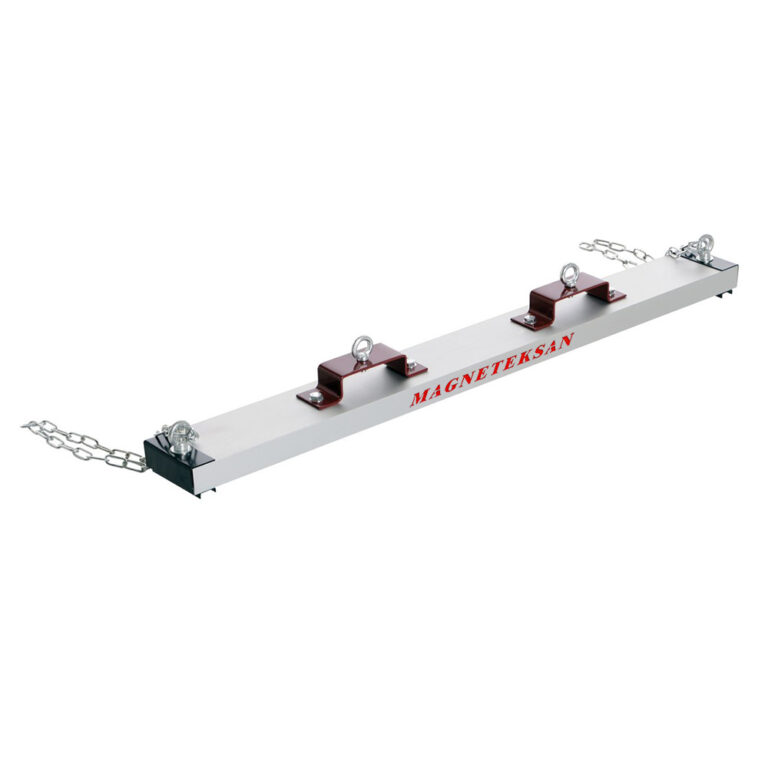
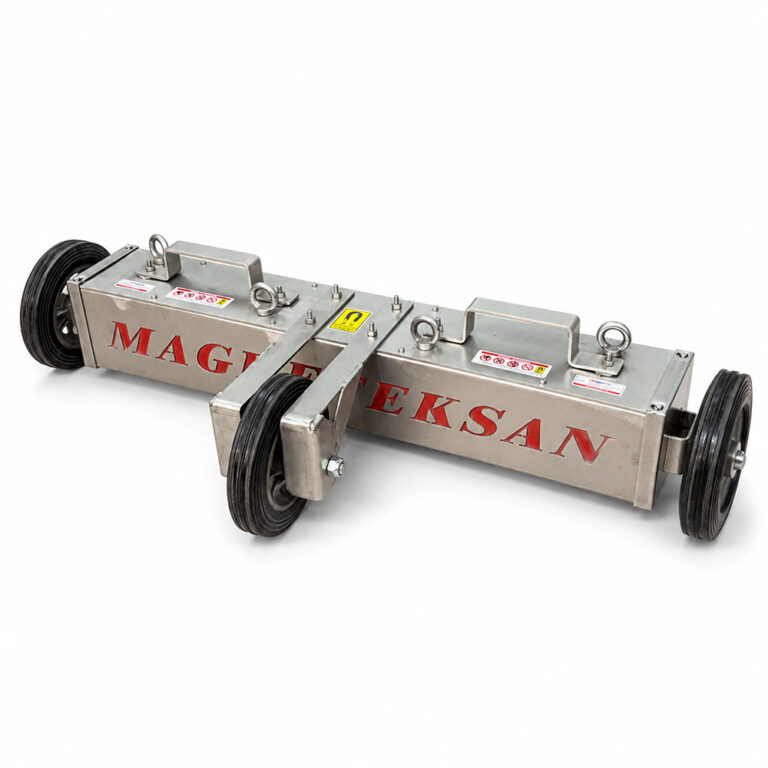
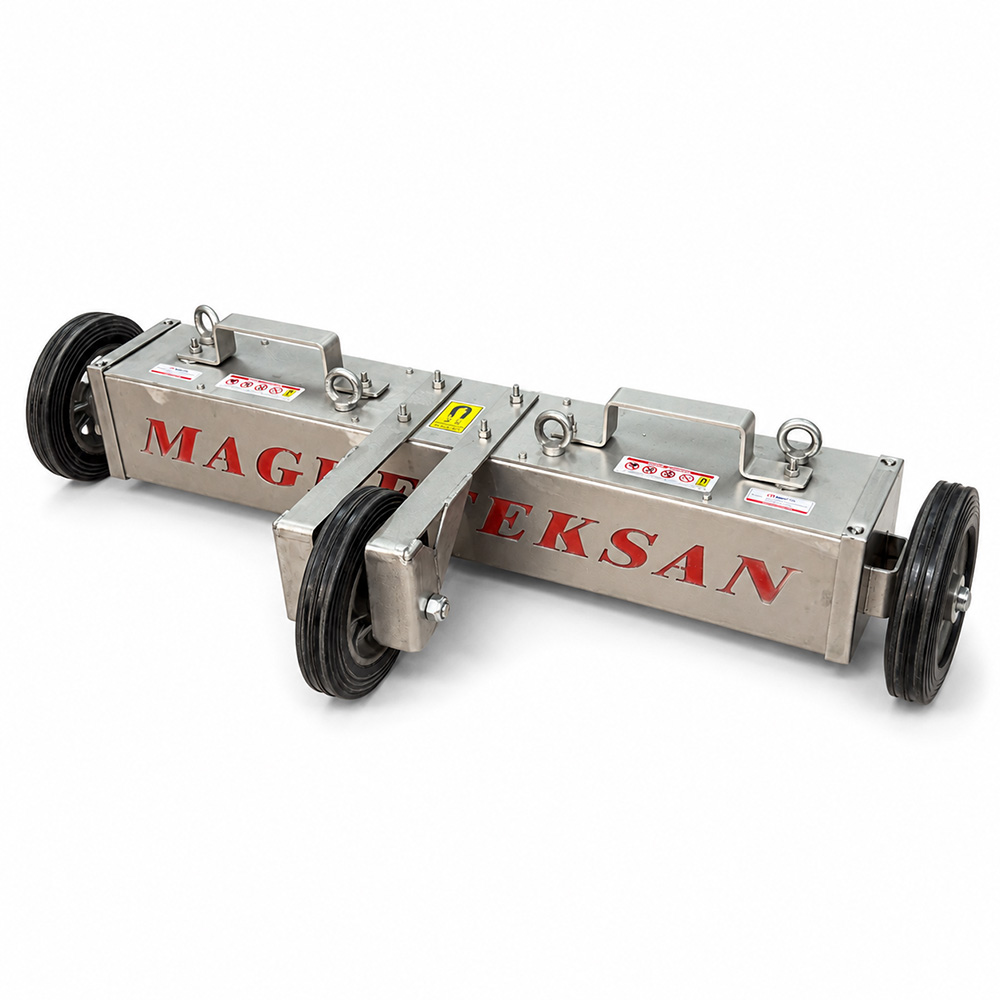
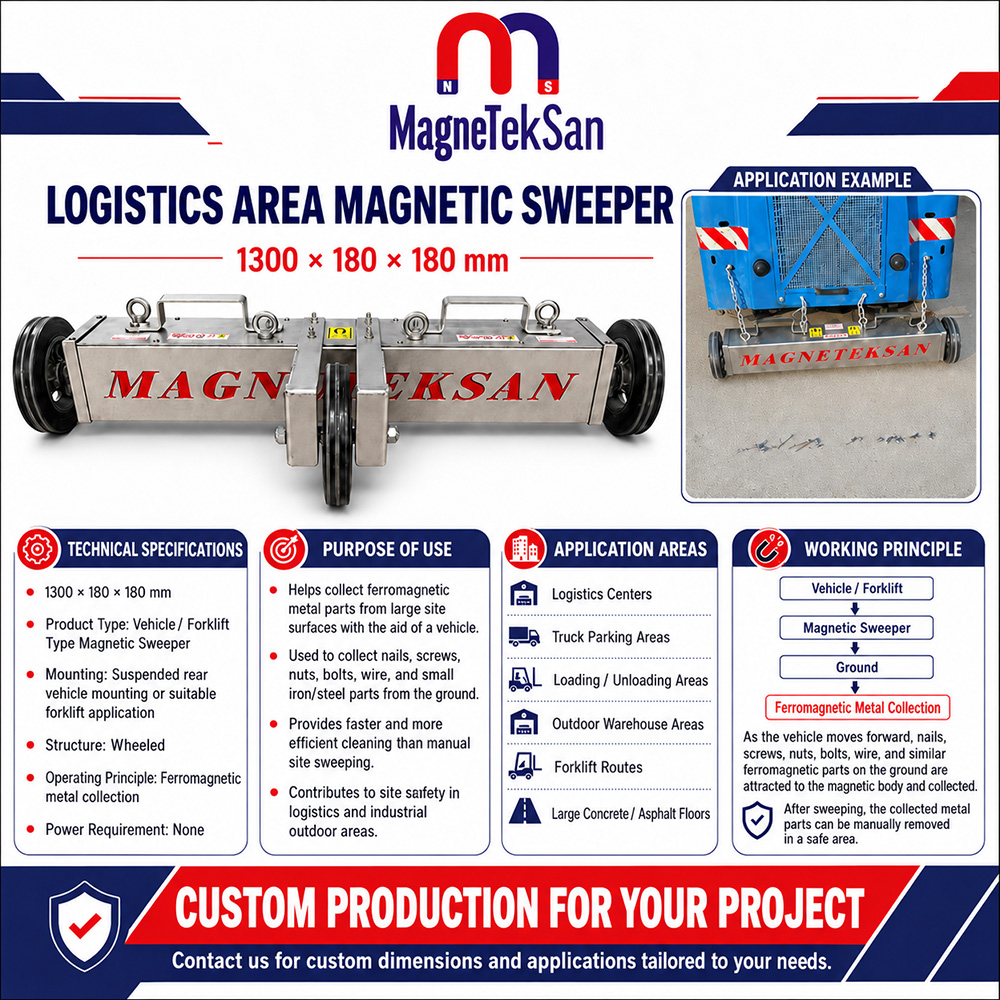
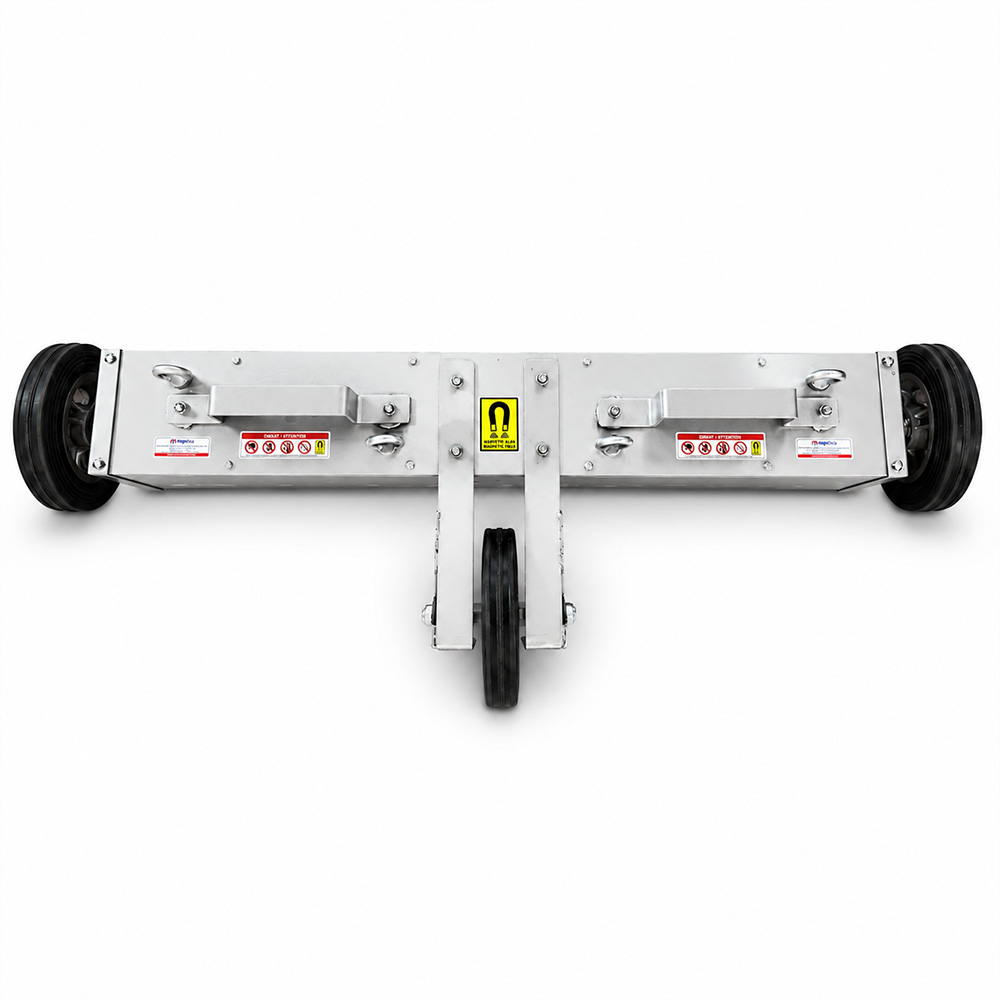
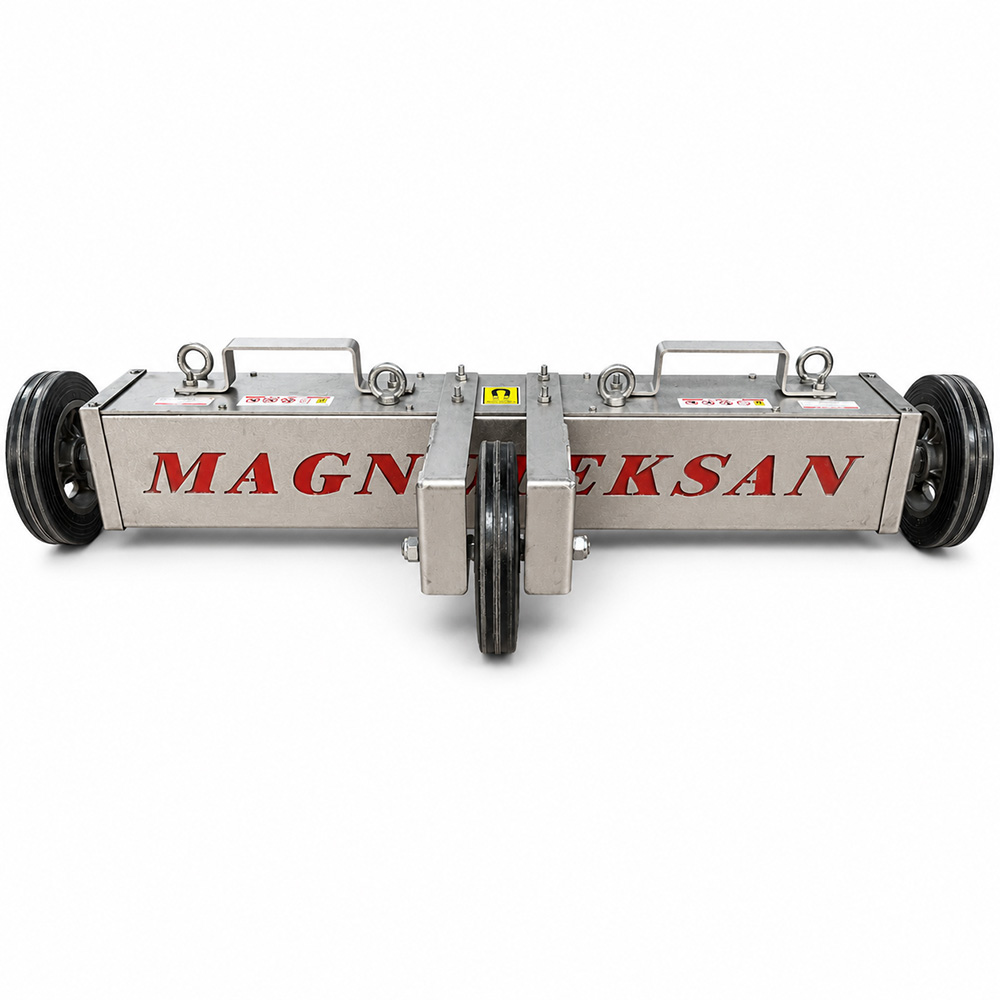
The 1300x180x180 mm Magnetic Sweeper for Logistics Yards is a vehicle-mounted industrial magnetic cleaning system designed to collect ferromagnetic metal debris from large outdoor surfaces. Its wheeled construction allows it to be moved behind a suitable vehicle or used with a compatible forklift mounting arrangement. The permanent magnetic system collects nails, screws, bolts, steel wire and other ferrous fragments without requiring electricity.
| Technical Specification | Value |
|---|---|
| Product Type | Vehicle / Forklift Magnetic Sweeper |
| Primary Application | Logistics Yard Cleaning |
| Overall Dimensions | 1300x180x180 mm |
| Length | 1300 mm |
| Width | 180 mm |
| Height | 180 mm |
| Operating Method | Vehicle-Mounted Mobile Sweeping |
| Mounting | Suspended / Application-Specific |
| Ground Support | Wheeled |
| Magnetic System | Permanent Magnets |
| Electrical Power | Not Required |
| Target Contaminants | Ferromagnetic Metal Debris |
| Typical Collected Materials | Nails, Screws, Nuts, Bolts, Steel Wire |
| Suitable Locations | Logistics Centres, Truck Parks, Loading Areas |
| Cleaning Method | Controlled Manual Removal of Collected Metal |
| Main Function | Magnetic Metal Collection from Industrial Ground Surfaces |
Extra Information
What Is a Magnetic Sweeper for Logistics Yards?
A Magnetic Sweeper for Logistics Yards is industrial ground-cleaning equipment designed to collect ferromagnetic metal debris from large outdoor working areas.
Logistics facilities experience constant movement of trucks, trailers, forklifts, pallet trucks and other industrial vehicles. During loading, unloading, maintenance and material handling, metal objects may fall onto the ground.
These objects can include:
-
Nails from wooden pallets.
-
Screws and bolts.
-
Steel nuts and washers.
-
Pieces of iron wire.
-
Ferrous metal fragments.
-
Small steel components from equipment.
The Magneteksan 1300x180x180 mm magnetic sweeper is designed to help remove suitable ferromagnetic debris using a permanent magnetic system.
Unlike handheld magnetic sweepers, this model can be moved using an appropriately equipped vehicle or forklift, making it particularly useful for larger industrial areas.
Why Is Magnetic Ground Cleaning Important in Logistics Centres?
Large logistics centres often have extensive vehicle circulation areas.
Trucks, forklifts and other industrial vehicles regularly travel across:
-
Loading bays.
-
Container handling areas.
-
Truck parking zones.
-
Warehouse entrances.
-
Distribution yards.
-
Industrial access roads.
Small ferrous objects may remain on these surfaces after routine operations.
Sharp metal debris, especially nails and steel wire, can create an unwanted risk for vehicle tyres.
Regular magnetic sweeping helps reduce the presence of such debris and supports better housekeeping across the facility.
How Does the Magnetic Sweeper Work?
The magnetic sweeper is connected to a suitable vehicle or forklift using an appropriate mounting arrangement.
As the vehicle moves across the ground, the sweeper passes over the surface.
Ferromagnetic metal objects within the effective magnetic field can be attracted towards the magnetic collecting surface.
Typical operating sequence:
Vehicle or Forklift
↓
1300 mm Magnetic Sweeper
↓
Industrial Ground Surface
↓
Collection of Ferromagnetic Metal Debris
↓
Controlled Removal of Collected Metal
After sweeping, the collected metal should be removed in a designated safe area.
Collection performance depends on the metal properties, ground clearance, surface conditions and vehicle speed.
Where Can This Magnetic Sweeper Be Used?
The product is particularly suitable for large industrial and logistics environments.
Typical applications include:
-
Logistics centres.
-
Truck parking areas.
-
Distribution centres.
-
Loading and unloading yards.
-
Warehouse outdoor areas.
-
Factory access roads.
-
Freight terminals.
-
Industrial vehicle circulation zones.
-
Large paved storage yards.
-
Container handling facilities.
The most suitable locations are areas where a vehicle can travel safely while maintaining an appropriate working distance between the sweeper and the ground.
Why Is It Useful in Truck Parking Areas?
Truck parking areas often have extensive paved surfaces and frequent heavy vehicle movement.
Nails, screws and steel fragments may be left on the ground during loading operations, maintenance or pallet handling.
A vehicle-mounted magnetic sweeper helps collect suitable ferromagnetic debris from these areas.
Regular sweeping can contribute to:
-
Reduced accumulation of sharp ferrous debris.
-
Improved ground cleanliness.
-
More systematic yard maintenance.
-
Reduced exposure of tyres to loose magnetic metal objects.
-
More efficient inspection of large parking areas.
However, no magnetic sweeper can guarantee complete prevention of tyre punctures.
Can It Be Used in Loading and Unloading Areas?
Yes.
Loading and unloading areas are among the most relevant applications.
Wooden pallets, packaging components, metal fasteners and industrial handling equipment are frequently moved in these locations.
Damaged pallets may release steel nails onto the ground.
Maintenance activities may also leave screws, nuts and bolts on the surface.
The magnetic sweeper can help collect these ferromagnetic objects before they accumulate in vehicle movement areas.
Can It Be Used in Warehouse Outdoor Areas?
Yes.
The product can be considered for large outdoor warehouse surfaces, including:
-
Concrete yards.
-
Asphalt loading roads.
-
Vehicle parking spaces.
-
Outdoor storage zones.
-
Industrial access routes.
It is generally more suitable for large vehicle-accessible surfaces than narrow warehouse aisles.
The mounting arrangement and available turning space should be checked before use.
Can the Magnetic Sweeper Be Mounted Behind a Vehicle?
Yes, provided a suitable mounting and suspension system is used.
The sweeper can be positioned behind an appropriate yard vehicle so that it travels across the ground as the vehicle moves.
The mounting system must be designed for the specific vehicle.
Important considerations include:
-
Attachment points.
-
Vehicle dimensions.
-
Turning clearance.
-
Sweeper ground clearance.
-
Safe operating speed.
-
Stability of the mounting system.
The connection should be mechanically suitable for the intended operating conditions.
Can It Be Used with a Forklift?
Yes, subject to a compatible mechanical mounting arrangement.
Forklifts are commonly used in logistics centres, distribution facilities and industrial warehouses.
The magnetic sweeper can be integrated into a suitable forklift application for collecting ferrous debris from ground surfaces.
Before installation, the following should be considered:
-
Forklift dimensions.
-
Available mounting points.
-
Turning radius.
-
Forklift ground clearance.
-
Lifting system movement.
-
Visibility and operator safety.
-
Intended sweeping direction.
The mounting configuration must not interfere with safe forklift operation.
Can It Be Mounted at the Front of a Forklift?
A front-mounted application may be possible if an appropriate mechanical connection is designed.
In this configuration, the magnetic sweeper can pass over the ground before the forklift tyres reach the same area.
This may be useful in facilities where forklifts frequently travel across large paved surfaces.
However, the installation must be checked for compatibility with the forklift’s lifting mechanism, turning clearance and safe operation.
Can It Be Mounted Behind a Forklift?
Yes, where a suitable rear connection is available.
A rear-mounted sweeper can travel behind the forklift during controlled yard movements.
This arrangement may allow magnetic ground sweeping to be incorporated into routine vehicle movements.
The final installation should be assessed for mechanical safety, turning clearance and the intended operating environment.
Can It Be Used with Trucks or Other Yard Vehicles?
The magnetic sweeper can be considered for suitable yard vehicles with an appropriately designed mounting system.
Potential vehicle types include:
-
Industrial yard vehicles.
-
Utility vehicles.
-
Suitable trucks.
-
Compatible forklifts.
-
Other site maintenance vehicles.
The connection system should be designed according to the vehicle’s geometry and intended working conditions.
What Is the Advantage of the 1300 mm Length?
The 1300 mm length provides a relatively wide magnetic collecting section compared with small handheld magnetic sweepers.
This helps the operator cover wider ground strips during each pass.
The design is particularly useful for:
-
Large truck parking areas.
-
Industrial loading yards.
-
Factory access roads.
-
Distribution centre surroundings.
-
Wide vehicle circulation zones.
Actual coverage per hour depends on vehicle speed, overlap between passes and the site layout.
The 1300 mm overall length should not be treated as a guaranteed effective collection width without verification of the magnetic working area.
What Is the Advantage of the 180×180 mm Body?
The 180×180 mm body dimensions form part of the sweeper’s overall mechanical construction.
The product has an overall size of 1300x180x180 mm.
This configuration is intended for industrial yard applications.
However, body dimensions alone do not determine:
-
Magnetic attraction force.
-
Effective collection distance.
-
Maximum lifting capacity.
-
Magnetic field strength.
-
Maximum permissible operating speed.
These characteristics depend on the internal magnetic design and operating conditions.
What Is the Purpose of the Wheels?
The wheeled structure helps the magnetic sweeper move along suitable ground surfaces.
It also helps maintain a controlled distance between the magnetic collecting surface and the ground.
This is important because magnetic attraction generally decreases as the distance between the magnet and the metal object increases.
The appropriate operating height depends on:
-
Ground conditions.
-
Wheel configuration.
-
Mounting geometry.
-
Target metal size.
-
Vehicle movement.
The wheels also help reduce direct contact between the magnetic body and the ground.
Does the Magnetic Sweeper Collect Nails?
Yes.
Iron and steel nails are typical target objects for this type of magnetic sweeper.
Examples include:
-
Wooden pallet nails.
-
Steel construction nails.
-
Loose packaging nails.
-
Nails from damaged crates.
The ability to collect a particular nail depends on its magnetic properties, size, orientation and distance from the magnetic collecting surface.
Can It Collect Screws and Bolts?
Yes, if they have sufficient ferromagnetic properties.
Typical target objects include:
-
Steel screws.
-
Steel bolts.
-
Iron nuts.
-
Ferromagnetic washers.
-
Steel fastening components.
Not all fasteners are magnetic, so collection cannot be guaranteed for every material.
Can It Collect Steel Wire?
Yes.
Steel and iron wire fragments can be attracted to the magnetic collecting surface when they enter the effective magnetic field.
These objects are particularly relevant to logistics yard maintenance because sharp wire fragments can remain on paved surfaces.
Their collection depends on size, magnetic properties and working distance.
Can It Collect Metal Shavings?
Ferromagnetic metal shavings may be collected if they are sufficiently affected by the magnetic field.
However, this product is primarily designed for larger outdoor ground areas rather than specialised fine-shaving removal inside machining facilities.
For workshops with substantial quantities of fine swarf, a different magnetic collection system may be more appropriate.
Can It Collect Aluminium?
No, not by ordinary ferromagnetic attraction.
Aluminium is not a ferromagnetic material.
The sweeper is not intended to collect non-ferromagnetic materials such as:
-
Aluminium.
-
Copper.
-
Brass.
Different collection methods are required for these materials.
Can It Collect Stainless Steel?
That depends on the stainless steel grade and its magnetic properties.
Some stainless steel grades are magnetic, while others have very weak magnetic attraction.
Therefore, the sweeper cannot be guaranteed to collect all stainless steel objects.
Application testing may be necessary when stainless steel debris is a significant concern.
Can It Collect Stones, Glass or Plastic?
No.
The magnetic sweeper is not a conventional mechanical road sweeper.
It is designed to collect suitable ferromagnetic metal objects.
It does not magnetically collect:
-
Stones.
-
Glass.
-
Plastic.
-
Wood.
-
Paper.
-
Rubber.
-
Nonmagnetic packaging waste.
These materials require conventional cleaning equipment.
Can It Replace a Conventional Road Sweeper?
No.
The two types of equipment perform different functions.
| Equipment | Main Function |
|---|---|
| Conventional Road Sweeper | General dust, dirt and waste removal |
| Magnetic Sweeper | Collection of ferromagnetic metal debris |
| Mechanical Floor Sweeper | Removal of loose surface material |
| Magnetic Yard Sweeper | Targeted collection of iron and steel objects |
A logistics facility may benefit from using both conventional cleaning equipment and magnetic sweeping equipment.
Does the Magnetic Sweeper Help Protect Vehicle Tyres?
It can help reduce the presence of sharp ferromagnetic objects on the ground.
Nails, steel wire and similar debris may pose a risk to tyres used on trucks, trailers and forklifts.
By collecting suitable objects, the sweeper helps reduce exposure to these hazards.
However, it does not guarantee that tyres will never be punctured or damaged.
Tyre safety also depends on inspection, maintenance, ground conditions and the presence of nonmagnetic sharp objects.
Which Ground Surfaces Are Suitable?
The product is generally most suitable for relatively even, hard surfaces.
Examples include:
-
Concrete.
-
Asphalt.
-
Smooth industrial paving.
-
Suitable hard-surfaced loading yards.
The sweeper’s operating height and wheel movement should be checked for each surface.
Highly uneven ground may affect the distance between the magnets and the metal debris.
Can It Be Used on Gravel?
It may collect ferromagnetic objects lying on or near the surface of gravel.
However, gravel can increase the distance between the metal object and the magnetic collecting surface.
Objects buried beneath stones may be more difficult to collect.
Smooth, hard ground generally allows more controlled operating conditions.
Can It Be Used on Uneven Ground?
The suitability depends on the degree of unevenness.
Large bumps, deep holes and sudden changes in ground level may affect:
-
Wheel movement.
-
Ground clearance.
-
Mounting stability.
-
Collection performance.
-
Mechanical safety.
The operating height and connection system should be assessed before use.
How Fast Should the Vehicle Travel?
No verified maximum operating speed has been specified for this model.
The vehicle should therefore move at a controlled, appropriately low speed.
Higher speeds can reduce the time during which a metal object remains within the magnetic field.
The appropriate operating speed depends on ground conditions, mounting configuration and the type of debris being collected.
Does It Collect All Metal in a Single Pass?
No such guarantee should be made.
Collection performance depends on:
-
Metal size.
-
Metal shape.
-
Ferromagnetic properties.
-
Distance from the magnetic surface.
-
Ground conditions.
-
Vehicle speed.
-
Magnetic system configuration.
Areas with heavy metal contamination may require repeated or overlapping passes.
How Should a Large Logistics Yard Be Swept?
A systematic sweeping pattern can improve area coverage.
The yard can be divided into parallel sweeping lanes.
For example:
First Sweeping Pass
↓
Controlled Turn
↓
Second Parallel Pass
↓
Additional Overlapping Passes
↓
Inspection and Collection of Remaining Debris
The sweeping route should be planned to avoid unsafe interactions with vehicles, pedestrians and loading operations.
How Often Should Magnetic Sweeping Be Performed?
There is no universal sweeping interval suitable for every logistics facility.
Frequency depends on:
-
Vehicle traffic.
-
Loading and unloading activity.
-
Pallet usage.
-
Maintenance operations.
-
Metal contamination levels.
-
Site housekeeping requirements.
High-traffic facilities may incorporate magnetic sweeping into routine yard maintenance schedules.
How Is the Collected Metal Removed?
After sweeping, the vehicle should be moved to a designated safe cleaning area.
The collected ferromagnetic debris can then be removed from the magnetic collecting surface using an appropriate controlled manual cleaning procedure.
Operators should take precautions against sharp metal objects and strong magnetic attraction.
Collected metal may be transferred to:
-
Scrap metal containers.
-
Ferrous waste collection bins.
-
Suitable recycling collection points.
A dedicated automatic release mechanism has not been confirmed for this model, so it should not be described as an automatic-release magnetic sweeper.
Does the Magnetic Sweeper Require Electricity?
No.
The magnetic system operates using permanent magnets.
It does not require an electrical connection to attract ferromagnetic metal debris.
This simplifies its use in suitable outdoor areas where an electrical power supply may not be available.
What Is the Main Advantage for Large Logistics Centres?
Large logistics centres may have extensive outdoor surfaces requiring regular inspection and cleaning.
Sweeping these areas with a handheld magnetic tool can be time-consuming.
The 1300x180x180 mm vehicle-mounted magnetic sweeper allows wider areas to be covered using an appropriate yard vehicle or forklift.
Its key practical benefits include:
-
Vehicle-assisted sweeping.
-
Collection of ferromagnetic debris.
-
Wheeled movement across suitable surfaces.
-
No electricity required for magnetic attraction.
-
Suitability for large outdoor industrial areas.
-
Potential integration into routine yard maintenance.
What Is the Advantage for Truck Parking Areas?
Truck parking areas often combine:
-
Large paved surfaces.
-
Frequent heavy vehicle traffic.
-
Loading and unloading operations.
-
Pallet handling.
-
Vehicle maintenance activities.
Regular magnetic sweeping helps reduce the accumulation of suitable ferromagnetic objects in these environments.
It can contribute to more systematic ground maintenance and a cleaner vehicle circulation area.
Can the Magnetic Sweeper Be Manufactured in Custom Dimensions?
Yes.
Magneteksan can evaluate custom magnetic sweeper designs for different industrial vehicles and site requirements.
Potential customisation options include:
-
Overall length.
-
Magnetic collecting width.
-
Body dimensions.
-
Mounting configuration.
-
Vehicle connection points.
-
Wheel arrangement.
-
Working height.
-
Magnetic system design.
-
Intended metal debris types.
-
Site operating conditions.
The final design should be based on the actual vehicle and application requirements.
What Information Is Needed for a Custom Magnetic Sweeper?
For a custom vehicle-mounted magnetic sweeper, the following information is useful:
-
Type of vehicle or forklift.
-
Vehicle dimensions.
-
Available mounting points.
-
Required sweeping width.
-
Ground surface type.
-
Required working clearance.
-
Types of ferromagnetic debris.
-
Approximate site area.
-
Expected operating conditions.
-
Any special mechanical or maintenance requirements.
These details help determine an appropriate configuration.
Why Choose the Magneteksan Magnetic Sweeper for Logistics Yards?
The 1300x180x180 mm Magnetic Sweeper for Logistics Yards by Magneteksan is designed to support the collection of ferromagnetic metal debris from large industrial ground surfaces.
Its main features include:
-
1300x180x180 mm overall dimensions.
-
Vehicle-mounted or compatible forklift operation.
-
Wheeled construction for controlled ground movement.
-
Collection of ferrous nails, screws, bolts, nuts and steel wire.
-
Suitability for logistics centres and truck parking areas.
-
Permanent magnetic operation without electricity.
-
Wide-area sweeping capability compared with handheld equipment.
-
Custom mounting and application options subject to engineering assessment.
For facilities where trucks, forklifts and other industrial vehicles regularly operate, this magnetic sweeper provides a practical supplementary method for reducing loose ferromagnetic metal debris on the ground.