Product Information
Extra Information
Product Information
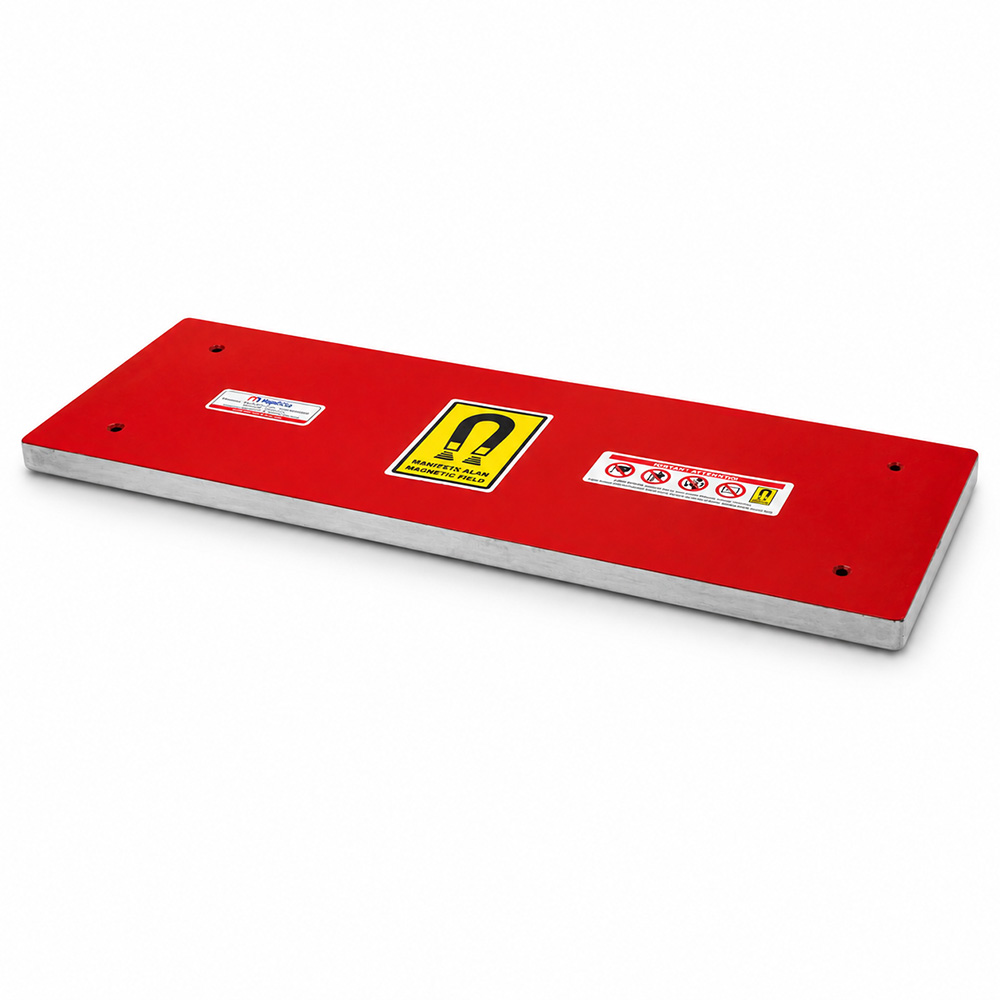
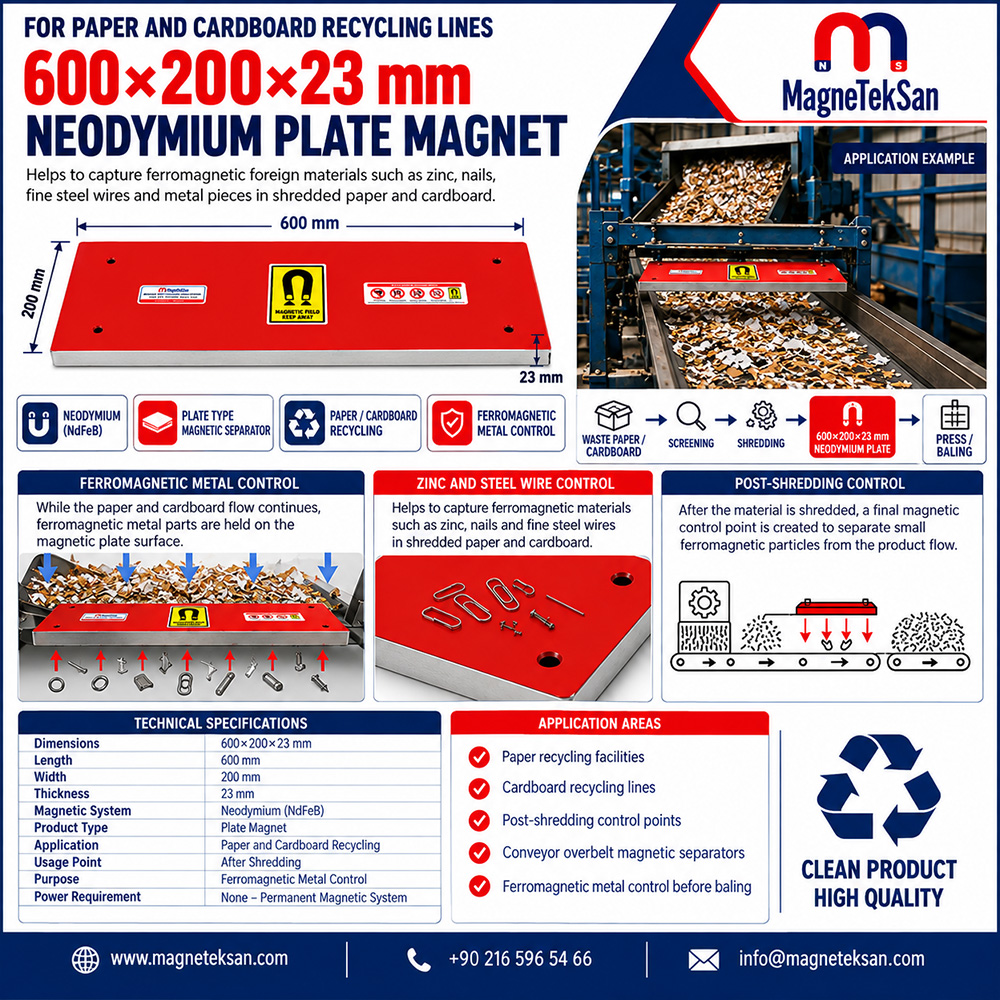
The 600x200x23 mm Neodymium Plate Magnet is designed to help capture ferromagnetic metal contaminants in paper, cardboard and corrugated board recycling lines. Its 600×200 mm magnetic working face and compact 23 mm thickness make it suitable for evaluation at compatible conveyor, chute and material transfer points, particularly after shredding and before baling. The permanent neodymium (NdFeB) magnetic system helps retain suitable steel staples, paper clips, wires and iron fragments without requiring electrical power to generate the magnetic field.
| Technical Specification | Value |
|---|---|
| Product Type | Neodymium Plate Magnet |
| Overall Dimensions | 600x200x23 mm |
| Length | 600 mm |
| Width | 200 mm |
| Thickness | 23 mm |
| Magnetic Material | Neodymium (NdFeB) |
| Magnetic System | Permanent Magnet |
| Main Application | Paper and Cardboard Recycling |
| Compatible Material Types | Waste Paper, Cardboard and Corrugated Board |
| Typical Process Stage | After Shredding / Before Baling |
| Typical Installation Area | Conveyor, Chute or Material Transfer Point |
| Magnetic Working Face | 600×200 mm |
| Primary Function | Ferromagnetic Metal Contamination Control |
| Target Contaminants | Ferromagnetic Staples, Paper Clips, Steel Wire and Iron Fragments |
| Inspection and Cleaning | Periodic Surface Inspection and Cleaning |
| Electrical Power Requirement | Not Required to Generate the Magnetic Field |
Extra Information
1. Why Is Magnetic Separation Important in Paper and Cardboard Recycling?
Paper and cardboard recycling involves collecting, sorting, shredding, conveying and processing waste materials.
Although the main recyclable materials are cellulose-based, waste paper and cardboard can contain foreign objects such as steel staples, paper clips, metal wires and iron fragments.
Some metal contaminants originate from packaging and office materials, while others may enter the product stream through equipment wear or maintenance activities.
The 600x200x23 mm Neodymium Plate Magnet provides an additional point of control for suitable ferromagnetic contaminants in recycling lines.
2. What Is a 600x200x23 mm Neodymium Plate Magnet?
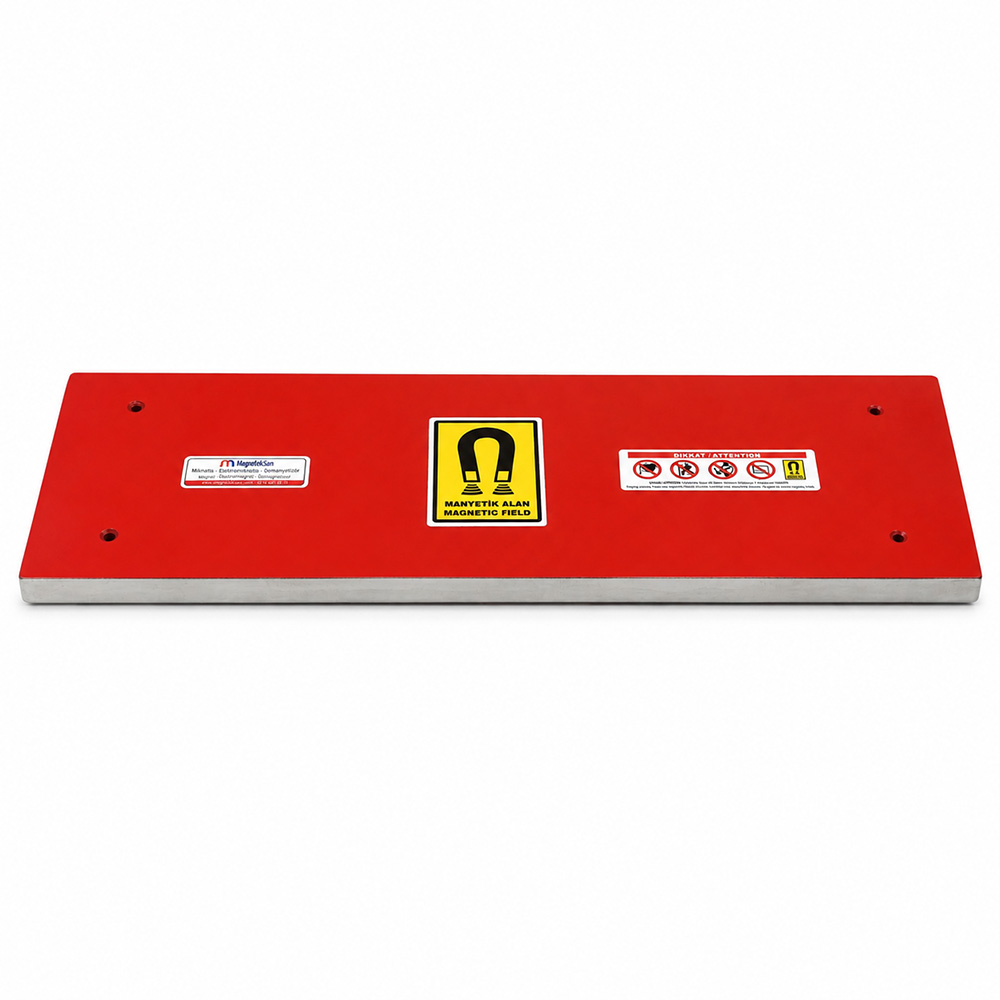
The 600x200x23 mm Neodymium Plate Magnet is an industrial permanent magnetic separator intended for ferromagnetic metal contamination control.
It has a length of 600 mm, a width of 200 mm and a thickness of 23 mm.
The magnetic system uses neodymium (NdFeB) permanent magnets and does not require an electrical supply to generate its magnetic field.
The plate can be evaluated for installation near suitable material flow points in paper, cardboard and corrugated board recycling systems.
3. How Does a Neodymium Plate Magnet Work?
The plate generates a permanent magnetic field that can attract suitable ferromagnetic particles passing sufficiently close to its active surface.
When shredded paper or cardboard moves through a compatible conveyor or chute, ferromagnetic foreign objects may be attracted toward the magnetic plate.
The main recyclable material continues through the process, while suitable magnetic contaminants can remain on the plate.
A simplified operating sequence is:
Shredded Paper and Cardboard → Neodymium Plate Magnet → Ferromagnetic Metal Retention → Next Processing Stage
Actual separation performance depends on the properties of the metal contaminants, the distance from the magnetic surface and the conditions of material flow.
4. Why Is a Plate Magnet Useful in Paper and Cardboard Recycling?
Waste paper and cardboard can contain small metal components left over from previous uses.
These may include staples from documents, paper clips, fastening wires and fragments from packaging equipment.
A magnetic plate installed at a suitable material transfer point can help capture ferromagnetic pieces before the material reaches downstream processing equipment.
This can support contamination control and complement other recycling line inspection and maintenance procedures.
5. Why Is Magnetic Separation Considered After Shredding?
Shredding reduces the size of waste paper and cardboard and can expose foreign objects that were previously enclosed within larger pieces of material.
Small ferromagnetic contaminants may then have more opportunities to approach the magnetic surface.
For this reason, installation after shredding is a practical option to evaluate.
An example process arrangement is:
Waste Paper and Cardboard → Sorting → Shredding → Neodymium Plate Magnet → Baling or Further Processing
The final position should be selected according to the actual layout of the recycling facility.
6. Can the Plate Magnet Capture Steel Staples?
Yes, staples made from steel with sufficient ferromagnetic properties can be attracted by the neodymium magnetic system.
Staples are common foreign objects in office paper, packaging and certain cardboard products.
When shredded material passes sufficiently close to the magnetic surface, suitable steel staples may be retained.
However, not all staples have identical material properties, and the magnet cannot be assumed to capture every staple under all operating conditions.
7. Can the Plate Magnet Remove Paper Clips?
Paper clips manufactured from ferromagnetic steel can be attracted to the magnetic plate.
This makes the product relevant to recycling streams containing office paper, mixed paper waste and other materials with metallic fastening components.
The effectiveness of capture depends on the clip material, size, orientation and distance from the plate.
Paper clips made from non-ferromagnetic materials should not be expected to behave in the same way as conventional magnetic steel clips.
8. Can the Magnet Capture Thin Steel Wires?
Thin wires made from ferromagnetic steel can be attracted by a permanent neodymium magnet when they enter a suitable region of the magnetic field.
Such wires may originate from packaging, binding materials or mechanical equipment.
The probability of retention depends on the wire dimensions, magnetic properties, orientation and material flow conditions.
The plate should not be described as capable of capturing every type of wire, particularly when the wire is made from a non-ferromagnetic metal.
9. Does Paper or Cardboard Stick to the Magnet?
Paper and cardboard are not normally ferromagnetic materials.
The purpose of the plate magnet is therefore not to attract the recyclable paper or cardboard itself.
Instead, the system targets suitable ferromagnetic foreign objects mixed into the material stream.
The intended separation principle is:
Paper and Cardboard Flow → Magnetic Attraction of Ferromagnetic Contaminants → Continuation of the Main Material Flow
Mechanical buildup of paper dust or fragments may still occur depending on the installation and operating conditions.
10. Where Should the Magnet Be Installed After a Shredder?
A suitable installation point may be located at the shredder discharge, along a conveyor or at a downstream transfer chute.
The objective is to position the magnetic working surface close enough to the passing material for suitable ferromagnetic particles to experience effective attraction.
The following process arrangement can be considered:
Shredder → Conveyor or Chute → 600x200x23 mm Neodymium Plate Magnet → Baler or Next Process
The correct location depends on the material flow pattern, installation space, working distance and equipment design.
11. Can the Plate Magnet Be Used Before a Baling Machine?
Yes. The plate can be evaluated for ferromagnetic contamination control before paper or cardboard enters a baling machine.
For example:
Shredded Cardboard → Conveyor → Magnetic Control Point → Baling Machine
The magnet may help retain suitable steel staples, clips and iron fragments from the moving material.
Its function is to provide an additional magnetic control point rather than guarantee that the baled material contains no metal.
12. How Can the Magnet Be Used Near a Conveyor?
A plate magnet can be positioned near a suitable conveyor material flow path.
As shredded paper or cardboard travels past the magnetic working face, ferromagnetic pieces that approach sufficiently closely may be attracted.
The installation should account for the conveyor width, material layer thickness, belt speed and available clearance.
The plate’s 600×200 mm face dimensions must be compared with the actual material flow area.
The required mounting arrangement should be established from the installation drawing rather than assumed from the plate dimensions alone.
13. Can the Magnet Be Installed in a Material Chute?
A chute installation can be considered when the mechanical arrangement allows material to pass at a suitable distance from the magnetic surface.
In some applications, the chute geometry may provide a more controlled flow path than a deep layer of material on a conveyor.
This can be relevant for a compact plate magnet with a thickness of 23 mm.
However, the actual working distance, material accumulation and maintenance access must be evaluated before installation.
14. Why Are Material Transfer Points Suitable for Magnetic Control?
Material transfer points often provide accessible locations where recyclable material moves between machines.
Examples include the discharge of a shredder, a conveyor transition and a chute feeding the next processing stage.
A magnetic plate installed at a suitable transfer point can create an additional opportunity to capture ferromagnetic contaminants.
The effectiveness of the arrangement depends on how the material is distributed and how closely contaminants approach the magnetic face.
15. Why Is the Distance Between the Magnet and the Material Important?
Magnetic attraction generally decreases as the distance from the magnetic surface increases.
A ferromagnetic fragment passing close to the plate may experience greater attraction than an otherwise similar fragment passing farther away.
For this reason, the plate should be positioned at a safe and suitable working distance from the material stream.
Important factors include:
- Distance between the plate and the material
- Thickness of the moving material layer
- Size and magnetic properties of contaminants
- Conveyor or material flow speed
- Orientation of the plate relative to the flow
No specific maximum working distance has been verified for this model.
16. How Does Material Layer Thickness Affect Separation?
Shredded paper and cardboard can form uneven or relatively thick layers during conveying.
Metal fragments located deep within a thick material layer may pass farther from the magnetic plate.
This can reduce the opportunity for those fragments to be attracted and retained.
A more controlled and evenly distributed material flow may improve the opportunity for magnetic interaction.
The suitable layer thickness must be evaluated under actual operating conditions.
17. Does Conveyor Speed Affect Magnetic Separation?
Yes. Conveyor speed can influence how long a ferromagnetic contaminant remains within the effective region of the magnetic field.
At higher speeds, the available interaction time may decrease.
The actual effect also depends on particle size, magnetic properties, plate position and material layer thickness.
Therefore, conveyor speed should be considered alongside working distance and the type of contamination.
A guaranteed operating speed has not been specified for this product.
18. What Is the Advantage of the 600 mm Plate Length?
The plate has a confirmed length of 600 mm.
This dimension provides a relatively extended magnetic face for evaluation in compatible conveyor, chute and transfer point installations.
The usable arrangement depends on how the plate is oriented relative to the direction and width of material flow.
A 600 mm plate length does not automatically mean that the product is suitable for every conveyor with a nominal width of 600 mm.
The actual coverage area and mounting geometry must be checked before installation.
19. What Is the Importance of the 200 mm Plate Width?
The confirmed width of the plate is 200 mm.
Together with the 600 mm length, it defines a magnetic face measuring 600×200 mm.
The suitability of this face depends on the material flow path and the orientation of the plate.
Before installation, the available space and the intended coverage of the material stream should be compared with the plate dimensions.
20. What Does the 23 mm Plate Thickness Mean?
This model has a confirmed thickness of 23 mm.
Its relatively compact plate geometry may be useful where installation space is limited and the material can pass close to the magnetic face.
However, this product should not be assumed to provide the same working distance or separation capability as a much thicker suspended magnetic separator intended for larger ferrous scrap.
The appropriate application is the control of suitable ferromagnetic contaminants at a compatible working distance.
No guaranteed magnetic reach or lifting capacity has been verified.
21. Why Is Neodymium Used in the Magnetic System?
Neodymium-iron-boron (NdFeB) is a permanent magnetic material used in many industrial magnetic separation products.
The neodymium system in this plate provides magnetic attraction without continuous electrical excitation.
This can make it suitable for passive magnetic control points in recycling processes.
However, actual magnetic performance depends on the internal magnet arrangement and the overall magnetic circuit design.
The exact magnet grade and magnetic flux density in Gauss have not been confirmed for this product.
22. Does the Neodymium Plate Magnet Require Electricity?
No electrical supply is required to generate the magnetic field because the product uses permanent neodymium magnets.
Unlike an electromagnet, the plate does not depend on continuous electrical excitation to remain magnetic.
This statement applies specifically to magnetic field generation.
The surrounding conveyor, shredder, baler or other processing equipment may still require electrical power.
The plate should not be described as an automatically controlled or self-cleaning magnetic separator without corresponding technical evidence.
23. Which Ferromagnetic Metals Can Be Captured?
The plate is intended to attract particles with suitable ferromagnetic properties.
Examples include:
- Iron fragments
- Carbon steel pieces
- Ferromagnetic steel staples
- Ferromagnetic paper clips
- Steel wire fragments
- Suitable iron-containing wear particles
Retention depends on the dimensions, shape, mass and magnetic characteristics of the contaminant.
No specific minimum particle size or guaranteed capture efficiency has been verified.
24. Can the Plate Magnet Remove Aluminium, Copper or Brass?
Aluminium, copper and brass are not ferromagnetic under normal operating conditions.
They are not attracted by an ordinary permanent magnetic separator in the same way as iron and ferromagnetic steel.
Therefore, the plate should not be advertised as a universal separator for all metals.
Magnetic behaviour also varies among stainless steel grades and metallurgical conditions.
If the recycling process requires removal of non-ferromagnetic metals, additional separation technologies may be needed.
25. Why Is Periodic Cleaning of the Plate Important?
Ferromagnetic contaminants can accumulate on the active magnetic surface during operation.
As the quantity of retained metal increases, newly arriving contaminants may have less opportunity to approach an unobstructed magnetic surface.
The plate should therefore be inspected and cleaned at intervals appropriate to the contamination load.
Before cleaning, the associated equipment must be safely stopped, isolated from hazardous energy sources and protected against unexpected startup.
Permanent magnets remain magnetically active even when the surrounding machinery is switched off.
Cleaning procedures should account for the risk of attraction between the magnet and ferromagnetic tools or components.
26. How Often Should the Magnetic Plate Be Inspected?
There is no universal cleaning interval suitable for every paper and cardboard recycling facility.
The required frequency depends on the metal content of the incoming waste, operating hours, material throughput and the rate at which contaminants accumulate.
During initial operation, more frequent inspections can help establish an appropriate maintenance schedule.
Periodic checks should consider:
- Quantity of accumulated ferromagnetic metal
- Condition of the magnetic working surface
- Mechanical integrity of the plate
- Stability of the installation
- Accessibility for safe cleaning
- Changes in the material flow or contamination load
The inspection schedule should be adjusted according to actual operating conditions.
27. Can a Plate Magnet Replace a Magnetic Drum Separator?
Not necessarily. Plate magnets and magnetic drum separators are different types of equipment.
A plate magnet can provide a localised magnetic control point near a conveyor, chute or material transfer location.
A magnetic drum separator uses a rotating drum arrangement and may be selected for other continuous material handling and separation requirements.
The appropriate choice depends on material characteristics, throughput, contaminant size, working distance and the desired separation arrangement.
For some recycling lines, a combination of different magnetic separation technologies may be appropriate.
28. How Do You Choose the Right Plate Magnet for Paper Recycling?
The selection of a magnetic separator should not be based on plate dimensions alone.
The following factors should be evaluated:
- Type of recyclable material
- Conveyor or chute dimensions
- Thickness of the material layer
- Required hourly throughput
- Material movement speed
- Type of ferromagnetic contaminants
- Approximate size and mass of metal fragments
- Distance between the plate and the material
- Available installation space
- Mechanical mounting requirements
- Safe access for inspection and cleaning
- Position within the recycling process
The confirmed specifications of this model are 600 mm length, 200 mm width, 23 mm thickness, permanent neodymium (NdFeB) magnetic system and intended use in paper and cardboard recycling.
The magnetic field strength in Gauss, magnet grade, housing material, mounting hole dimensions, maximum operating temperature, rated throughput and guaranteed separation efficiency have not been confirmed.
Magneteksan – Magnetic Separation Solutions for Paper and Cardboard Recycling
The 600x200x23 mm Neodymium Plate Magnet can be evaluated as a compact ferromagnetic contamination control point in suitable waste paper, cardboard and corrugated board recycling lines.
Positioned at an appropriate location after shredding and before baling or further processing, it can help retain suitable steel staples, paper clips, wires and iron fragments.
For technical evaluation or a quotation, customers can provide Magneteksan with conveyor dimensions, material layer thickness, operating speed, required throughput, installation drawings and information about the metal contaminants to be captured.
Magneteksan – Industrial Magnetic Separation Solutions for Recycling and Material Processing.