Product Information
Extra Information
Product Information
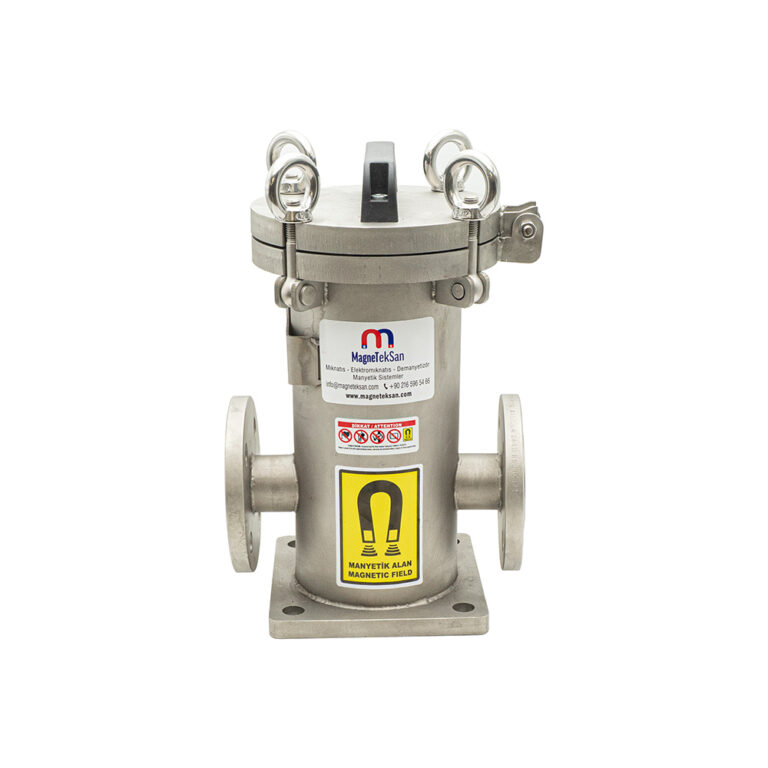
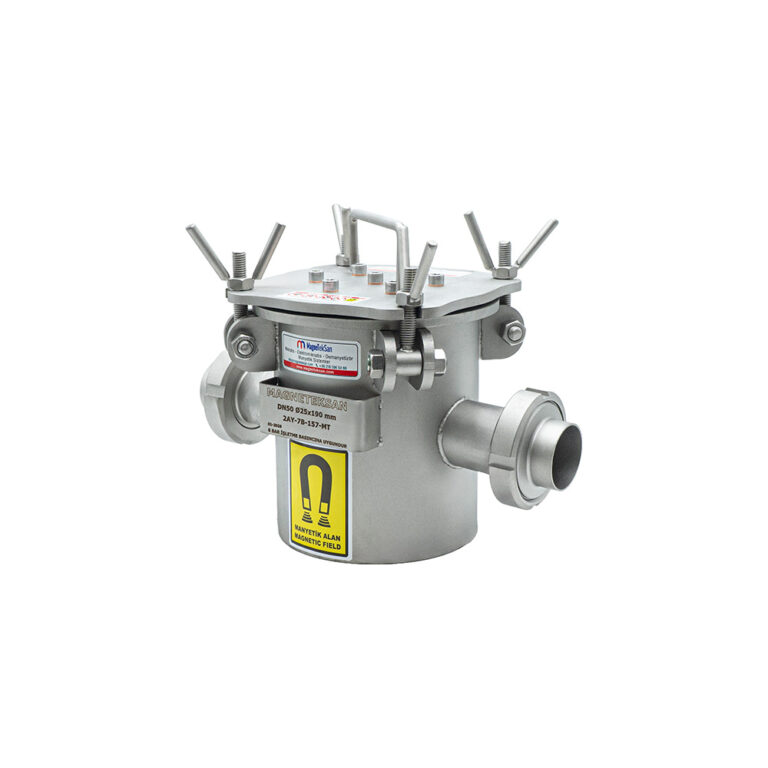
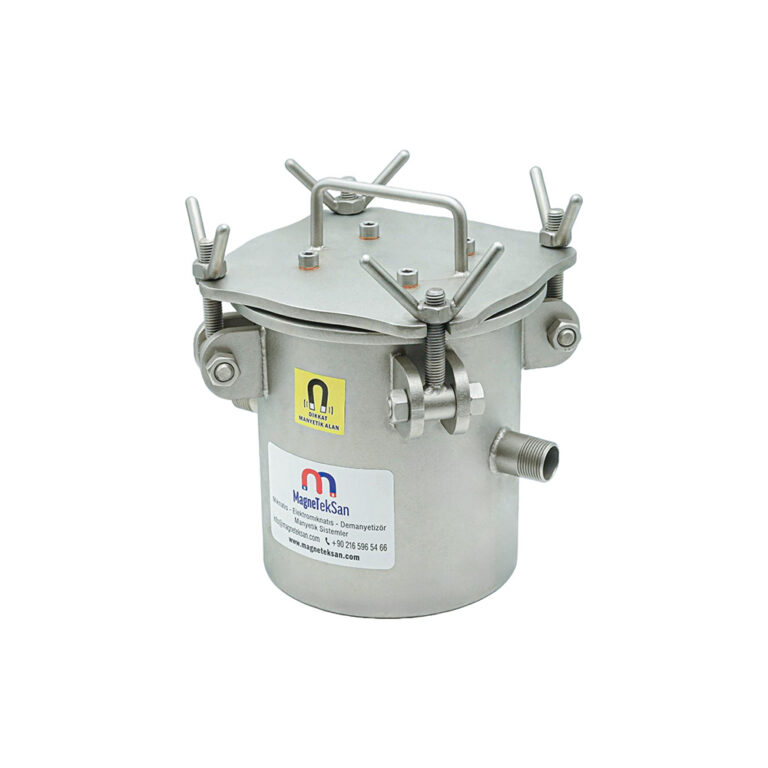
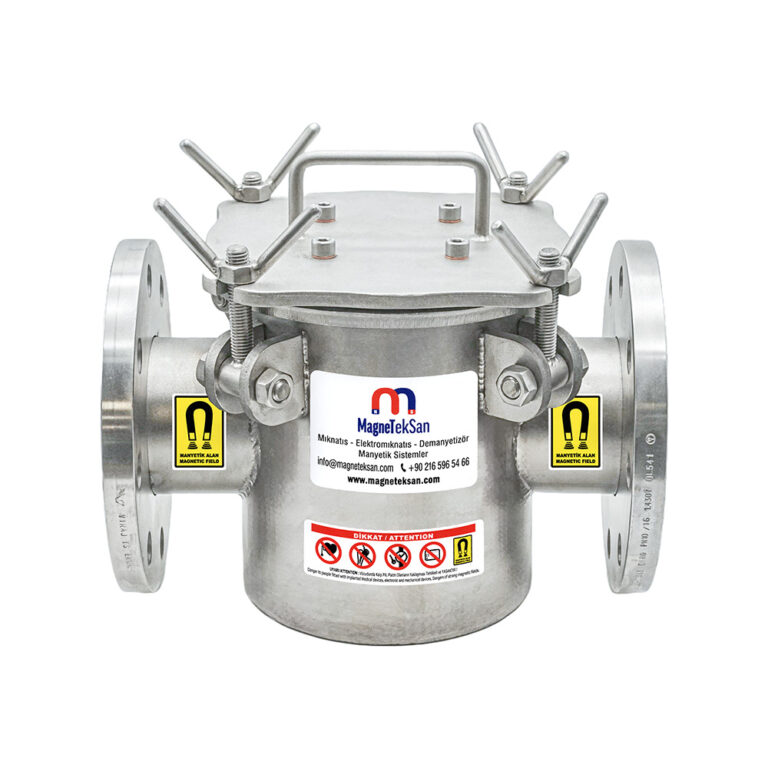
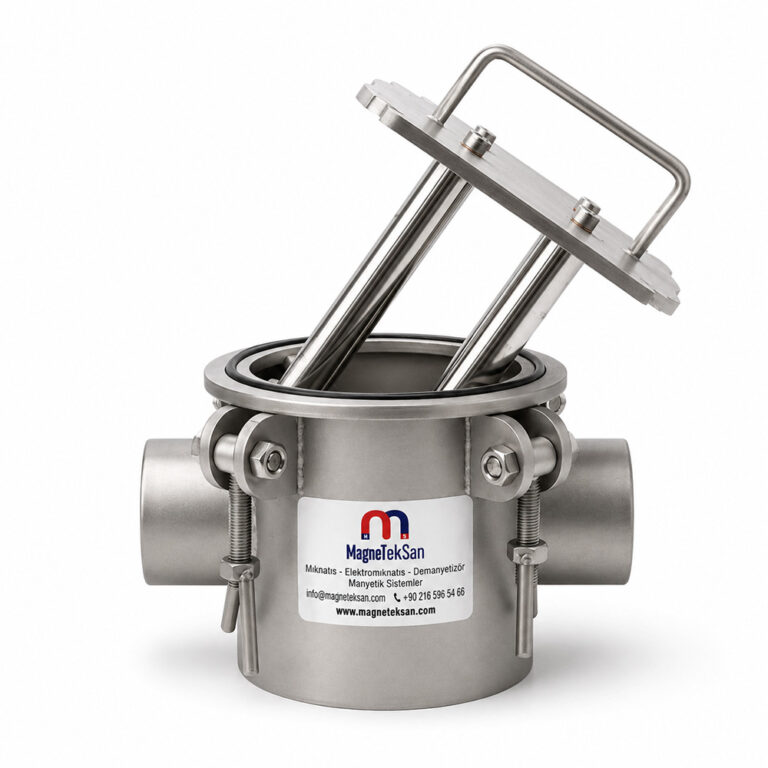
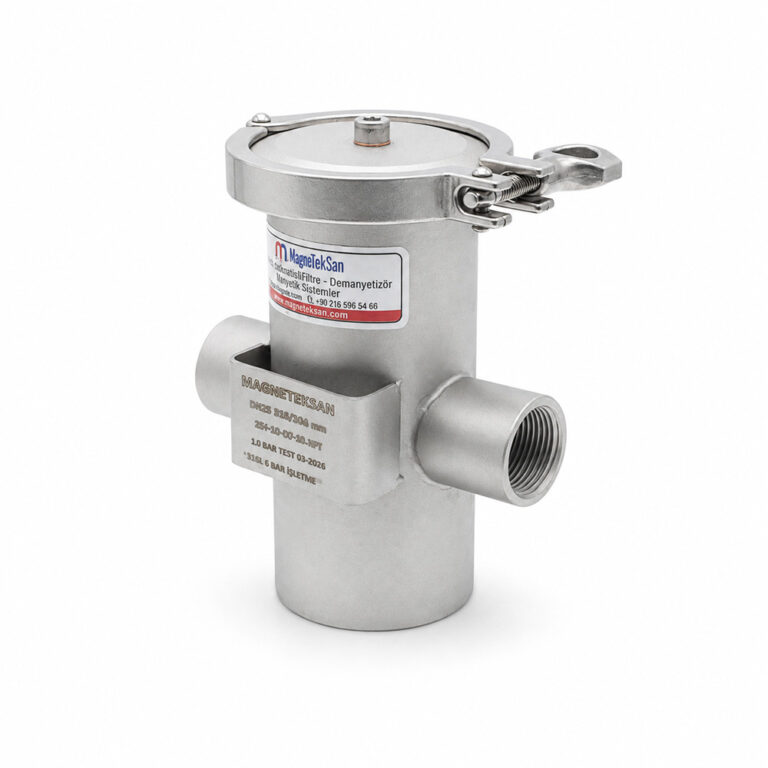
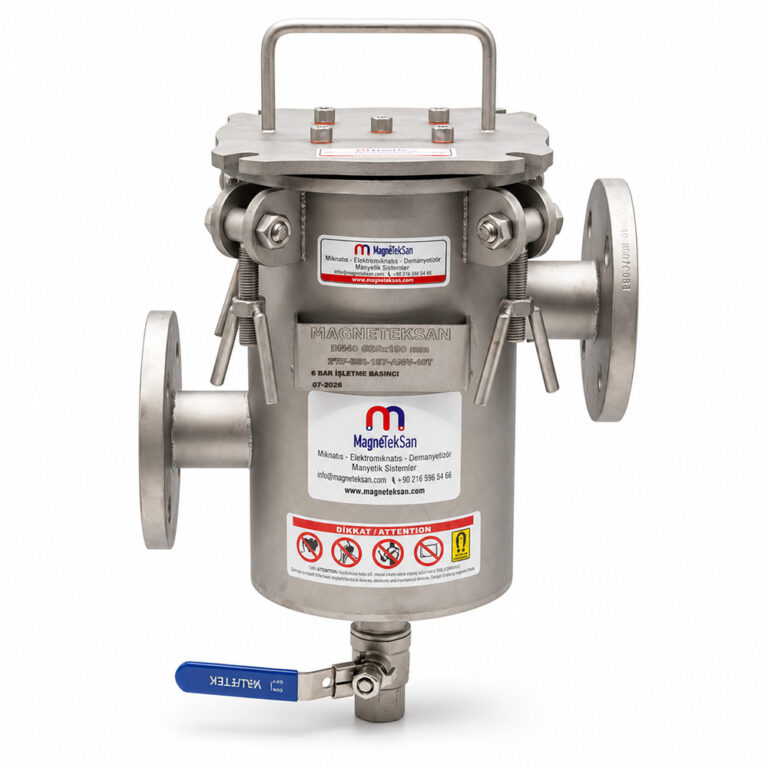
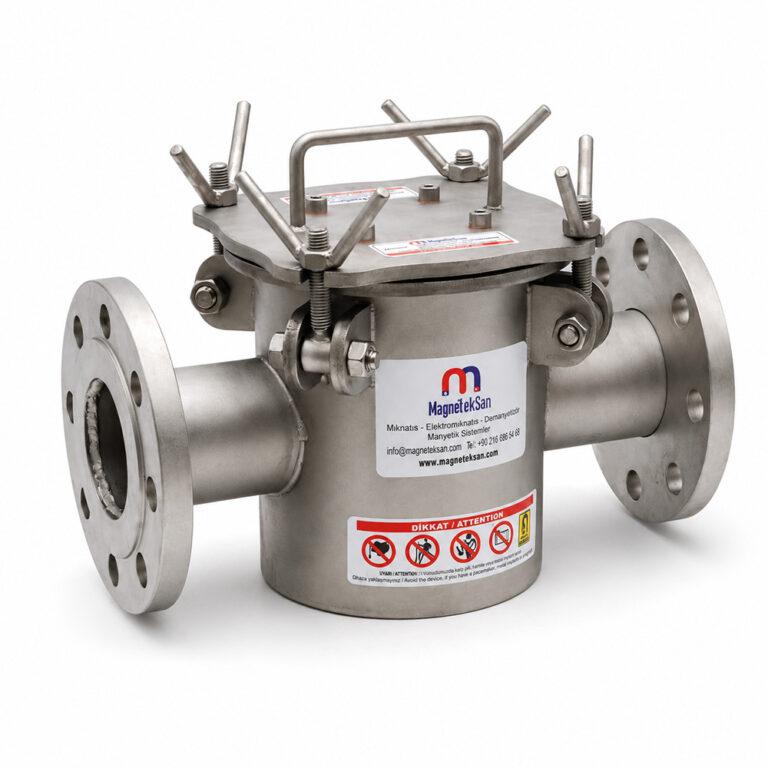
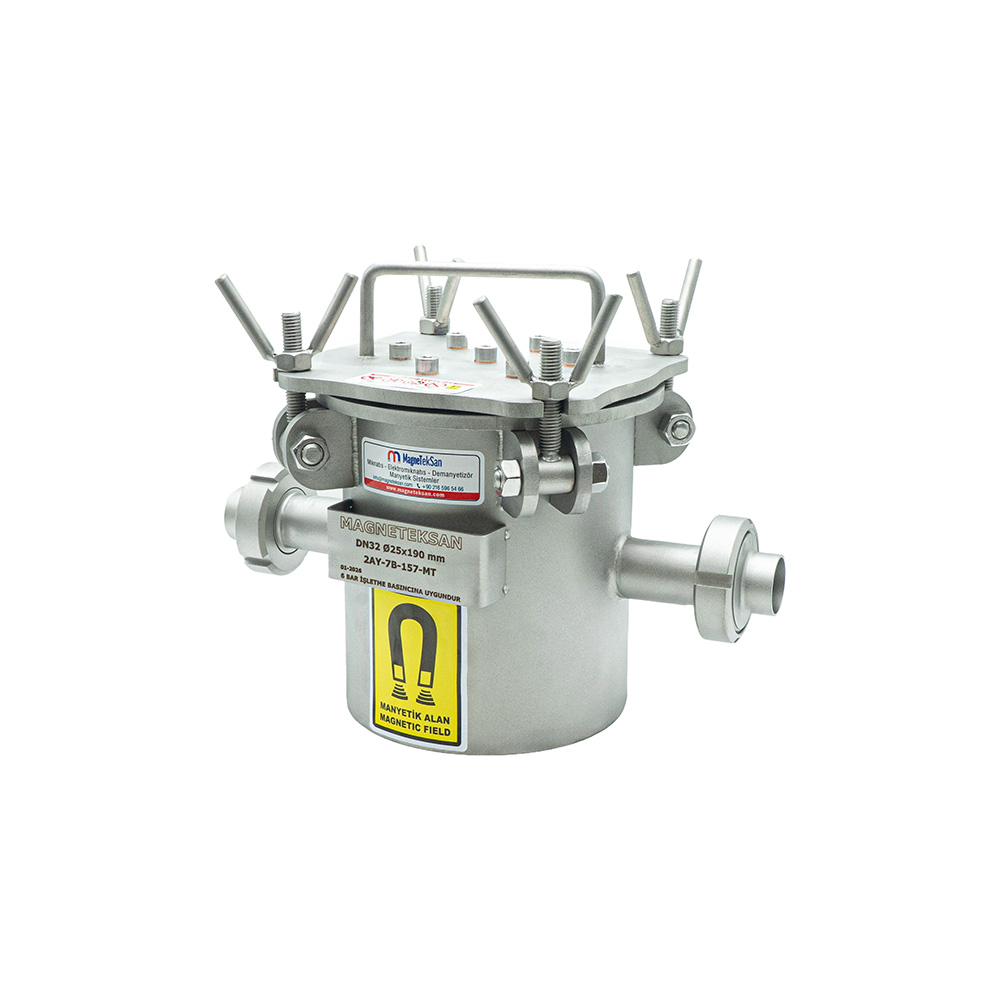
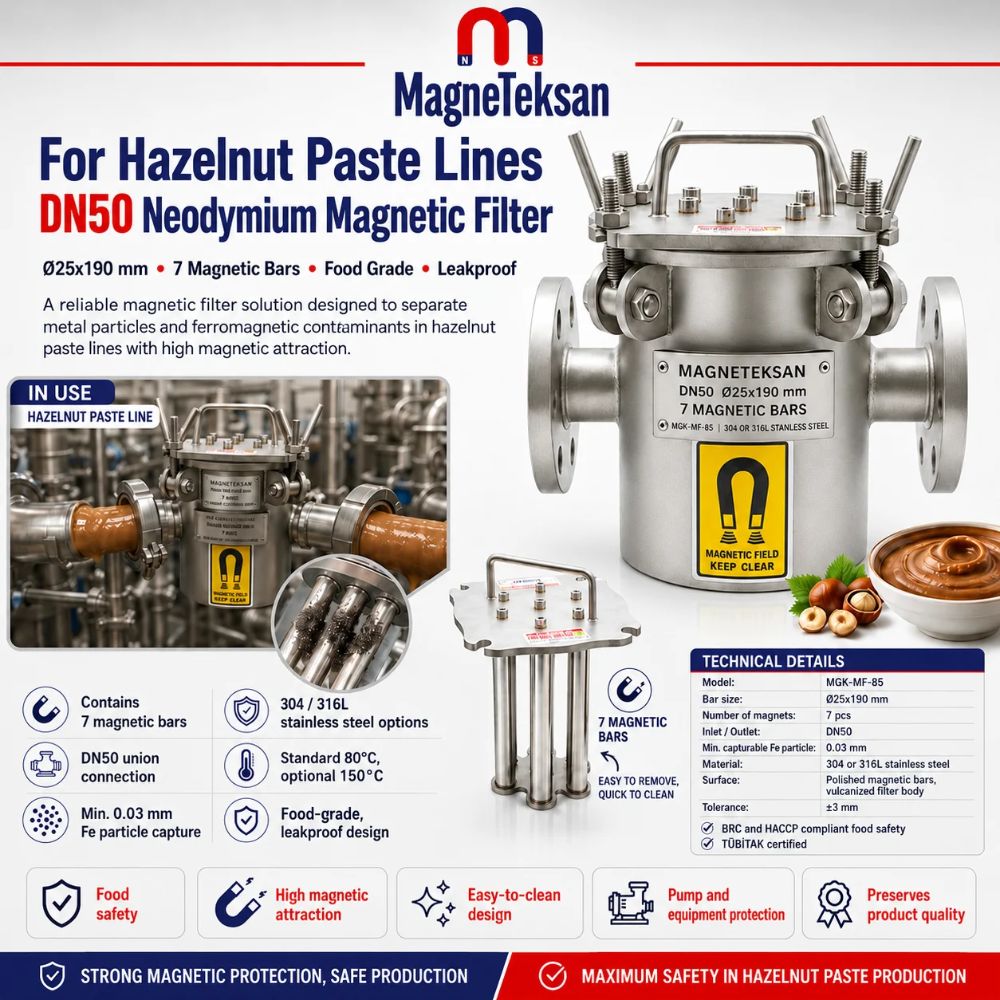
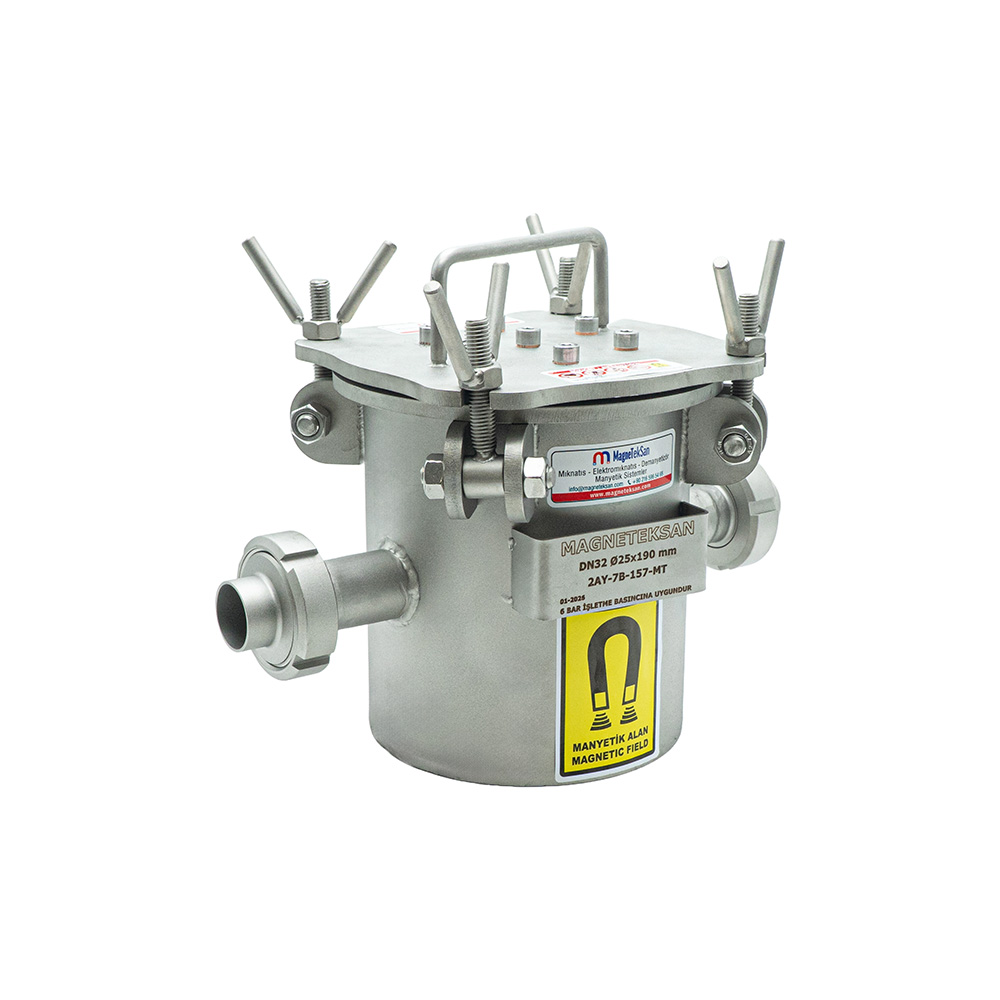
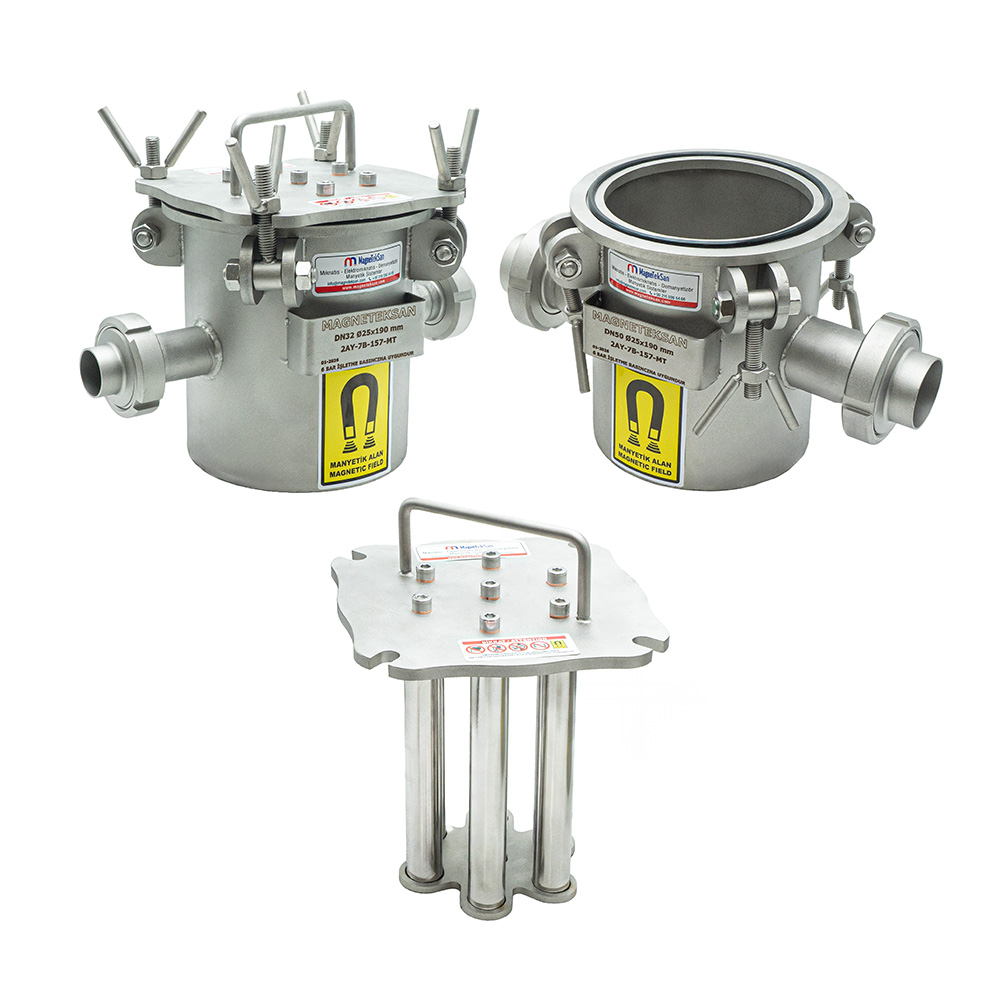
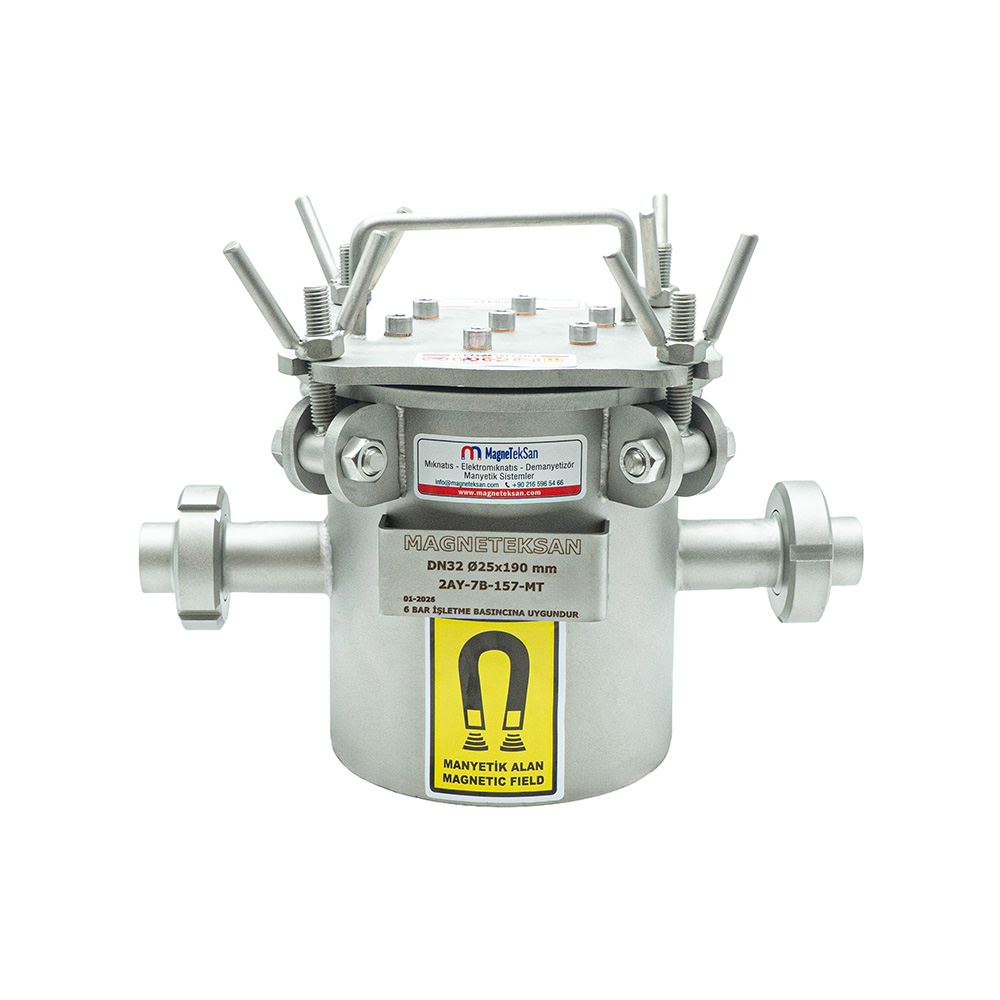
The DN50 Neodymium Magnetic Filter is designed to help remove ferromagnetic metal contamination from hazelnut puree, hazelnut paste and similar viscous food products during processing. Its stainless steel housing contains seven Ø25×190 mm neodymium magnetic rods, providing multiple magnetic collection surfaces as the product flows through the filter. Featuring DN50 union connections and manual cleaning, the filter is available in AISI 304 or AISI 316 stainless steel, with a standard operating temperature of up to 80°C and an optional 150°C version.
| Technical Specification | Details |
|---|---|
| Product Type | Inline neodymium magnetic filter |
| Primary Application | Hazelnut puree and hazelnut paste production |
| Inlet Size | DN50 |
| Outlet Size | DN50 |
| Connection Type | Union connections |
| Magnetic Rod Quantity | 7 |
| Magnetic Rod Dimensions | Ø25×190 mm |
| Magnetic Material | Neodymium (NdFeB) |
| Housing Material | Stainless steel |
| Stainless Steel Options | AISI 304 / AISI 316 |
| Standard Operating Temperature | Up to 80°C |
| Optional Temperature Rating | Up to 150°C |
| Target Contaminants | Ferromagnetic metal particles |
| Indicative Fe Particle Capture | Down to approximately 0.03 mm under suitable process conditions |
| Cleaning Method | Manual |
| Installation | Inline DN50 processing pipeline |
Extra Information
1. DN50 Neodymium Magnetic Filter for Hazelnut Puree Production
The DN50 Neodymium Magnetic Filter is designed for the magnetic separation of ferrous contaminants in hazelnut puree processing lines. It can be installed in a compatible pipeline to provide an additional contamination-control stage.
The filter contains seven neodymium magnetic rods, each measuring Ø25×190 mm. These rods create multiple magnetic collection surfaces inside the stainless steel housing.
As hazelnut puree flows through the filter, suitable ferromagnetic particles can be attracted to the magnetic rods. The remaining product continues through the processing line.
Filter selection should account for product viscosity, operating temperature, flow rate and pressure conditions. The DN50 connection size alone is not sufficient to confirm suitability.
2. Magnetic Separation in Hazelnut Paste Processing
Hazelnut paste production involves several processing operations, including grinding, transfer and mixing. Contact with mechanical equipment can introduce ferromagnetic particles into the product.
An inline magnetic filter helps intercept suitable metallic contamination before it reaches subsequent processing or packaging equipment. Its location should be selected according to the production layout.
The seven-rod configuration provides several magnetic contact surfaces within the filter housing. The actual separation result depends on how the viscous product moves around these surfaces.
Magnetic separation complements equipment maintenance and other foreign-body control measures. It should not be regarded as a complete solution for every type of contamination.
3. DN50 Inline Magnetic Filter Design
The filter features DN50 inlet and outlet connections for installation in compatible process pipelines. Its inline configuration allows the product to pass through a magnetic separation chamber.
Union-type connections are specified for this model. Their compatibility with the existing pipeline and applicable connection standard should be checked before installation.
The housing contains seven Ø25×190 mm magnetic rods. Their arrangement provides magnetic collection surfaces within the product flow path.
Hydraulic suitability must be assessed separately from the nominal connection diameter. Viscosity, flow rate and pressure loss can influence filter performance and system operation.
4. Seven Neodymium Magnetic Rods
This model incorporates seven neodymium magnetic rods inside the filter housing. Each rod contributes an additional magnetic collection surface.
The multi-rod arrangement allows the flowing product to encounter magnetic surfaces at several positions. Ferromagnetic particles passing sufficiently close may be retained.
The number of rods is an important design parameter, but it does not independently establish capture efficiency. Rod placement and the available flow passages also matter.
For viscous hazelnut puree, the relationship between rod arrangement and hydraulic resistance deserves particular attention. A suitable balance is needed between separation and product flow.
5. Ø25×190 mm Magnetic Rod Construction
Each magnetic rod in this model has specified dimensions of Ø25×190 mm. The diameter and length are relevant to the internal arrangement of the separation chamber.
The rods use neodymium magnetic material. Their purpose is to attract suitable ferromagnetic particles from the product stream.
Rod geometry influences the available magnetic collection surfaces and the spaces through which the puree passes. It can also affect cleaning accessibility.
The published product information does not specify a numerical surface Gauss value. Such a value should be obtained from measurements or product-specific documentation rather than assumed.
6. Ferrous Particle Removal from Hazelnut Puree
Hazelnut puree may encounter metallic equipment during crushing, grinding, pumping and transfer. Wear or accidental damage can introduce small ferrous particles.
The magnetic filter is intended to retain suitable ferromagnetic contaminants while the puree flows through the housing. The particles accumulate on the magnetic rods.
The product specification refers to potential capture of Fe particles down to approximately 0.03 mm under suitable process conditions. This is a conditional performance indication, not a universal guarantee.
Particle properties, magnetic response, viscosity and flow conditions all influence actual capture. Process-specific verification is advisable where defined contamination limits apply.
7. Magnetic Filtration After Hazelnut Grinding
Grinding equipment can be a potential source of metallic wear particles in nut processing. A magnetic filter positioned after grinding may provide an additional control stage.
The DN50 filter can be considered for a compatible transfer pipeline downstream of the grinding operation. Installation must be coordinated with the equipment arrangement.
The seven neodymium rods provide surfaces for collecting suitable ferromagnetic particles carried by the puree. Captured contamination should be removed during scheduled cleaning.
Filter installation does not eliminate the need to inspect grinding equipment. Preventive maintenance remains important for reducing the generation of metallic contamination.
8. Magnetic Filtration Before Filling and Packaging
A magnetic filter may be installed before a filling machine when the process layout allows. This provides a separation stage relatively close to the final product packaging operation.
The DN50 union-connected design can be integrated into compatible pipelines. The installation should provide safe access for inspection and manual cleaning.
During operation, the puree flows past seven neodymium rods. Ferromagnetic particles with suitable properties may remain attached to the magnetic surfaces.
Final product safety may require additional inspection methods. Magnetic filtration cannot reliably remove all nonmagnetic metals or other foreign materials.
9. Magnetic Filters for Viscous Food Products
Hazelnut puree and hazelnut paste can have substantially different flow characteristics from water. Their viscosity may vary with temperature, formulation and processing conditions.
The internal geometry of a magnetic filter influences the movement of viscous products through the housing. Excessive restriction can increase pressure loss.
This DN50 model uses seven magnetic rods to provide multiple collection surfaces. Its suitability should be assessed using the actual product and intended operating conditions.
Flow rate and viscosity data are important when specifying an inline filter. A nominal pipe size does not establish the maximum achievable throughput.
10. Magnetic Separation in Nut Butter Production
Nut butter production can involve grinding, mixing and product transfer through metallic equipment. Ferromagnetic contamination may arise from equipment wear or maintenance activities.
An inline magnetic filter can provide an additional separation stage for suitable products. Hazelnut paste is the primary application described for this model.
The seven-rod neodymium assembly helps retain suitable ferrous particles as the product passes through the housing. Cleaning removes accumulated contamination.
Different nut butters may have different viscosities, particle sizes and processing temperatures. Compatibility should therefore be evaluated before applying the same filter to another product.
11. Stainless Steel Magnetic Filter Housing
The filter is manufactured with a stainless steel housing intended for industrial food-processing applications. Stainless steel provides a practical construction material for compatible processing environments.
The product is offered with AISI 304 and AISI 316 stainless steel options. The appropriate material should be selected according to the process and cleaning conditions.
The housing contains the magnetic rod assembly and directs the product through the separation area. Its sealing arrangement must be compatible with the operating conditions.
Stainless steel construction alone does not establish compliance with every food-contact regulation. Material certificates and relevant documentation should be checked where required.
12. AISI 304 and AISI 316 Material Options
AISI 304 is a commonly used stainless steel for many industrial processing applications. It may be appropriate when the product and cleaning environment are compatible with its corrosion resistance.
AISI 316 offers a different corrosion-resistance profile and may be considered for more demanding environments. Material selection should account for cleaning chemicals and process exposure.
Both grades are listed as available options for this DN50 magnetic filter. The selected grade should be specified clearly in the quotation and manufacturing documentation.
Neither material option should be assumed automatically suitable for every chemical or sanitation procedure. Engineering assessment remains necessary.
13. Standard 80°C Operating Temperature
The standard configuration is specified for operating temperatures up to 80°C. This limit is relevant to the magnetic system and overall filter selection.
Hazelnut puree temperature can influence viscosity and therefore the hydraulic behaviour of the production line. Operating conditions should be evaluated together.
The standard temperature rating should not be exceeded without confirming the suitability of the installed configuration. Other components and seals must also be considered.
Where higher temperatures are required, the manufacturer offers an optional configuration. The correct version should be selected before production and installation.
14. Optional 150°C High-Temperature Magnetic Filter
An optional version is available for operating temperatures up to 150°C. This configuration is intended for processes requiring a higher temperature capability than the standard model.
High-temperature operation can affect magnetic materials, sealing components and the characteristics of the processed product. All relevant parts must be specified for the intended conditions.
The optional 150°C capability should not be assumed to apply to every standard filter. It must be explicitly requested and confirmed.
Actual operating temperature, cleaning temperature and exposure duration should be provided during technical evaluation. These details help define the appropriate configuration.
15. Manual Cleaning of the Magnetic Filter
The DN50 filter is designed for manual cleaning. Ferromagnetic particles collected on the magnetic rods must be removed periodically.
Before cleaning, the production line should be stopped and safely isolated. Pressure and temperature conditions must be addressed according to site procedures.
Collected particles should be removed without returning them to the product stream. The magnetic rods and accessible surfaces should also be inspected for damage.
Cleaning frequency depends on contamination levels, operating hours and production conditions. Initial inspections can help establish a suitable maintenance interval.
16. Union Connections for DN50 Pipelines
The product is specified with union-type inlet and outlet connections. These connections are intended to facilitate installation in compatible DN50 pipelines.
The exact union geometry and mating components should be confirmed before manufacturing or installation. A nominal DN50 designation alone does not define every connection dimension.
Connection selection should account for the existing pipework, sealing requirements and maintenance access. Incorrect mating components can cause installation or sealing problems.
The filter should be supported appropriately to avoid imposing excessive loads on the connections. Installation must follow the applicable mechanical and process safety requirements.
17. Ferromagnetic Contamination from Processing Equipment
Industrial food-processing equipment contains moving and stationary metallic components. Wear, damage and maintenance activities can create potential sources of ferrous contamination.
Grinding machines, pumps, mixers and transfer systems are among the equipment that may be involved in hazelnut puree production. The actual contamination risk depends on the installation.
The magnetic filter can retain suitable ferromagnetic particles that reach its separation chamber. The seven neodymium rods provide collection surfaces for this purpose.
Magnetic filtration does not repair the source of contamination. Equipment inspection and preventive maintenance should remain part of the control strategy.
18. Magnetic Filters Compared with Metal Detectors
A magnetic filter physically attracts and retains suitable ferromagnetic particles. Contamination remains on the magnetic rods until it is removed during cleaning.
A metal detector uses a different detection principle and may identify certain metallic contaminants that are not effectively captured by a magnetic filter.
Nonmagnetic metals, including aluminium and copper, are not reliably removed by neodymium magnetic filtration. The filter therefore cannot replace every metal-detection function.
The two technologies may be used as complementary controls. Their selection depends on the contaminants of concern, product properties and production requirements.
19. Magnetic Rod Quantity and Separation Performance
The seven-rod design provides multiple magnetic surfaces inside the DN50 filter housing. This increases the number of potential contact locations within the flow path.
The effectiveness of the arrangement depends on the distribution of product flow around the rods. Viscous materials can behave differently from low-viscosity liquids.
Rod quantity alone does not establish a guaranteed removal percentage. Magnetic field distribution, particle characteristics and hydraulic conditions must also be considered.
Where performance requirements are critical, validation under representative production conditions is advisable. The assessment should reflect the actual product and contamination risks.
20. Product Viscosity and Magnetic Filter Selection
Viscosity is an important consideration when selecting a filter for hazelnut puree. It influences flow behaviour and the pressure needed to move the product through the system.
The internal magnetic rod assembly introduces surfaces and passages within the filter housing. Their interaction with viscous products can affect pressure loss.
Temperature changes may alter the viscosity of hazelnut paste. The filter should therefore be evaluated across the intended operating range.
Engineering selection should use actual viscosity and flow information rather than relying only on the DN50 connection size. This helps avoid unsuitable hydraulic configurations.
21. Flow Rate and Pressure Loss Considerations
The maximum flow rate of this specific filter is not stated in the published product specification. It should not be inferred from the connection size alone.
Flow rate, product viscosity and internal geometry collectively influence pressure loss. These parameters are especially relevant for thick food products.
The pressure rating of the filter is also not specified in the available product information. The operating and maximum system pressures should be confirmed before final selection.
A technical assessment can establish whether the proposed configuration is suitable for the intended pumping system. This is important for stable operation and mechanical safety.
22. Installation in Pumped Food Processing Lines
Hazelnut puree is often transferred through processing equipment using pumps. An inline magnetic filter can be considered at an appropriate location within such a system.
Potential positions include transfer lines, tank connections and sections before filling equipment. The correct position depends on the layout and contamination-control objectives.
The filter must be compatible with the system’s operating pressure, temperature and product characteristics. Maintenance access should also be included in the installation plan.
A magnetic filter should not be installed solely on the basis of its nominal DN size. The complete process conditions require engineering review.
23. Magnetic Filtration for Praline and Nut Creams
Praline and nut cream production may involve viscous mixtures containing ground nuts, fats and other ingredients. Some formulations may be compatible with inline magnetic filtration.
The DN50 hazelnut puree filter can be considered as a reference design for related applications. Suitability for each formulation must be evaluated separately.
The neodymium rods are intended to capture suitable ferromagnetic particles, not to remove nonmagnetic ingredients or perform particle-size screening.
Product viscosity, temperature and cleaning requirements should be supplied during the selection process. These factors influence both separation and hydraulic performance.
24. Indicative Capture of Fine Fe Particles
The product description identifies the potential capture of iron particles down to approximately 0.03 mm under suitable process conditions. This is a conditional technical statement.
The actual ability to retain a particle depends on its magnetic properties, geometry, location in the flow and exposure to the magnetic field.
The 0.03 mm indication should not be interpreted as a guaranteed removal threshold for every particle or operating condition. Verification may be required for critical applications.
A process-specific test can provide more relevant evidence of performance than a nominal particle-size figure alone. Testing should reflect the actual product and operating parameters.
25. Maintenance and Inspection of the Filter Housing
Regular inspection helps maintain the condition of the magnetic filter. Important checks include the housing, connection areas, magnetic rods and accessible sealing surfaces.
Collected metallic contamination should be removed before excessive accumulation occurs. Cleaning intervals can be adjusted according to observed contamination levels.
The quantity and type of collected particles may also provide useful information about upstream equipment condition. Unusual increases should be investigated.
Maintenance should follow appropriate isolation, pressure-release and temperature-safety procedures. The filter should only be returned to service after proper reassembly and inspection.
26. Custom Magnetic Filters for Food Production Lines
Food production facilities may use different pipe sizes, connection arrangements and operating temperatures. A standard configuration may not be suitable for every installation.
Magneteksan offers custom magnetic filter designs for different process requirements. Potential variations include connection types, magnetic rod arrangements and stainless steel options.
The seven-rod DN50 model is a specific configuration. Different designs should be defined and quoted separately rather than assumed to have identical specifications.
To evaluate a custom filter, relevant information includes product type, viscosity, flow rate, pressure, temperature and connection details. These inputs support appropriate engineering selection.
27. Verified Specifications and Technical Limitations
The confirmed product specifications include DN50 inlet and outlet connections, seven Ø25×190 mm neodymium rods and union-type connections. AISI 304 and AISI 316 stainless steel options are available.
The standard operating temperature is up to 80°C, with an optional high-temperature version rated up to 150°C. Manual cleaning is part of the product design.
The product information does not establish a specific Gauss value, maximum throughput, pressure rating or exact housing dimensions for this seven-rod configuration. These values require separate confirmation.
Fine Fe particle capture down to approximately 0.03 mm is described only for suitable process conditions. Actual performance should be assessed for the intended application.
28. Engineering Selection and Long-Term Operation
Selecting a DN50 magnetic filter for hazelnut puree production begins with understanding the complete processing system. Product viscosity, flow rate, temperature, pressure and contamination risks are key inputs.
The seven neodymium rods provide multiple magnetic collection surfaces inside the stainless steel housing. Their purpose is to retain suitable ferromagnetic particles while the product passes through.
Long-term operation requires manual cleaning, routine inspection and appropriate maintenance. Changes in formulation or processing conditions may require reassessment of the filter.
Magnetic filtration should be integrated into a broader foreign-body control strategy. Correct specification, installation and operational verification help support reliable production.