Product Information
Extra Information
Product Information
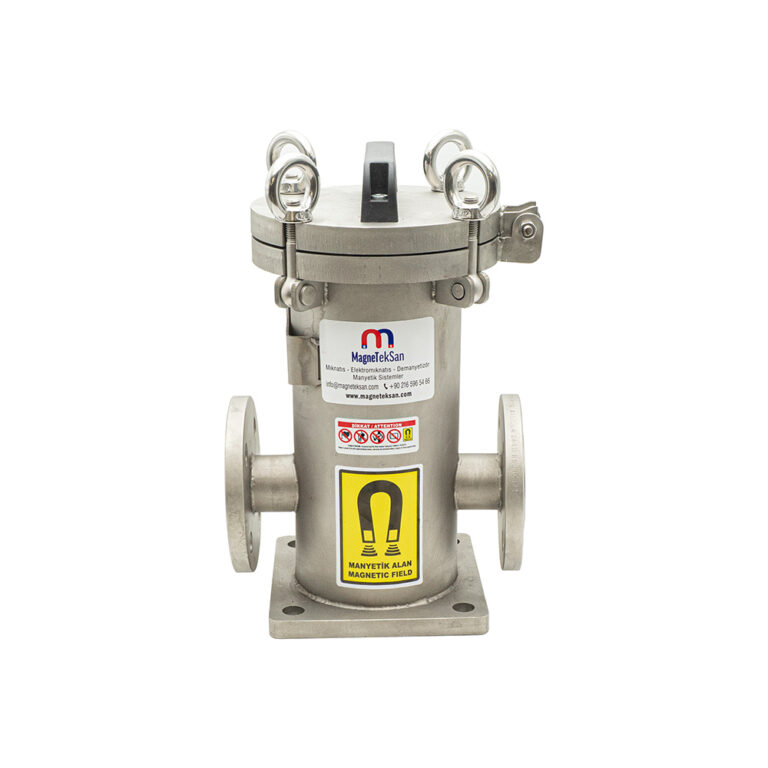
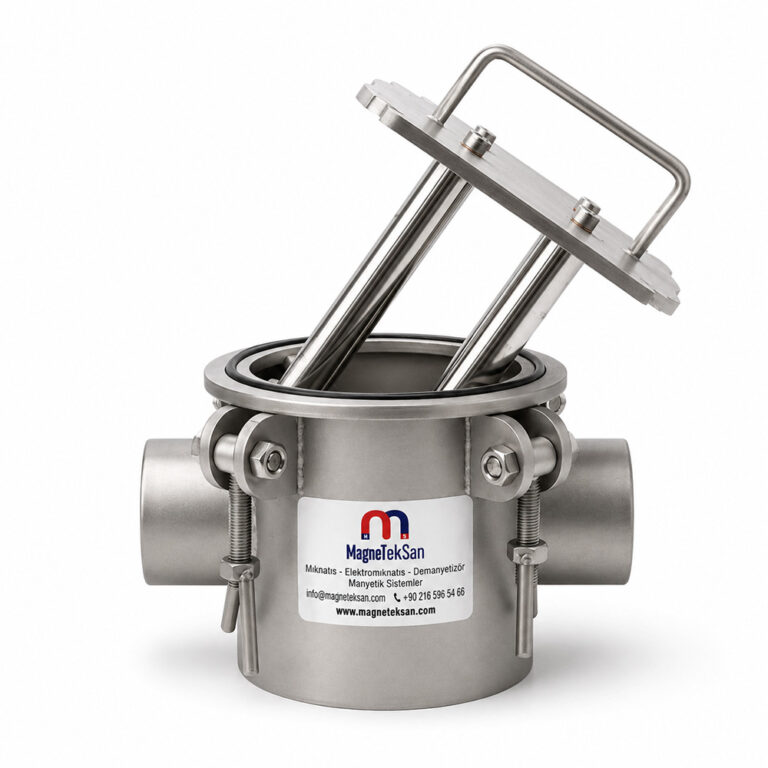
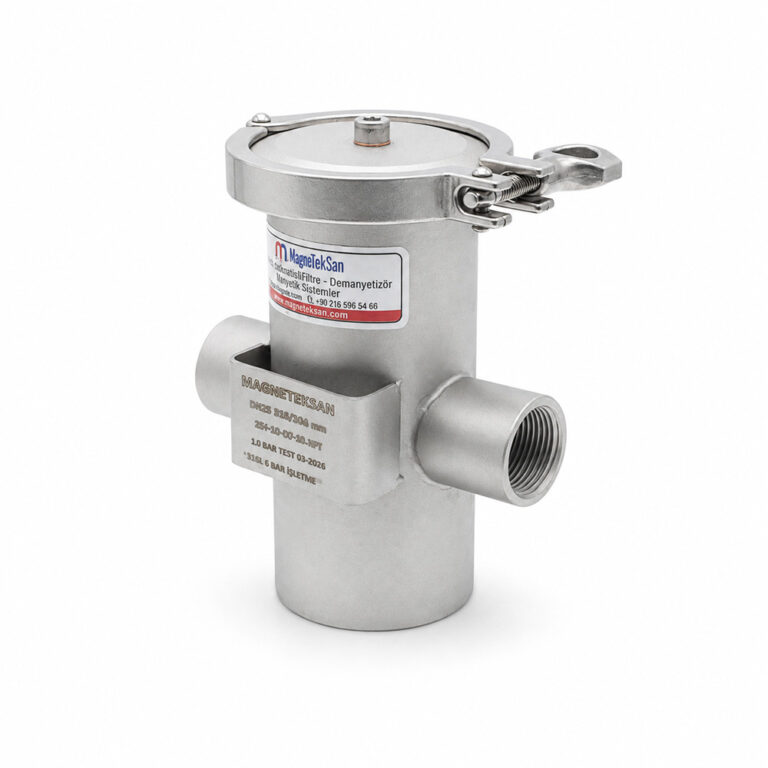
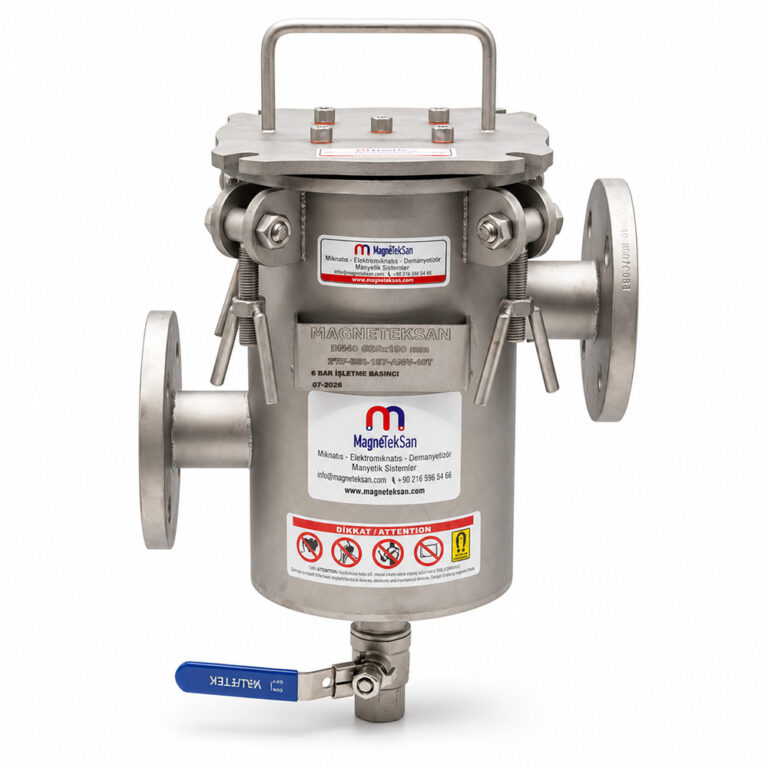
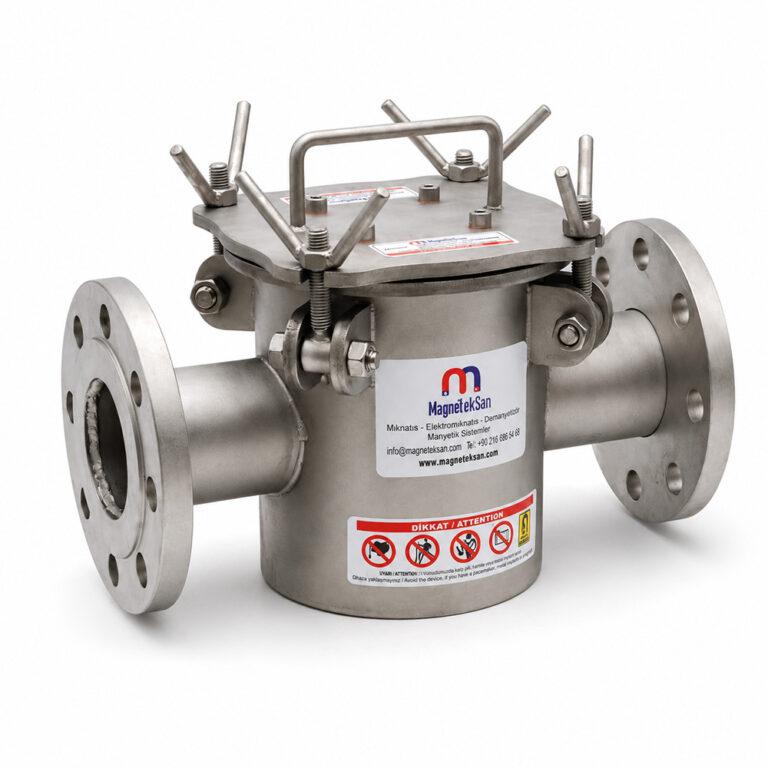
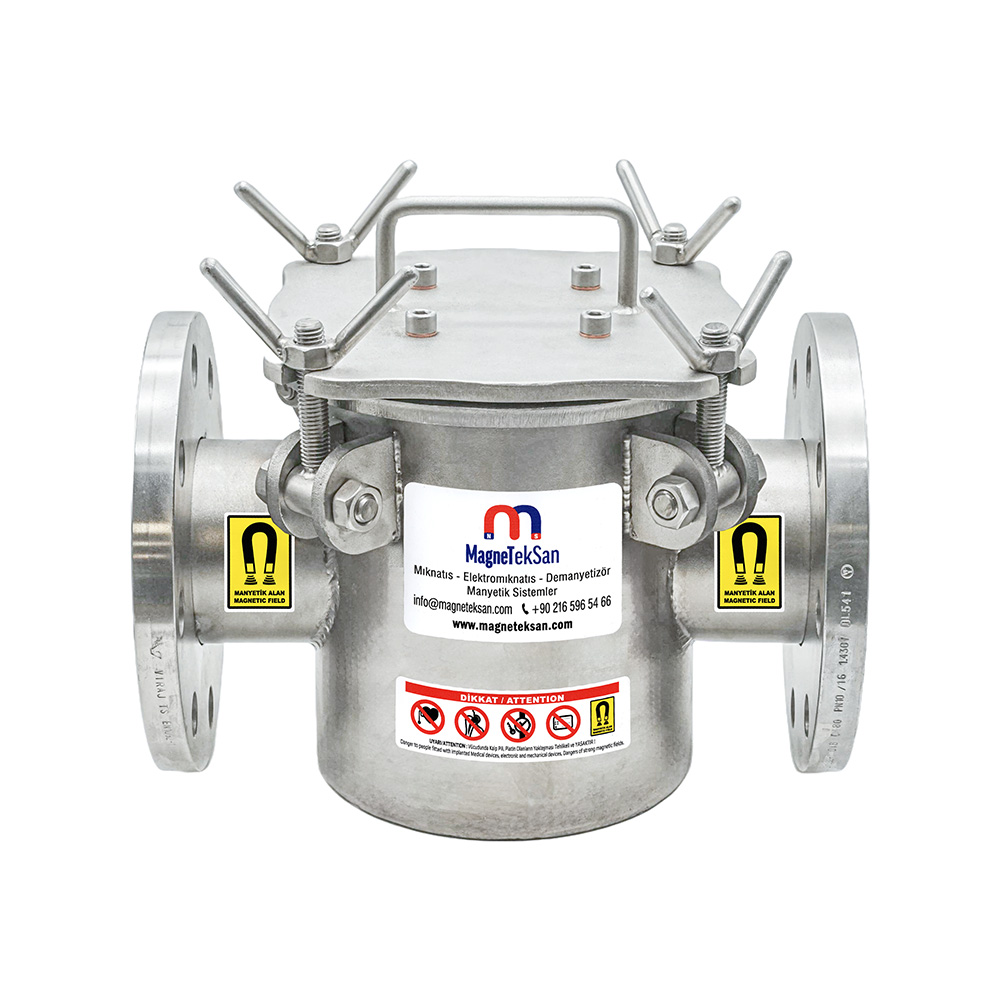
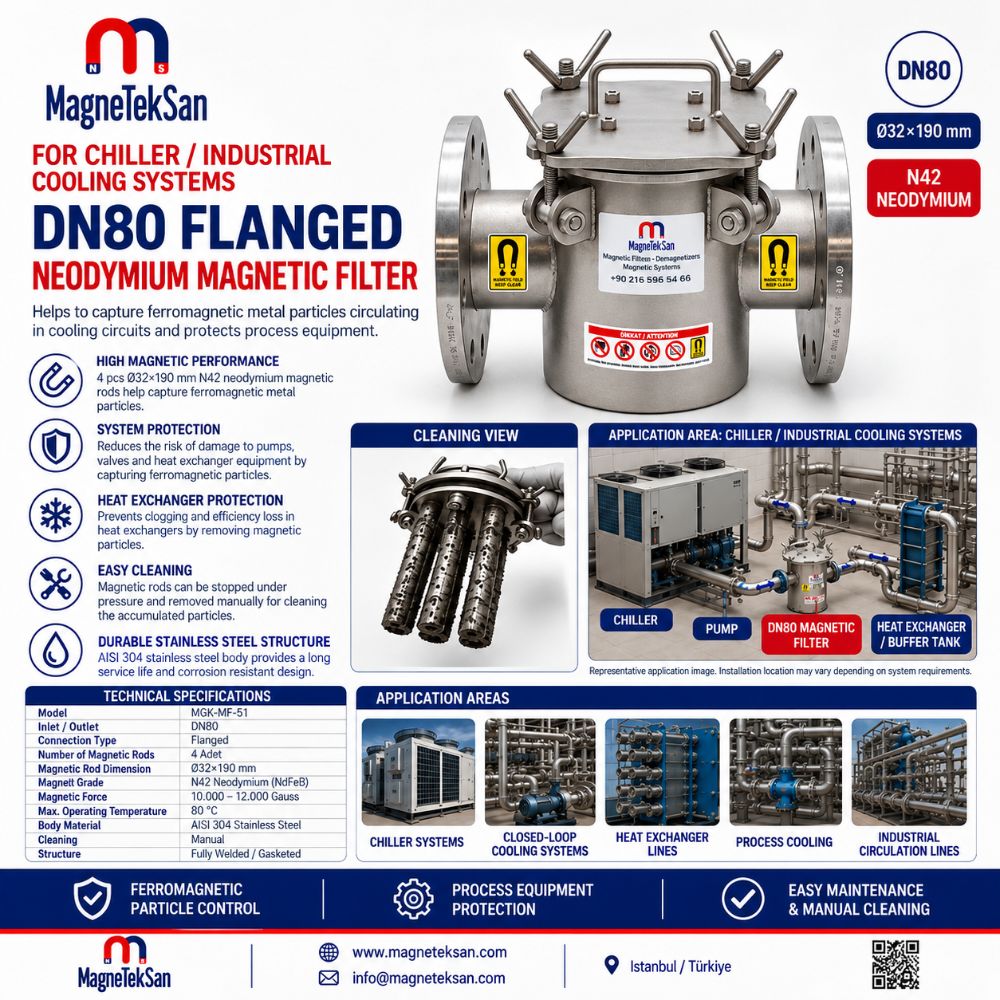
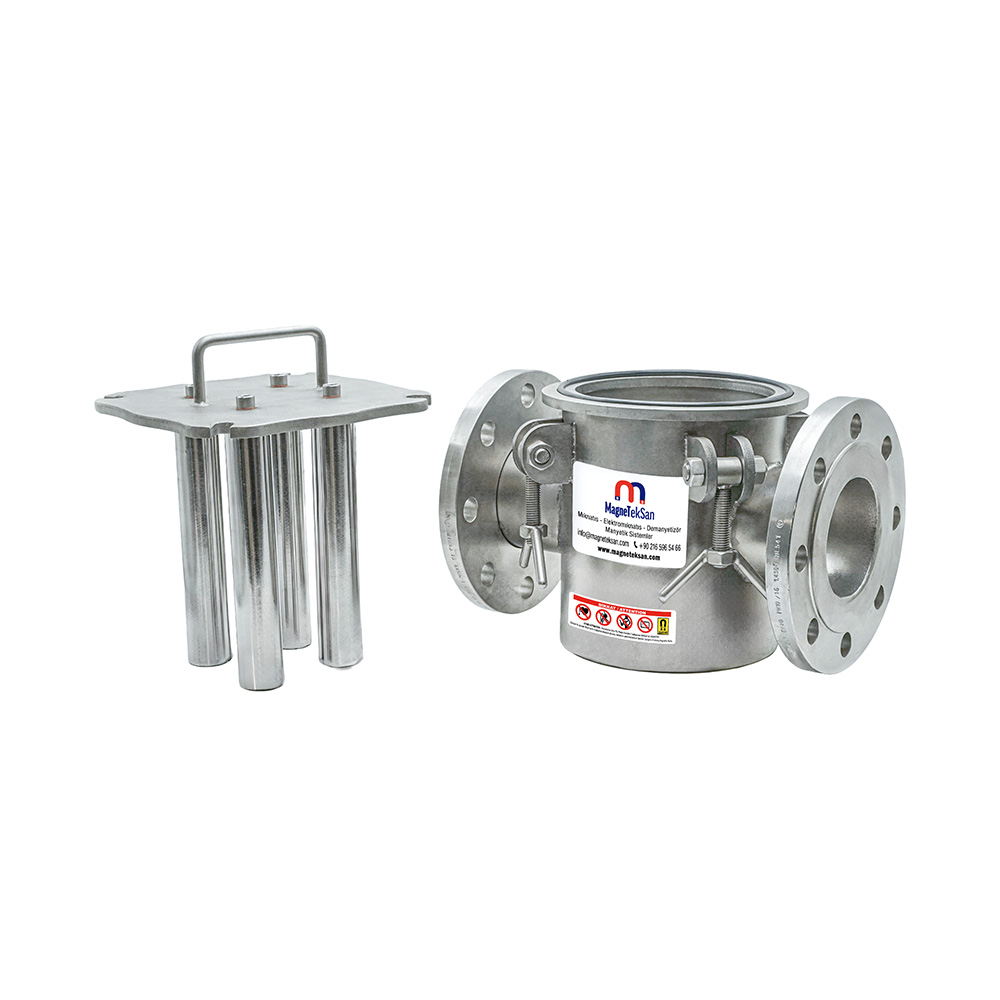
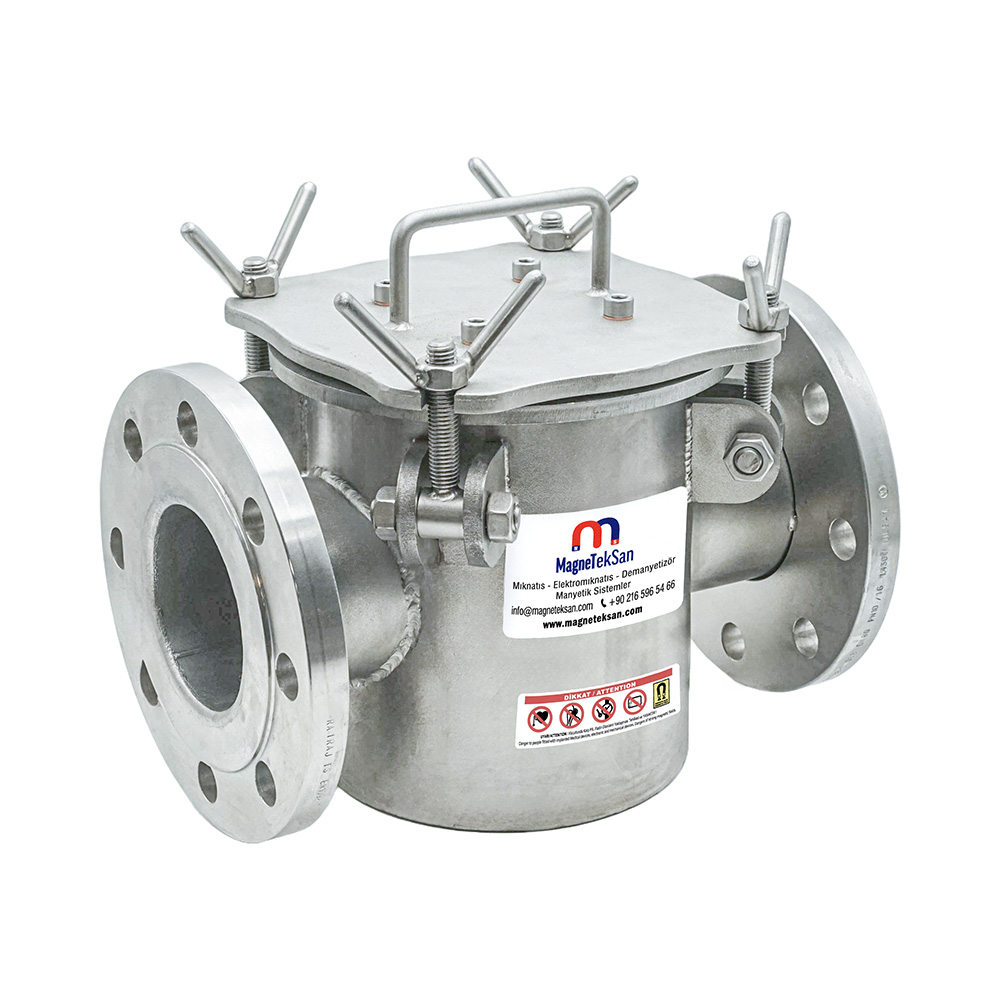
The DN80 flanged neodymium magnetic filter is designed to capture ferromagnetic contaminants circulating in industrial chiller and closed-loop cooling water systems. It incorporates four Ø32×190 mm N42 neodymium magnetic rods generating a specified magnetic field of 10,000–12,000 Gauss to help retain magnetite, iron oxides and ferrous wear particles. Its AISI 304 stainless steel housing, DN80 flanged connections and manually cleanable magnetic assembly support integration into compatible industrial cooling circuits.
| Technical Specification | Value |
|---|---|
| Product Model | MGK-MF-51 |
| Product Type | Neodymium Magnetic Filter |
| Main Application | Chiller and Cooling Water Lines |
| Inlet Connection | DN80 |
| Outlet Connection | DN80 |
| Connection Type | Flanged |
| Magnetic Rod Quantity | 4 |
| Magnetic Rod Dimensions | Ø32×190 mm |
| Magnetic Material | Neodymium (NdFeB) |
| Magnet Grade | N42 |
| Magnetic Field Strength | 10,000–12,000 Gauss |
| Maximum Operating Temperature | 80°C |
| Housing Material | AISI 304 Stainless Steel |
| Minimum Capturable Fe Particle Size | 0.03 mm |
| Surface Finish | Polished Rods / Sandblasted Housing |
| Cleaning Method | Manual |
Extra Information
1. DN80 Magnetic Filter for Industrial Chiller Systems
The DN80 magnetic filter is designed for industrial chiller installations where cooling water continuously circulates through pipelines, pumps and temperature-control equipment. Its principal function is to help remove ferromagnetic contaminants from the circulating liquid.
The MGK-MF-51 model incorporates a flanged DN80 inlet and outlet, allowing integration into appropriately designed industrial cooling circuits. Connection compatibility must be verified against the existing pipeline and flange specifications.
Four N42 neodymium magnetic rods are positioned inside the filter housing to attract magnetically responsive particles. Their Ø32×190 mm dimensions provide magnetic collection surfaces within the flowing water.
The filter is intended to supplement cooling-water cleanliness management rather than replace conventional water treatment. Its effectiveness depends on the magnetic properties of the contaminants, operating flow conditions and maintenance practices.
2. Neodymium Magnetic Filtration in Cooling Water Pipelines
Neodymium magnetic filtration uses permanent magnetic elements to capture ferromagnetic particles transported by circulating water. The separation process does not require an electrically energized magnetic coil.
The MGK-MF-51 filter contains N42 neodymium magnets with a specified magnetic field strength of 10,000–12,000 Gauss. This magnetic field attracts suitable iron-containing particles toward the rod surfaces.
As cooling water passes through the housing, particles sufficiently influenced by the magnetic field can migrate toward the collection surfaces. The captured material remains attached until the magnetic assembly is cleaned.
Magnetic separation does not reliably remove nonmagnetic contaminants such as plastic, sand or copper particles. Additional mechanical filtration may be required where the water contains mixed particulate contamination.
3. DN80 Flanged Magnetic Filter Connection Design
The DN80 flanged connection enables the magnetic filter to be installed directly within a compatible industrial pipeline. Flanged assemblies provide a detachable connection arrangement for maintenance and equipment replacement.
Both inlet and outlet connections are specified as DN80. The nominal connection size must be considered alongside the actual flange dimensions, sealing arrangement and pipeline configuration.
Before installation, the mating flanges, gasket material and fastening components should be checked for compatibility. A DN80 designation alone does not establish the applicable flange standard or pressure rating.
Proper installation should avoid imposing excessive pipe loads on the filter housing. Adequate pipeline support and correctly aligned connections are important for maintaining sealing integrity.
4. Four Ø32×190 mm Neodymium Magnetic Rods
The MGK-MF-51 magnetic filter contains four neodymium magnetic rods, each measuring Ø32×190 mm. These dimensions are specific to the product and distinguish it from other magnetic filter configurations.
The Ø32 mm rod diameter provides a substantial external collection surface for magnetically attracted particles. The 190 mm length defines the specified longitudinal dimension of each magnetic element.
Using four magnetic rods creates multiple collection surfaces within the filter body. Their arrangement allows circulating water to encounter magnetic collection regions as it passes through the housing.
The number and dimensions of magnetic rods influence both particle capture opportunities and internal flow conditions. Hydraulic suitability must therefore be assessed using the complete filter geometry rather than the nominal pipe diameter alone.
5. N42 Neodymium Magnet Technology
N42 neodymium magnets belong to the NdFeB family of permanent magnetic materials. They are used in industrial separation equipment where a compact magnetic system with a strong magnetic field is required.
The MGK-MF-51 uses N42 neodymium magnetic rods to attract ferromagnetic particles from cooling water. The magnetic elements operate without an external electrical power supply.
Magnet grade is one parameter in the design of a magnetic separator. Actual particle capture also depends on magnetic circuit geometry, particle properties, distance from the magnetic surface and liquid movement.
The maximum operating temperature of this complete filter model is specified as 80°C. The temperature rating should not be increased based solely on the general characteristics of neodymium magnetic materials.
6. 10,000–12,000 Gauss Magnetic Field Strength
The magnetic system of the DN80 filter has a specified field strength of 10,000–12,000 Gauss. This value characterizes the magnetic system but should not be interpreted as a guaranteed removal efficiency.
Magnetic field strength contributes to the attraction of ferromagnetic particles approaching the rods. Particles closer to effective magnetic collection regions generally experience more favorable capture conditions.
The magnetic response of a particle depends on its composition, dimensions and exposure to the magnetic field. Flow velocity and residence time also affect the opportunity for separation.
For accurate engineering evaluation, the stated Gauss range should be considered together with operating conditions. A magnetic field specification alone cannot establish the percentage of particles removed from a particular cooling circuit.
7. Magnetite Removal from Closed-Loop Cooling Systems
Magnetite is an iron oxide that can form in systems containing ferrous metallic components. Its magnetic properties make it an important target for magnetic separation in industrial water circuits.
In closed-loop cooling systems, magnetite particles may circulate with the water and reach pumps, valves and heat exchangers. Accumulation can contribute to fouling and operating difficulties.
The four neodymium rods inside the MGK-MF-51 help attract magnetically responsive magnetite particles. Captured material collects on the rod surfaces until maintenance is performed.
Magnetic filtration helps control circulating magnetite but does not eliminate the underlying causes of corrosion. Appropriate water chemistry, corrosion management and system maintenance remain necessary.
8. Ferromagnetic Iron Oxide Particle Separation
Industrial cooling circuits may contain iron oxide particles originating from corrosion of ferrous pipes and equipment. Different iron oxides have different magnetic properties and therefore respond differently to magnetic filtration.
The DN80 neodymium filter is intended to capture magnetically responsive iron-containing contaminants. Strongly ferromagnetic particles are generally more suitable for this separation method than weakly magnetic or nonmagnetic material.
Particles moving near the magnetic rods may be attracted and retained on their surfaces. Capture depends on the balance between magnetic attraction and forces associated with the flowing liquid.
Not every iron oxide particle will necessarily be removed during a single passage. The actual separation result depends on particle characteristics, system flow and the magnetic field distribution.
9. Protection of Industrial Circulation Pumps
Circulation pumps maintain water movement through industrial chiller and process cooling systems. Ferrous wear particles and corrosion debris circulating in the water can create additional contamination risks for pump components.
A DN80 magnetic filter can help reduce the quantity of ferromagnetic material reaching selected equipment. This may support cleaner operating conditions within the circulation system.
The appropriate installation position relative to a pump depends on the hydraulic design. The filter should not automatically be placed upstream or downstream without considering system requirements.
Pressure loss, available pump head and maintenance accessibility must be evaluated before installation. The magnetic filter is a supplementary protective component rather than a substitute for correct pump selection or maintenance.
10. Magnetic Filtration for Heat Exchanger Protection
Industrial heat exchangers transfer thermal energy between process streams through designated heat-transfer surfaces. Suspended metallic contamination can contribute to deposits within the cooling-water circuit.
Ferromagnetic particles are particularly relevant where carbon steel components or other iron-containing materials are present. These particles may circulate toward heat exchanger passages.
Installing a magnetic filter at a suitable point can help capture ferromagnetic material before it reaches sensitive equipment. The installation position should reflect the system flow arrangement and maintenance strategy.
Magnetic filtration cannot prevent every form of heat exchanger fouling. Scale, biological deposits and nonmagnetic solids require other water treatment and filtration measures.
11. AISI 304 Stainless Steel Magnetic Filter Housing
The MGK-MF-51 filter housing is manufactured from AISI 304 stainless steel. This material is commonly used for industrial equipment requiring corrosion resistance under compatible operating conditions.
The housing provides the structural enclosure for the internal magnetic rod assembly. It also forms part of the sealed liquid-handling arrangement.
AISI 304 stainless steel has application-dependent chemical compatibility limitations. Cooling-water composition, chloride concentration and cleaning chemicals should be assessed before use.
The stainless steel specification does not independently establish a particular pressure rating. Maximum allowable pressure must be confirmed through the product’s mechanical design documentation.
12. Sealed Stainless Steel Construction
The magnetic filter is described as having a fully stainless steel and sealed construction. This configuration is intended for installation within compatible liquid circulation pipelines.
Sealing integrity is important because industrial cooling circuits may operate continuously for extended periods. Connections and removable access points must remain properly assembled during operation.
Before commissioning, the installation should be inspected for correct gasket positioning, flange alignment and secure assembly. Any required pressure or leak testing should follow the applicable engineering procedure.
A sealed construction does not mean that maintenance can be performed while the filter is pressurized. The system must be safely isolated and depressurized before opening the housing.
13. Polished Magnetic Rod Surface Finish
The four magnetic rods have polished external surfaces. This finish provides a smooth collection surface for magnetically attracted particles.
During operation, ferromagnetic contamination accumulates on the rod surfaces. The resulting deposits may include fine magnetite, iron-containing corrosion products and ferrous wear particles.
A polished finish can facilitate manual removal of accumulated material when the assembly is serviced. Appropriate cleaning tools should be selected to avoid unnecessary surface damage.
The rod surfaces should be inspected during maintenance for wear, scratches and other visible deterioration. Their condition is relevant to the continued cleanliness and serviceability of the filter.
14. Sandblasted Stainless Steel Filter Body
The external housing of the MGK-MF-51 has a sandblasted surface finish. This is a specified characteristic of the filter body rather than the magnetic rods.
The sandblasted finish provides a consistent industrial surface appearance. It should be distinguished from the polished finish used on the magnetic collection elements.
External surface condition should be monitored during routine equipment inspections. Deposits, mechanical damage and exposure to unsuitable chemicals can affect the appearance and condition of stainless steel surfaces.
Cleaning methods should be compatible with AISI 304 stainless steel. Aggressive chemicals and unsuitable abrasive tools should be avoided where they could damage the surface.
15. Manual Cleaning of the Magnetic Filter Assembly
The MGK-MF-51 is designed for manual cleaning. Ferromagnetic particles collected during operation must be periodically removed from the magnetic rods.
Before maintenance, the cooling circuit should be safely stopped or isolated according to the installation procedure. The filter must be depressurized and brought to a safe temperature before opening.
The magnetic rod assembly can then be removed through the service access arrangement described for the product. Accumulated particles should be carefully cleaned from the collection surfaces.
After cleaning, the assembly should be reinstalled and the sealing arrangement checked before recommissioning. Maintenance procedures should follow the equipment design and site safety requirements.
16. Magnetic Filter Maintenance Intervals
The appropriate cleaning interval depends on the amount of ferromagnetic contamination present in the cooling circuit. A universal maintenance frequency cannot be established from the magnetic specifications alone.
Older installations containing corroded steel pipelines may produce more magnetic debris than relatively clean systems. Operating duration and water chemistry can also influence contamination levels.
During initial operation, more frequent inspections may help establish the rate of particle accumulation. The quantity of material collected provides useful information for determining a suitable maintenance schedule.
Maintenance frequency should be adjusted based on actual operating experience. Excessive particle buildup should be addressed before it creates operational or servicing difficulties.
17. Maximum Operating Temperature of 80°C
The maximum operating temperature specified for the MGK-MF-51 magnetic filter is 80°C. This limit applies to the identified product configuration.
Temperature affects the suitability of magnetic materials, sealing components and other parts of a liquid-handling assembly. The complete filter must therefore be evaluated rather than considering the magnet material alone.
Industrial chiller circuits normally require operating conditions compatible with the equipment installed in the system. Temperature excursions should be considered when assessing filter suitability.
Applications requiring temperatures above 80°C should not use this model without engineering confirmation of a suitable alternative configuration. The stated limit must not be interpreted as a recommended continuous operating temperature for every fluid.
18. Minimum Capturable Fe Particle Size of 0.03 mm
The product specifies a minimum capturable Fe particle size of 0.03 mm. This value refers to the stated iron particle capture capability of the magnetic system.
The specification should not be interpreted as an absolute filtration cut-off equivalent to a calibrated mechanical filter mesh. Magnetic separation is influenced by particle magnetism and process conditions.
Very small ferromagnetic particles may be captured when they encounter a sufficiently effective magnetic collection region. Other particles of similar dimensions may behave differently depending on their composition and flow conditions.
The stated 0.03 mm value does not guarantee complete removal of all iron-containing particles of that size. Application-specific performance should be assessed where defined separation efficiency is required.
19. Magnetic Filter Installation in Chiller Return Lines
A chiller return line can be considered as a possible installation location for a magnetic filter. This arrangement may provide an opportunity to collect circulating ferromagnetic particles at a selected point in the system.
The suitability of the return line depends on the circuit configuration, available installation space and intended protection strategy. Other locations may be preferable for particular installations.
The DN80 flanged filter must be integrated without creating unacceptable hydraulic restrictions. Pipeline support and service clearance should be included in the installation plan.
A return-line installation should be selected through engineering evaluation rather than assumed to be universally optimal. The arrangement must also permit safe isolation and periodic manual cleaning.
20. Inline Magnetic Separation for Cooling Water Flow
The MGK-MF-51 operates as an inline magnetic separator installed within a compatible cooling-water pipeline. Water passes through the filter housing while magnetic elements attract suitable particles.
The internal arrangement contains four Ø32×190 mm rods. Their presence creates magnetic collection surfaces and influences the available internal flow passages.
Ferromagnetic particles passing near the rods may be captured by magnetic attraction. The remaining liquid continues through the filter outlet toward the next component in the circuit.
Inline magnetic filtration is a selective separation process. It does not provide a guaranteed barrier against every type of suspended solid or dissolved contaminant.
21. Flow Rate Considerations for DN80 Magnetic Filters
The DN80 designation identifies the nominal inlet and outlet connection size. It does not establish the maximum permissible flow rate of the complete magnetic filter.
Internal magnetic rods occupy part of the housing volume and influence flow distribution. Their arrangement must be considered when evaluating the filter’s hydraulic behavior.
Actual operating conditions depend on volumetric flow rate, liquid properties, internal geometry and the pressure characteristics of the circulation system. These factors affect the suitability of the filter.
The product page does not specify a numerical flow capacity for MGK-MF-51. Therefore, an application-specific hydraulic assessment is necessary before assigning a permissible operating flow rate.
22. Pressure Drop and Hydraulic System Compatibility
Pressure drop is an important consideration when adding equipment to an industrial cooling-water circuit. Any inline component can introduce additional hydraulic resistance.
The magnetic rods and housing geometry influence the flow passages inside the DN80 filter. The resulting pressure loss depends on operating flow conditions.
A circulation pump must have sufficient available head to accommodate the total system resistance. The filter should be evaluated together with valves, heat exchangers, piping and other installed components.
No verified pressure-drop curve or maximum operating pressure is provided for this specific model. These parameters must be confirmed before the filter is approved for a defined hydraulic duty.
23. Magnetic Filtration in Plastic Injection Cooling Systems
Plastic injection moulding facilities often use central cooling systems to regulate equipment temperatures. Circulating water may pass through pumps, distribution pipelines and temperature-control equipment.
Where ferrous components are present, corrosion or mechanical wear can introduce magnetically responsive particles into the water circuit. These contaminants may be transported throughout the installation.
A DN80 magnetic filter may be considered for a compatible central cooling line to help capture ferromagnetic contamination. The suitability of the connection size and hydraulic arrangement must be checked.
The filter is not intended to control dissolved salts, biological growth or nonmagnetic particles. Appropriate water treatment and conventional filtration remain important for reliable cooling system operation.
24. Magnetic Filters for CNC and Machine Tool Chillers
CNC machining facilities use cooling equipment for various machine tools and supporting industrial systems. Central chiller installations may circulate water through multiple connected machines.
Iron-containing debris can enter a cooling-water system through corrosion or wear of compatible ferrous components. Such particles may circulate with the liquid.
The MGK-MF-51 can be considered where the cooling circuit has suitable DN80 flanged connections and operating conditions. Its magnetic rods help collect ferromagnetic material from the water.
Machine-specific cooling requirements must be checked before installation. Magnetic filtration does not replace coolant chemistry control, mechanical filtration or manufacturer-specified cooling equipment maintenance.
25. Magnetic Particle Control in Laser Cutting Cooling Circuits
Industrial laser cutting equipment may use water-based cooling systems to control the temperature of associated components. The cooling circuit must operate within the requirements established by the equipment manufacturer.
Ferromagnetic particles can arise where the circulation system contains suitable iron-based components. These contaminants may be transported by the circulating liquid.
A magnetic filter can help collect ferromagnetic debris in a compatible external cooling-water circuit. The MGK-MF-51 provides a DN80 flanged arrangement for applications with matching connection requirements.
Laser cooling circuits can have strict water quality, pressure and flow specifications. Installation should only proceed after confirming compatibility with those requirements and the cooling equipment manufacturer’s instructions.
26. Magnetic Separation and Mechanical Filtration Differences
Magnetic filtration and mechanical filtration use different separation principles. A magnetic filter attracts magnetically responsive particles, whereas a mechanical filter retains particles according to its physical separation structure.
The MGK-MF-51 uses N42 neodymium rods to collect ferromagnetic contamination. It does not operate as a conventional fine-mesh strainer.
Sand, plastic particles, nonmagnetic scale and many other contaminants cannot be assumed to be captured by the magnetic elements. Their removal may require additional filtration or treatment equipment.
For systems containing mixed contamination, magnetic and mechanical filtration can be used as complementary methods. The selection of each method should reflect the actual contaminants and required water quality.
27. Technical Limitations of the DN80 Neodymium Magnetic Filter
The MGK-MF-51 is designed for ferromagnetic particle separation in compatible cooling-water applications. Its performance is selective and should not be described as universal solid-particle filtration.
The verified specifications include DN80 flanged connections, four Ø32×190 mm N42 rods, a 10,000–12,000 Gauss magnetic field and a maximum operating temperature of 80°C.
The available product information does not establish a specific maximum operating pressure, flow capacity, pressure-drop curve or guaranteed removal efficiency. These values should not be inferred from the DN80 designation.
Chemical compatibility, operating temperature, hydraulic conditions and contamination characteristics must be evaluated before installation. Additional engineering verification may be required for demanding industrial applications.
28. Engineering Evaluation and Long-Term Cooling Water Filtration
Selecting a magnetic filter requires an understanding of the cooling circuit and the contamination it carries. Nominal pipe diameter is only one part of the engineering assessment.
The MGK-MF-51 combines a DN80 flanged stainless steel housing with four N42 neodymium magnetic rods. This configuration is intended to help collect magnetite and other ferromagnetic particles from circulating cooling water.
Long-term performance depends on correct installation, suitable process conditions and regular cleaning of the magnetic collection surfaces. The amount of collected debris should be monitored as part of the maintenance programme.
Magnetic filtration is most effective when integrated into a broader cooling-water management strategy. Corrosion control, water treatment, hydraulic design and complementary filtration remain essential considerations for reliable system operation.