Product Information
Extra Information
Product Information
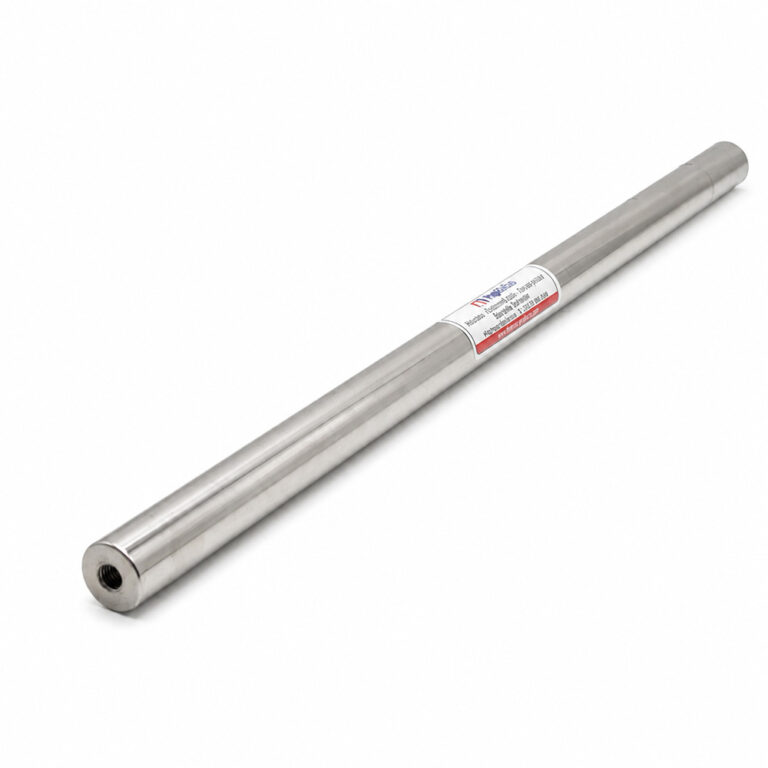
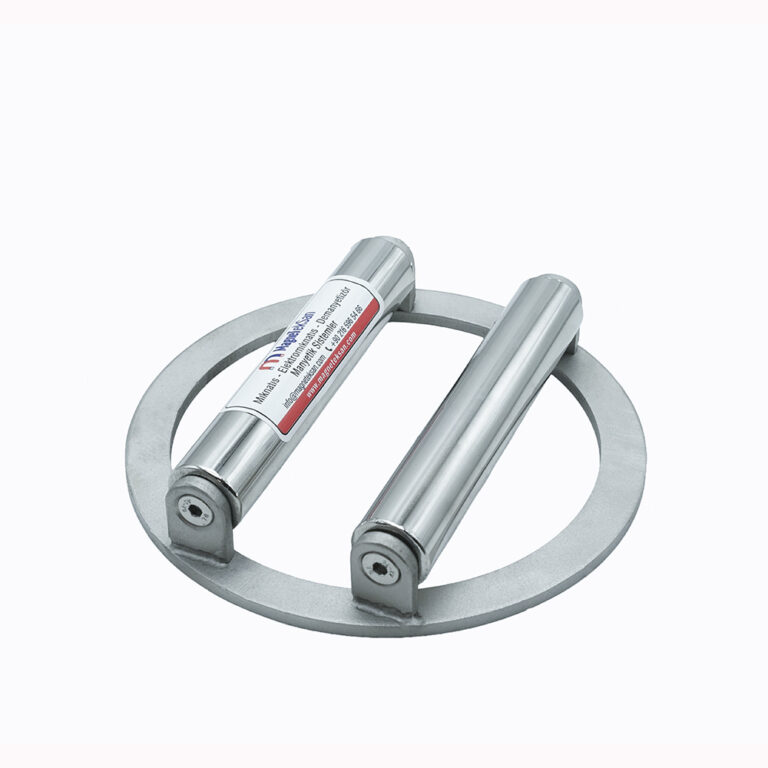
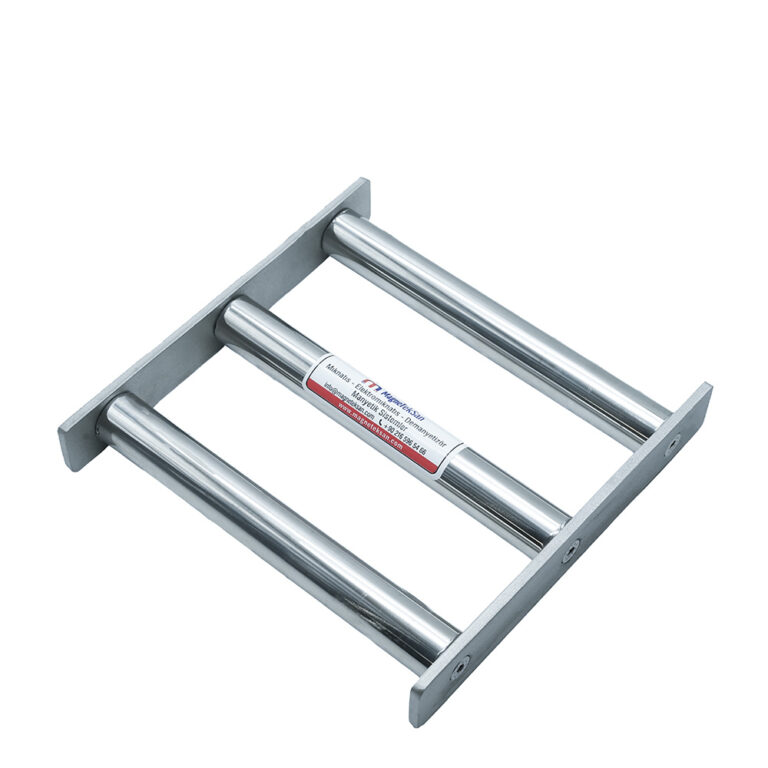
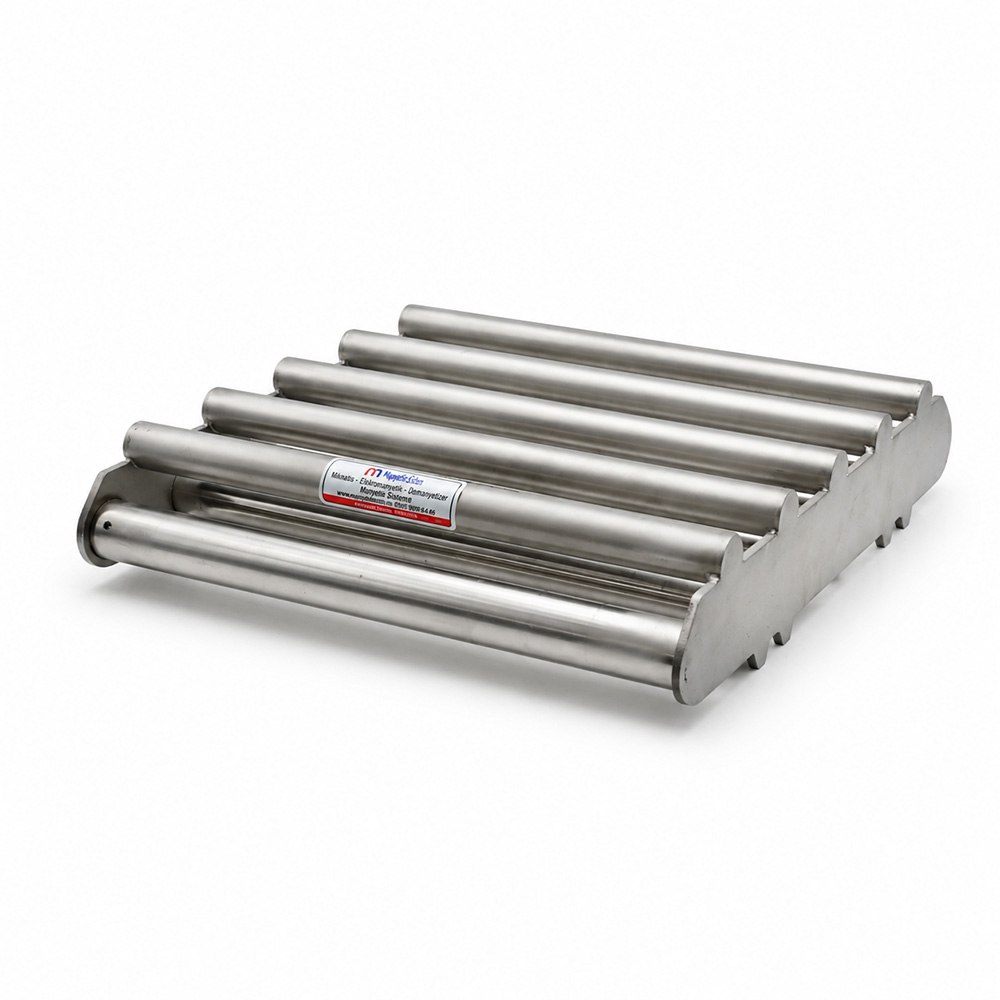
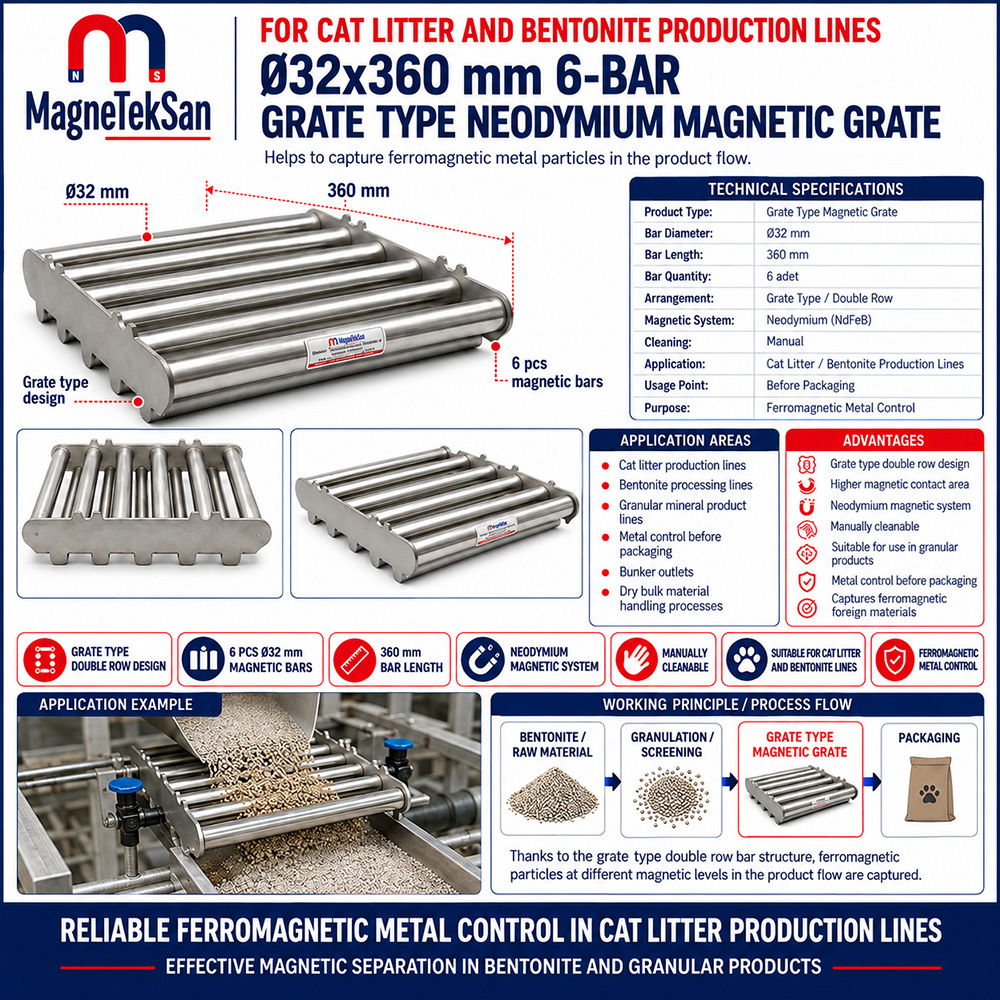
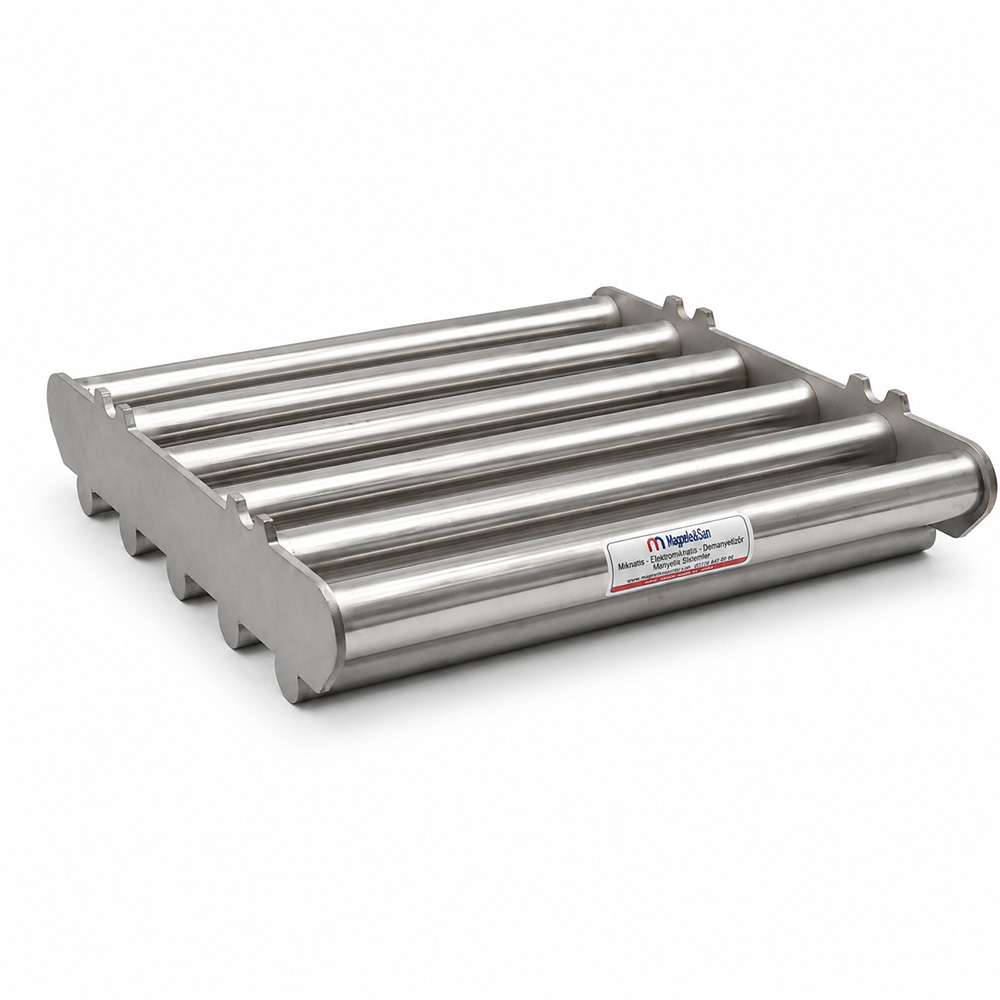
The Ø32×360 mm Staggered Neodymium Magnetic Grid is designed to help capture ferromagnetic metal contaminants in bentonite-based cat litter and suitable mineral granule production lines. Its double-row staggered configuration, with six Ø32 mm magnetic rods in the main row and a 360 mm rod working length, provides successive magnetic contact zones for flowing material. The permanent neodymium system supports manual cleaning and can be installed at a compatible process point, typically after granulation and screening and before packaging.
| Technical Specification | Value |
|---|---|
| Product Type | Staggered Neodymium Magnetic Grid |
| Main Application | Bentonite / Cat Litter Production |
| Magnetic Rod Diameter | Ø32 mm |
| Magnetic Rod Length | 360 mm |
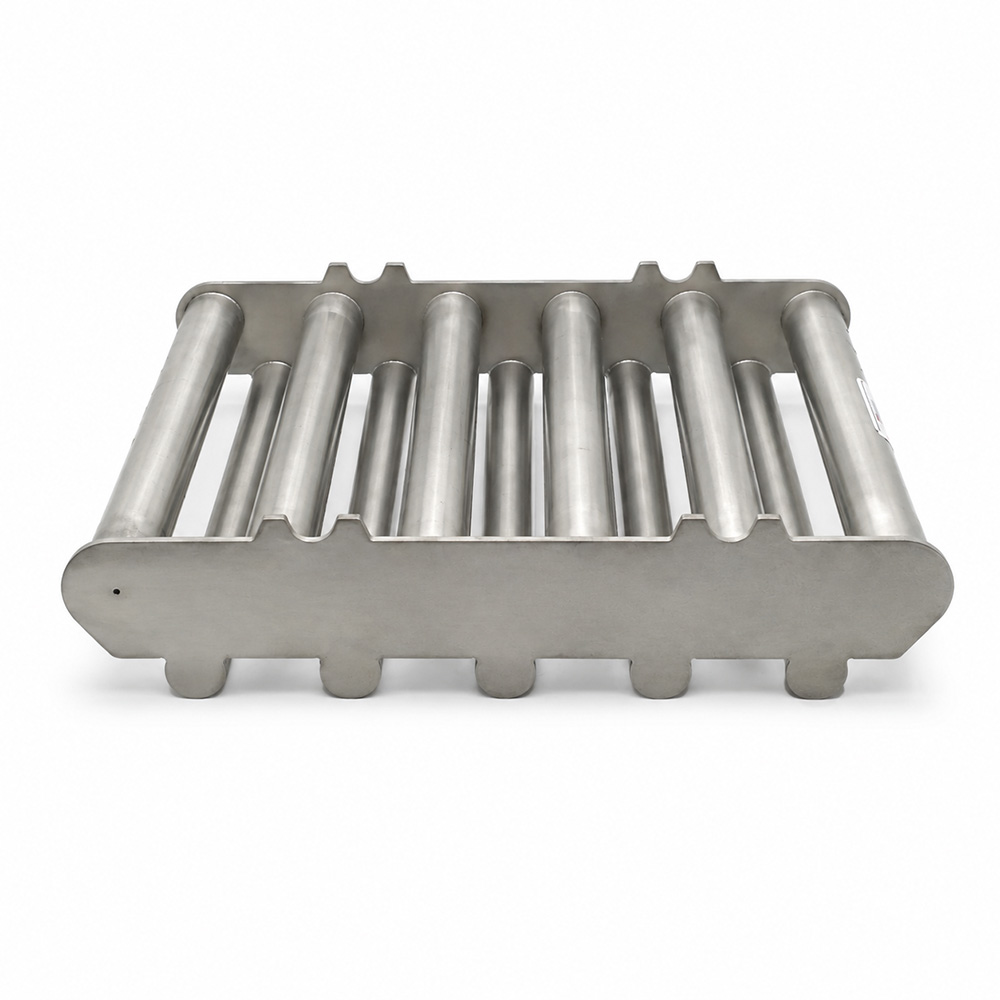
| Magnetic Rod Arrangement | Double Row / Staggered |
| Main Row Configuration | 6 Magnetic Rods |
| Second Row Position | Offset Relative to First-Row Gaps |
| Magnetic Material | Neodymium (NdFeB) |
| Magnetic System | Permanent Magnet |
| Cleaning Method | Manual |
| Material Flow | Suitable Dry Granules and Mineral Powders |
| Typical Installation Point | After Granulation and Screening / Before Packaging |
| Primary Function | Ferromagnetic Metal Contamination Control |
| Target Contaminants | Iron and Ferromagnetic Steel Particles |
| Magnetic Contact Arrangement | Two Staggered Magnetic Levels |
| Electrical Power Requirement | Not Required to Generate the Magnetic Field |
Extra Information
1. Why Is Magnetic Separation Important in Cat Litter Production?
Bentonite-based cat litter is produced through several mechanical processing stages, which may include crushing, grinding, granulation, drying, screening, conveying and packaging.
During these operations, mineral material can come into contact with crushers, mills, elevators, conveyors and other metal components.
Ferromagnetic contaminants may enter the product through raw materials, equipment wear or maintenance activities.
A staggered magnetic grid provides an additional control point to help capture suitable iron and ferromagnetic steel particles before the finished cat litter reaches the packaging system.
2. What Is the Ø32×360 mm Staggered Neodymium Magnetic Grid?
The Ø32×360 mm staggered neodymium magnetic grid is an industrial magnetic separator intended for compatible dry mineral and granular material flows.
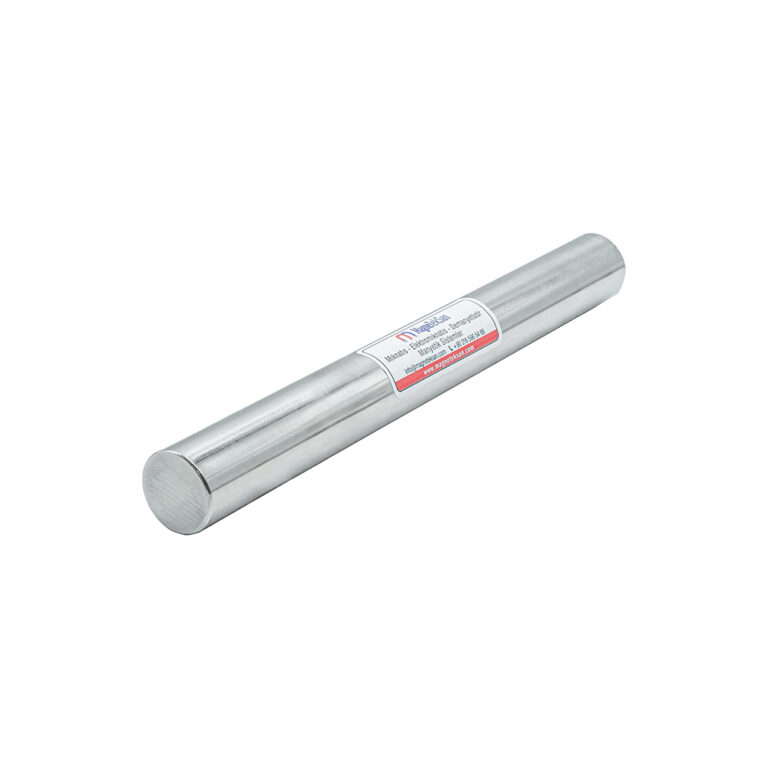
The product features Ø32 mm diameter magnetic rods with a working length of 360 mm.
Its rods are arranged in two staggered rows, with six magnetic rods specified for the main row.
The magnetic system uses permanent neodymium (NdFeB) magnets and is manually cleaned.
Its primary application is ferromagnetic metal contamination control in bentonite and cat litter production.
3. How Does the Staggered Magnetic Grid Work?
The material flows toward the first row of magnetic rods and passes through the spaces between them.
Suitable ferromagnetic particles that come sufficiently close to the magnetic surfaces may be attracted and retained.
The second row is offset relative to the gaps in the first row, creating another opportunity for magnetic contact.
The basic operating sequence is:
Granule Flow → First Magnetic Row → Offset Second Magnetic Row → Downstream Process
This arrangement aims to expose flowing material to magnetic surfaces at two different levels.
Actual separation performance depends on contaminant properties, material flow conditions and magnetic system design.
4. What Is the Advantage of a Double-Row Staggered Arrangement?
In a conventional single-row magnetic grid, some material may pass directly through the gaps between adjacent rods.
A staggered double-row configuration positions the second row relative to these gaps.
As material passes the first row, it subsequently encounters magnetic surfaces at a second level.
This design is intended to increase the opportunities for ferromagnetic particles to approach the magnetic rods.
However, the staggered arrangement alone does not guarantee a specific separation efficiency or complete removal of metal contamination.
5. Why Does the Main Row Have Six Magnetic Rods?
The technical specification identifies a six-rod configuration in the main row.
Multiple rods provide magnetic surfaces distributed across the material flow path.
This arrangement can help expose suitable ferromagnetic particles to magnetic attraction as the granules move through the grid.
The second row is staggered relative to the first row.
The available product specification does not separately confirm the number of rods in the second row, so the total rod count should be verified from the technical drawing before being stated.
6. Why Are Ø32 mm Magnetic Rods Used?
The magnetic rods have a confirmed diameter of Ø32 mm.
This rod size provides a magnetic working surface for interaction with ferromagnetic particles passing through the grid.
When a suitable metal particle approaches the surface closely enough, magnetic attraction may retain it.
Nevertheless, rod diameter is only one factor influencing separation performance.
Other relevant factors include:
- Size and magnetic properties of the metal particle
- Distance between the particle and the rod
- Material flow rate
- Thickness of the flowing material layer
- Spacing between magnetic rods
- Accumulation of captured metal on the rod surfaces
7. What Is the Benefit of the 360 mm Magnetic Rod Length?
The product has a confirmed magnetic rod working length of 360 mm.
This dimension is relevant when evaluating the grid for suitable product chutes, hopper outlets, granule transfer channels and packaging feed systems.
The installation must be checked against the actual dimensions of the process equipment.
The 360 mm rod length should not be confused with the overall external dimensions of the magnetic grid assembly.
Mounting clearances, supporting structures and maintenance access must be evaluated separately.
8. Why Is Neodymium Used in the Magnetic System?
Neodymium (NdFeB) is a permanent magnet material widely used in industrial magnetic separation applications.
The magnetic rods use neodymium magnets to attract suitable ferromagnetic particles.
Unlike an electromagnet, the permanent magnetic system does not require electrical excitation to generate its magnetic field.
The actual magnetic performance depends on the internal magnet arrangement, magnetic circuit, operating conditions and characteristics of the contaminants.
A specific Gauss rating or neodymium grade should not be assumed without verified technical data.
9. Why Can the Grid Be Installed After Granulation?
Granulation is an important stage in many bentonite-based cat litter production processes.
After the desired granule characteristics have been developed, the product may pass through additional drying and screening operations.
A magnetic control point after granulation can help capture suitable ferromagnetic particles before the granules reach the final packaging stage.
This position may be particularly useful when the material is transferred through a compatible gravity-fed chute or hopper.
The actual installation point must be selected according to the plant’s process layout and material flow characteristics.
10. Why Is Installation After Drying and Screening Useful?
In a typical cat litter production line, drying and screening may take place before the finished product is directed toward packaging.
A magnetic grid positioned downstream of these operations can provide an additional control point for ferromagnetic contaminants originating from upstream equipment.
Potential sources include screens, elevators, conveyors and other machinery.
The grid can be considered after the final screening stage when the product flows through a suitable transfer point.
It should be evaluated together with the required throughput and the risk of material accumulation between the magnetic rods.
11. Why Is Magnetic Separation Used Before Packaging?
Packaging is one of the final stages of cat litter production.
A magnetic separator installed before this stage can help retain suitable ferromagnetic contaminants before the product enters the weighing and bagging equipment.
An example arrangement is:
Finished Product Hopper → Staggered Magnetic Grid → Weighing System → Bagging Machine
This configuration provides a final magnetic control opportunity at a suitable point in the material flow.
It does not replace the need for appropriate equipment maintenance, raw material controls or other quality assurance measures.
12. What Is an Example Cat Litter Production Process?
A possible process sequence for bentonite-based cat litter is:
Bentonite Raw Material → Crushing / Grinding → Granulation → Drying → Screening → Staggered Magnetic Grid → Packaging
The exact process may differ according to the mineral source, product formulation and manufacturing technology.
Some plants may also include classification, additive dosing, intermediate storage and additional conveying stages.
The magnetic grid can be evaluated at a compatible point where dry material passes through the rod arrangement.
The purpose is to create an additional ferromagnetic metal control stage without unnecessarily disrupting material flow.
13. Is the Magnetic Grid Suitable for Bentonite Granules?
The main application of this product is bentonite-based cat litter and suitable mineral granule production.
Bentonite granules may pass through the magnetic grid while suitable ferromagnetic contaminants are retained on the rod surfaces.
The material should have flow characteristics compatible with the staggered double-row arrangement.
Granule size, moisture, bulk density and required production capacity are important factors.
Compatibility should be confirmed for the actual product rather than assumed from the fact that the material is bentonite-based.
14. Can the Grid Be Used with Fine Bentonite Powder?
The grid may also be considered for suitable fine mineral powders when the process conditions allow.
However, fine powders can behave differently from free-flowing granules.
Important factors include:
- Powder flowability
- Moisture content
- Tendency to adhere to surfaces
- Risk of bridging between rods
- Bulk density
- Required throughput
Very fine or moisture-sensitive powders may require additional evaluation of the grid geometry and installation arrangement.
The product should not be described as universally suitable for all powdered materials.
15. Where Do Ferromagnetic Contaminants Come From?
Ferromagnetic metal contamination may originate from several points in a cat litter production line.
Possible sources include:
- Wear particles from crushers
- Metal fragments from grinding equipment
- Steel wire fragments
- Damaged screws and fastening components
- Wear particles from conveyors and elevators
- Metal fragments introduced during maintenance
- Ferromagnetic impurities already present in the raw material
The magnetic grid is intended to help retain suitable particles from these sources as the product passes through the separator.
16. Which Metals Can the Neodymium Magnetic Grid Capture?
The magnetic system is designed to retain particles with sufficiently strong ferromagnetic properties.
Examples may include:
- Iron particles
- Carbon steel fragments
- Ferromagnetic steel chips
- Ferromagnetic wire fragments
- Suitable iron-based equipment wear particles
Capture depends on the size, shape, mass and magnetic properties of the particle.
The distance between the particle and the magnetic surface, together with the speed and distribution of material flow, also influences the result.
17. Can It Remove Aluminum, Copper and Brass?
Aluminum, copper and brass are not ferromagnetic under ordinary operating conditions.
These materials are not attracted by conventional permanent magnets in the same way as iron and ferromagnetic steel.
Therefore, the staggered magnetic grid should not be described as a system that removes all types of metals.
Stainless steel can also exhibit different magnetic properties depending on its alloy composition and metallurgical structure.
If the process requires control of non-ferromagnetic metal contamination, additional detection or separation technologies may be necessary.
18. Does Bentonite Itself Stick to the Magnetic Rods?
The purpose of the magnetic grid is not to collect the bentonite granules themselves.
The system is intended to retain suitable ferromagnetic foreign particles present in the mineral product stream.
The process can be summarized as:
Bentonite Granules → Magnetic Grid → Ferromagnetic Particles Retained → Main Material Continues
However, some mineral powders or granules may adhere to equipment surfaces because of moisture, material characteristics or mechanical accumulation.
Such behavior is different from the magnetic attraction of ferromagnetic contaminants.
19. How Is the Grid Used in Gravity-Fed Material Flow?
Cat litter granules may move from a hopper or transfer chute under the influence of gravity.
A magnetic grid can be positioned across a suitable material flow path.
As the granules pass between the magnetic rods, suitable ferromagnetic particles may be attracted to the magnetic surfaces.
The grid must be compatible with the available flow area and the required throughput.
The staggered rod arrangement should be evaluated carefully to avoid excessive restriction of the material passage.
20. Does Material Flow Rate Affect Magnetic Separation?
Yes. Flow rate is an important factor in magnetic separation.
As the amount of material passing through the grid increases, the flowing layer may become thicker.
Some metal particles may then travel farther from the magnetic rod surfaces.
Higher material velocity can also reduce the time available for magnetic interaction.
For this reason, the magnetic grid should be evaluated according to the actual throughput and material distribution within the chute.
No specific hourly capacity has been verified for this product.
21. Can Material Bridging or Blockage Occur?
Yes. Material bridging and accumulation are possible in certain dry granular or powder applications.
The risk depends on factors such as:
- Granule size and particle size distribution
- Material moisture
- Bulk density
- Feed rate
- Spacing between magnetic rods
- Staggered double-row geometry
The second row introduces additional magnetic surfaces into the material flow path.
While this arrangement creates additional opportunities for magnetic contact, it must also be checked for compatibility with the material’s flow characteristics.
A claim that the grid can never become blocked would not be technically justified.
22. What Should Be Considered in High-Capacity Production Lines?
High-capacity cat litter production lines require careful evaluation of material flow through the magnetic grid.
As throughput increases, the depth and distribution of the material layer may change.
Important parameters include:
- Available grid width
- Magnetic rod arrangement
- Rod spacing
- Material layer thickness
- Feed distribution
- Granule characteristics
- Cleaning frequency
The required production capacity should be confirmed before selecting the final separator arrangement.
The specified Ø32×360 mm rod dimensions alone do not establish a verified throughput rating.
23. Can the Magnetic Grid Be Installed Below a Hopper?
Yes, when the hopper design, available installation space and material flow conditions are suitable.
A possible arrangement is:
Finished Product Hopper → Staggered Magnetic Grid → Packaging Machine
In this configuration, the material flows downward through the staggered magnetic rod arrangement.
The grid can provide an additional control point for suitable ferromagnetic contaminants.
The installation must allow safe access for removal, inspection and manual cleaning of the magnetic assembly.
24. Can the Grid Be Used After a Crusher?
Crushing and grinding equipment can be potential sources of ferromagnetic wear particles.
For this reason, a magnetic control point after a crusher may be considered when the material characteristics and process arrangement are suitable.
An example sequence is:
Crusher → Magnetic Separation → Next Processing Stage
However, the main application of this product is ferromagnetic contamination control in bentonite and cat litter production, particularly after granulation and screening and before packaging.
An installation immediately after crushing requires separate assessment of particle size, material flow and mechanical compatibility.
25. How Should the Magnetic Grid Be Cleaned?
The magnetic grid is designed for manual cleaning.
Before cleaning, the production line must be stopped safely, relevant equipment isolated from energy sources and unintended restart prevented.
The magnetic grid assembly can then be removed according to the appropriate safe handling procedure.
Accumulated ferromagnetic particles, including iron fragments and steel wear particles, should be removed from the rod surfaces using a suitable cleaning method.
After inspection and cleaning, the assembly must be correctly reinstalled before production resumes.
Permanent magnets remain magnetically active even when the production equipment is switched off.
26. How Often Should the Grid Be Inspected and Cleaned?
There is no single cleaning interval suitable for every cat litter production plant.
The frequency depends on the contamination load, production capacity, operating hours and rate of metal accumulation.
During initial operation, more frequent inspections may help determine the actual amount of captured metal.
Routine inspection should consider:
- Accumulation of ferromagnetic particles
- Condition of the magnetic rod surfaces
- Mechanical condition of the grid
- Evidence of material bridging
- Ease of removal and reinstallation
- Safe maintenance access
The cleaning schedule should be established according to actual production conditions.
27. Does the Grid Require Electricity, and Can It Replace a Metal Detector?
The neodymium (NdFeB) magnetic system uses permanent magnets.
It does not require electrical power to generate its magnetic field.
The product is manually cleaned and should not be described as an automatic self-cleaning separator.
A magnetic grid and a metal detector also perform different functions.
The magnetic grid physically retains suitable ferromagnetic particles, whereas a metal detector uses an electronic detection system and may identify different types of metallic contaminants depending on its design.
Both technologies may be considered at different stages of the same production line when the contamination control requirements justify their use.
28. How to Select the Right Staggered Magnetic Grid for Cat Litter Production
Selecting a magnetic separator requires more than checking the rod diameter and length.
The following factors should be evaluated:
- Cat litter granule size
- Required hourly production capacity
- Available material passage width
- Moisture content
- Bulk density
- Flowability and bridging tendency
- Type and size of ferromagnetic contaminants
- Magnetic rod diameter
- Rod length and arrangement
- Available installation space
- Safe cleaning access
- Required inspection and maintenance frequency
For this product, the confirmed technical details are Ø32 mm rod diameter, 360 mm rod length, staggered double-row arrangement, six rods in the main row, neodymium (NdFeB) magnetic system and manual cleaning.
The total number of rods, magnetic field strength in Gauss, neodymium grade, housing material, maximum operating temperature and rated throughput have not been independently confirmed in the available specifications.
Magneteksan – Magnetic Separation Solutions for Bentonite and Cat Litter Production
The Ø32×360 mm Staggered Neodymium Magnetic Grid can be evaluated for ferromagnetic metal contamination control in compatible bentonite and mineral granule processing lines.
Its double-row staggered arrangement provides two successive magnetic contact levels, helping increase opportunities for suitable ferromagnetic particles to approach the magnetic surfaces.
For technical evaluation or a quotation, customers can provide their material characteristics, production capacity, installation drawings, available passage dimensions and details of the metal contaminants to be captured.
Magneteksan – Industrial Magnetic Separation Solutions for Mineral Granules and Cat Litter Production.