- Magneteksan
- > Hanger Type Magnetic Plates
- > E-Waste Shredding Line Suspended Ferrite Plate Magnet – 300x210x55 mm
E-Waste Shredding Line Suspended Ferrite Plate Magnet – 300x210x55 mm
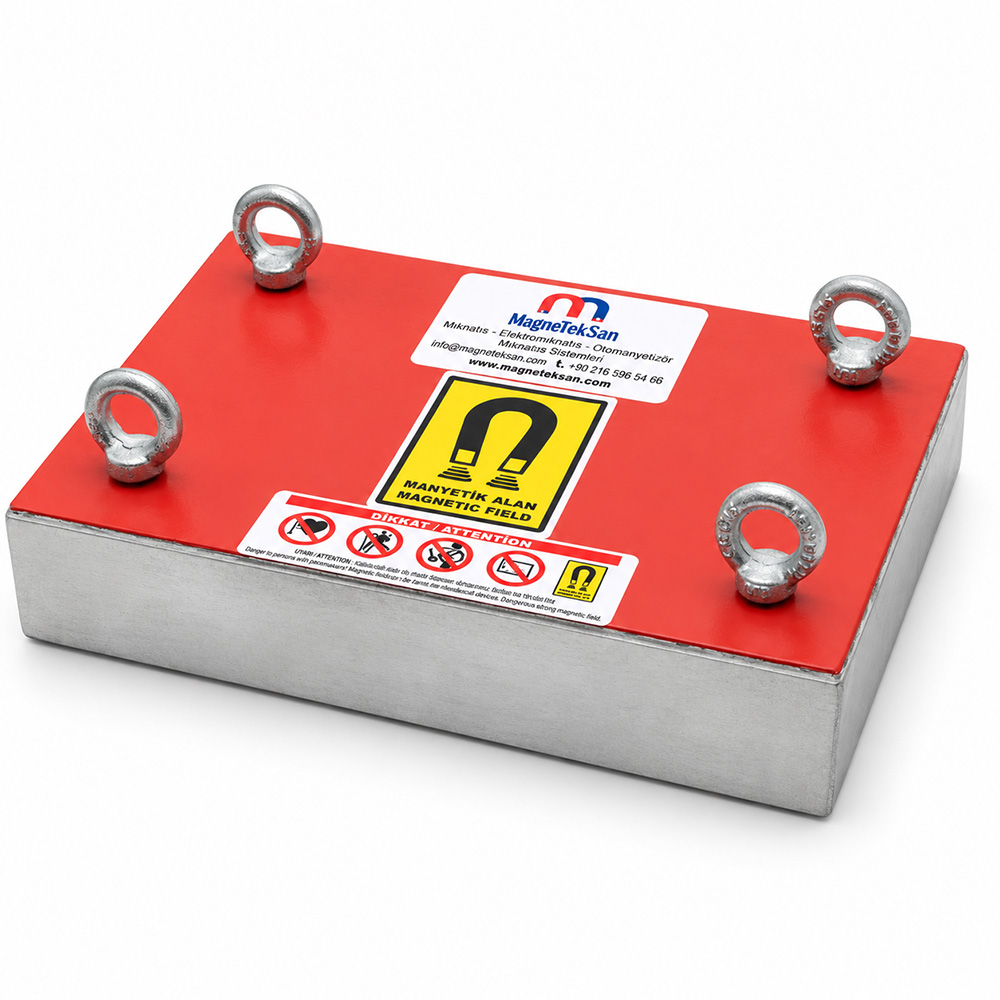
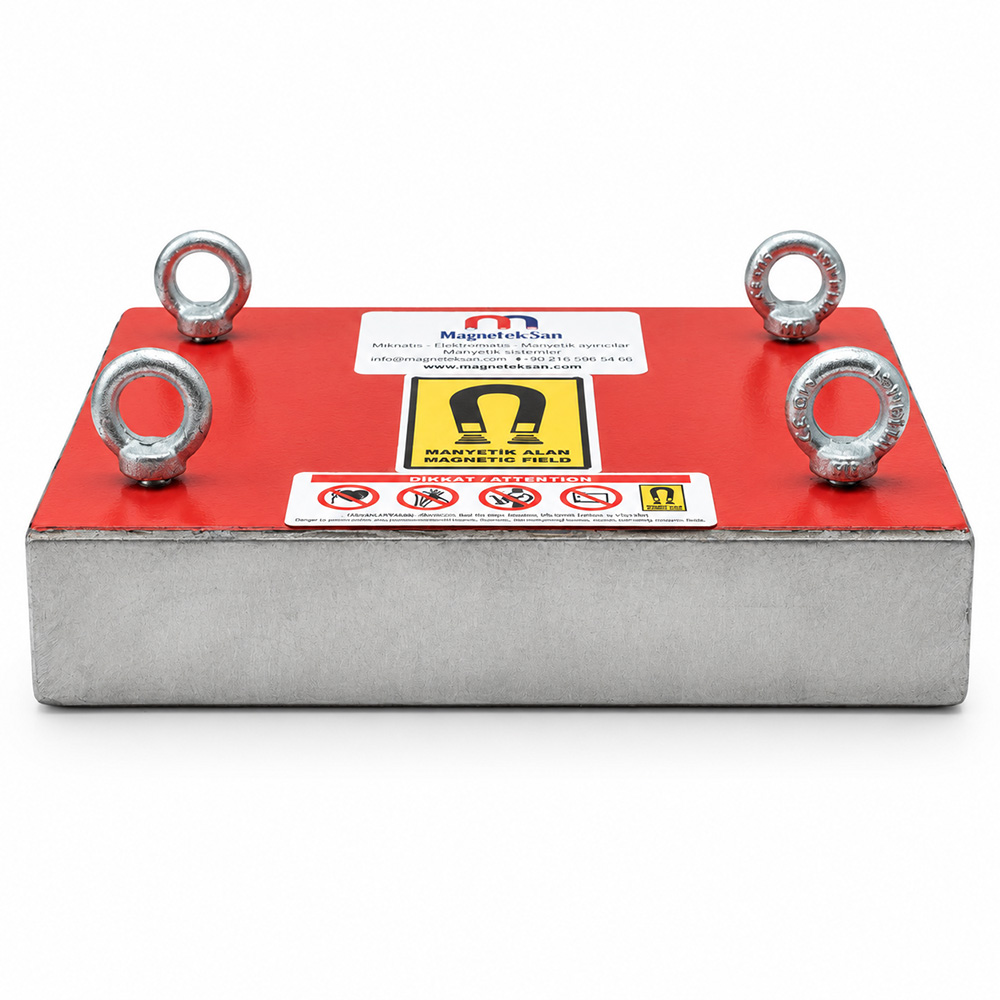
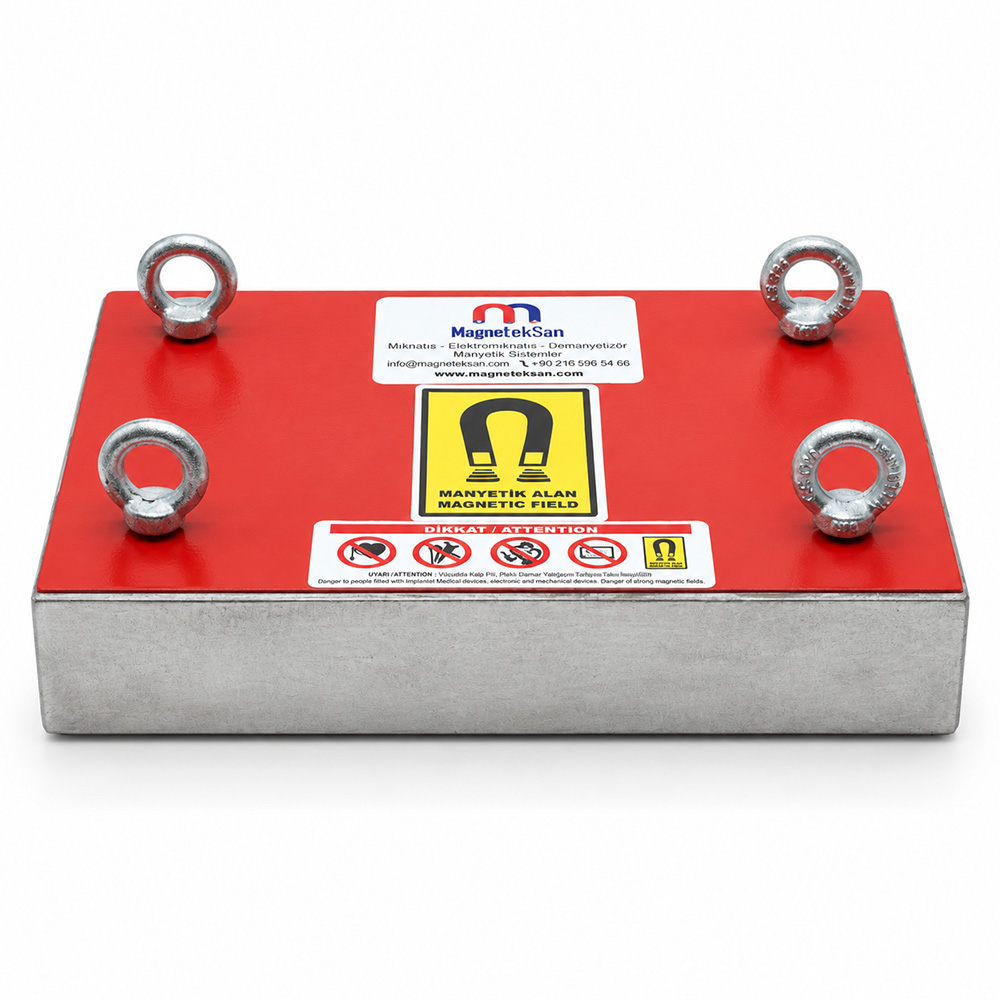
E-Waste Shredding Line Suspended Ferrite Plate Magnet – 300x210x55 mm
General Features
- Designed for use in electronic waste shredding and recycling lines.
- Helps separate ferromagnetic metal after the shredding process.
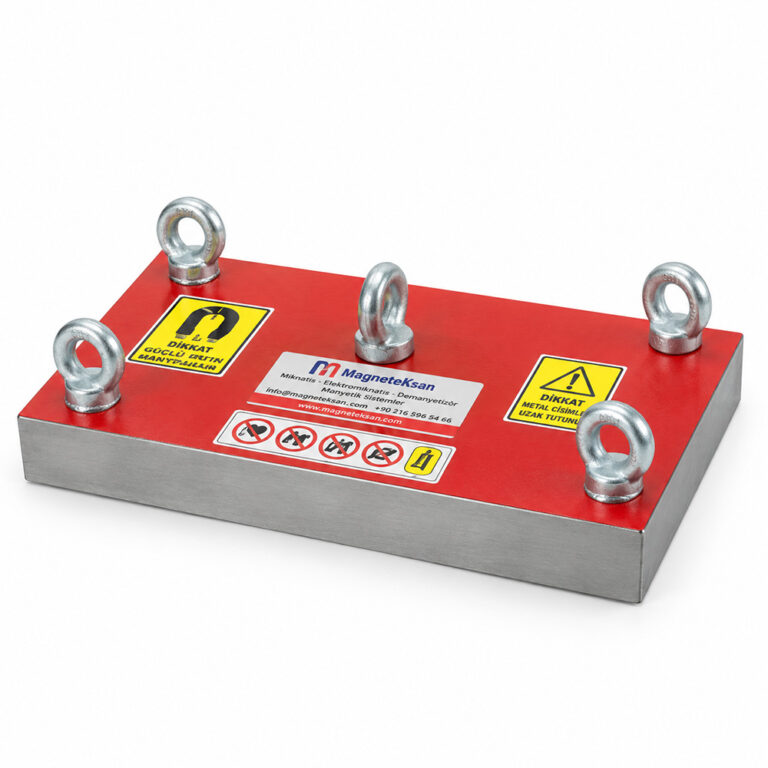
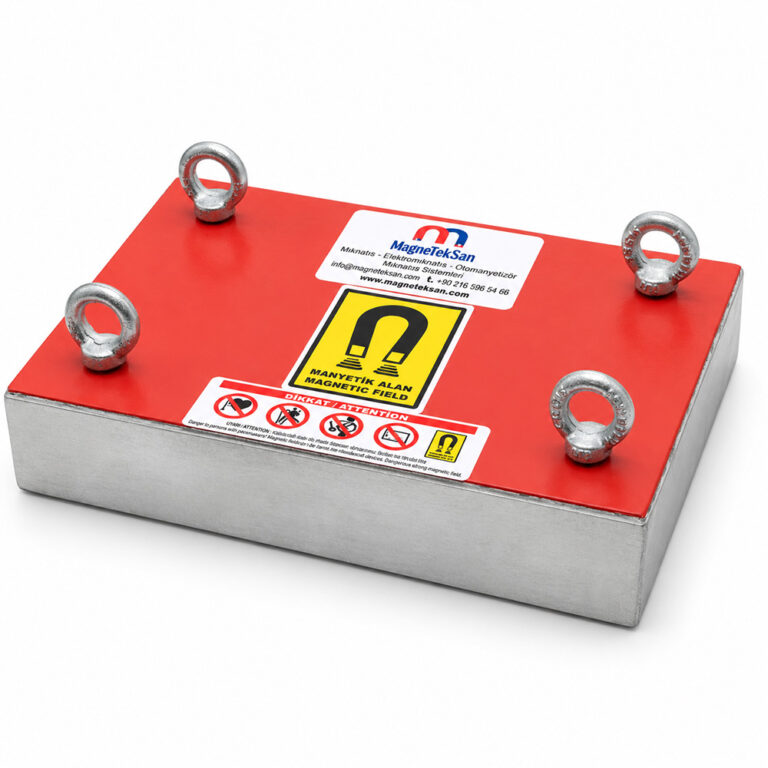
- Compact plate construction measuring 300x210x55 mm.
- Uses a permanent ferrite magnetic system.
- Equipped with 4xM8 female threaded connections.
- Suitable eye bolts or lifting eyes can be fitted to the M8 connections for suspended installation.
- Suitable for suspended installation above conveyor belts.
- Operates without electrical power.
Technical Specifications
- Product Type: Suspended Ferrite Plate Magnet
- Main Application: E-Waste Shredding Line
- Dimensions: 300x210x55 mm
- Magnetic System: Ferrite
- Connection: 4xM8 Female
- Suspension Connection: Eye Bolt / Lifting Eye
- Installation: Over Conveyor / Suspended
- Target Material: Ferromagnetic Iron / Steel
- Cleaning: Manual
- Electrical Power Required: No
Kategori: Hanger Type Magnetic Plates
Product Information
Extra Information
Product Information
The E-Waste Shredding Line Suspended Ferrite Plate Magnet – 300x210x55 mm is a permanent magnetic separator designed to help capture ferromagnetic iron and steel from shredded electronic waste travelling on conveyor belts. Its ferrite magnetic system and 4xM8 female suspension connections allow practical over-conveyor installation without electrical power.
| Technical Specification | Value |
|---|---|
| Product Type | Suspended Ferrite Plate Magnet |
| Main Application | E-Waste Shredding Line |
| Dimensions | 300x210x55 mm |
| Magnetic System | Ferrite |
| Connection | 4xM8 Female |
| Suspension Connection | Eye Bolt / Lifting Eye |
| Installation | Over Conveyor / Suspended |
| Target Material | Ferromagnetic Iron / Steel |
| Cleaning | Manual |
| Electrical Power Required | No |
Extra Information
What is an E-Waste Suspended Ferrite Plate Magnet?
The E-Waste Suspended Ferrite Plate Magnet is a permanent magnetic separator designed to help remove ferromagnetic metal pieces from material streams in electronic waste recycling lines.
The product features:
- 300x210x55 mm plate construction,
- permanent ferrite magnetic system,
- 4xM8 female threaded connections,
- suspended over-conveyor installation,
- manual cleaning,
- operation without electrical power.
Where is it used in an electronic waste recycling line?
One of the most suitable installation points is above the conveyor after the shredding process.
A typical process can be:
Electronic Waste
↓
Shredder
↓
Mixed Shredded E-Waste
↓
Conveyor Belt
↓
Suspended Ferrite Plate Magnet
↓
Ferromagnetic Metal Separation
↓
Remaining Material → Next Separation Process
After electronic equipment is shredded, steel screws, sheet steel fragments, clips, fasteners and other ferromagnetic components can become separated from the original products. The suspended plate magnet helps capture these components while they travel on the conveyor.
Why is the magnet used after shredding?
Shredding releases many individual components that were previously fixed inside electronic equipment.
These can include:
- steel screws,
- sheet steel fragments,
- clips,
- steel fasteners,
- iron fragments.
Once released, these ferromagnetic components can be exposed to the magnetic field and captured as they pass beneath the suspended plate magnet.
Does it separate all metals from electronic waste?
No.
The plate magnet is designed specifically to attract materials with sufficient ferromagnetic properties.
Materials that can typically be attracted include:
- iron,
- carbon steel,
- ferromagnetic screws,
- steel sheet fragments.
Materials that are not normally captured include:
- copper,
- aluminium,
- brass,
- plastic,
- most printed circuit board materials.
What are the 4xM8 female connections used for?
The upper surface of the plate has 4xM8 female threaded connections.
Suitable eye bolts or lifting eyes can be fitted to these connections, allowing the plate to be suspended using:
- chains,
- steel wire ropes,
- suitable suspension components.
The actual suspension components should be selected according to the installation load and mechanical safety requirements.
What is the advantage of four suspension points?
Four suspension points help keep the plate magnet balanced above the conveyor.
By adjusting the suspension lengths, the plate can be positioned:
- parallel to the conveyor,
- in a stable orientation,
- at a suitable distance from the material stream.
Correct positioning should be determined according to the actual conveyor and process conditions.
Does the plate magnet touch the conveyor belt?
No.
During normal operation, the magnet is suspended above the conveyor. The magnetic working surface faces the material stream but should not physically rub against the conveyor belt.
Why is the installation height important?
Magnetic attraction decreases as the distance between the magnet and the target ferromagnetic metal increases.
For this reason, the plate should be positioned:
- high enough not to obstruct the material flow,
- close enough to influence the target ferromagnetic pieces.
The correct installation height depends on the actual material, conveyor arrangement and process conditions.
What is a ferrite magnet?
Ferrite magnets are permanent magnets that generate a magnetic field without requiring electrical power.
They are widely used in industrial magnetic separation systems because they offer:
- permanent magnetic operation,
- no continuous electrical energy requirement,
- relatively simple construction,
- low routine maintenance requirements.
Does the plate magnet require electricity?
No.
The product uses a permanent ferrite magnetic system.
Therefore, it does not require:
- an electrical connection,
- electromagnetic coils,
- a power supply,
- an electrical control panel
to generate its magnetic field.
What types of metal pieces can it capture?
Ferromagnetic components that may be attracted include:
- steel screws,
- iron fragments,
- sheet steel pieces,
- steel fasteners,
- small ferromagnetic machine or equipment parts.
Actual capture performance depends on the size, weight, shape, magnetic properties and distance of the metal from the magnetic surface.
Does it attract copper?
No.
Copper is not ferromagnetic. Copper wires and copper components commonly found in electronic waste are therefore not separated from the material stream in the same way as iron or carbon steel.
Does it attract aluminium?
No.
Aluminium is not ferromagnetic. Other separation technologies are generally required when aluminium needs to be separated from an electronic waste stream.
Does it attract brass?
No.
Brass alloys are not normally ferromagnetic and are therefore not captured like iron or carbon steel.
Does it attract stainless steel?
It depends on the stainless steel grade and its metallurgical condition.
Some stainless steels can respond to a magnetic field, while others exhibit very little magnetic attraction. It should therefore not be assumed that all stainless steel pieces will be captured.
Where stainless steel separation is important, testing with representative samples is recommended.
Does it attract plastic or printed circuit boards?
No.
Plastic and standard printed circuit board materials are not ferromagnetic.
The suspended ferrite plate magnet is primarily used to help remove iron and suitable ferromagnetic steel components before the remaining electronic waste continues to subsequent separation stages.
What does ferromagnetic pre-separation mean?
Electronic waste recycling commonly involves several different separation stages.
A suspended ferrite plate magnet can be used at an early stage to reduce the amount of iron and steel-based material before the remaining material continues to other separation equipment.
Does conveyor speed affect magnetic separation performance?
Yes.
Conveyor speed affects the amount of time a metal component remains within the effective magnetic field.
At higher conveyor speeds, actual separation performance should be evaluated under operating conditions. A fixed maximum conveyor speed should not be stated without application-specific testing.
Does the thickness of the material layer affect performance?
Yes.
If a ferromagnetic component is buried beneath a thick layer of shredded material, the distance between the component and the magnetic plate increases.
This increased distance can reduce magnetic attraction.
Does the size of the metal piece affect performance?
Yes.
Capture performance can depend on the metal component’s:
- size,
- weight,
- shape,
- surface area,
- magnetic properties.
These factors should be considered together with the installation height and conveyor conditions.
What is the attraction distance?
A fixed attraction distance should not be specified for this product without application-specific testing.
The effective attraction distance varies according to:
- metal type,
- component size,
- component weight,
- component shape,
- material layer thickness,
- installation height,
- conveyor conditions.
The plate should therefore be positioned according to the actual process requirements.
Is the product manually cleaned?
Yes.
This model is a manually cleaned suspended ferrite plate magnet.
Ferromagnetic material accumulated on the magnetic working surface is removed manually after the conveyor and process have been safely stopped.
How is the magnetic plate cleaned?
After the conveyor and process have been safely stopped, captured metal pieces are removed from the magnetic working surface in a controlled manner.
Appropriate gloves and personal protective equipment should be used because captured metal fragments may have sharp edges.
How often should it be cleaned?
There is no single fixed cleaning interval suitable for every application.
Cleaning frequency should be determined according to:
- ferromagnetic metal load,
- amount of processed material,
- operating time,
- size and quantity of captured metal pieces.
Regular inspection is recommended to prevent excessive accumulation.
Does accumulated metal affect performance?
Yes.
If excessive metal accumulates on the magnetic working surface, part of the active surface may become covered and newly arriving ferromagnetic pieces may be prevented from approaching the magnet effectively.
Regular cleaning is therefore important.
Is this an automatically cleaned magnetic separator?
No.
This model is designed for manual cleaning.
For continuous processes with very high ferromagnetic metal loads, automatically cleaned magnetic separator systems may be evaluated separately.
How should the plate magnet be positioned over the conveyor?
The installation position should be determined according to:
- conveyor width,
- distribution of the material,
- active material flow area,
- required clearance above the material.
The objective is to ensure that the material stream passes beneath the effective magnetic working area of the plate.
Can eye bolts be fitted to the plate?
Yes.
The product has 4xM8 female threaded connections. Suitable eye bolts or lifting eyes can be fitted to these threaded points to create the suspension arrangement.
The eye bolts, chains and other suspension components must be selected according to the actual mechanical loads and installation safety requirements.
Should the suspension connections be inspected?
Yes.
The following components should be inspected periodically:
- M8 threads,
- eye bolts or lifting eyes,
- chains,
- suspension components.
They should be checked for loosening, wear, damage or deformation.
What maintenance does the plate magnet require?
Routine inspection should include:
- the magnetic working surface,
- the plate body,
- M8 threaded connections,
- suspension components.
If significant deformation or damage is detected on the body or mounting points, the unit should be assessed before continued use.
Can it be used with other separation equipment in an e-waste recycling line?
Yes.
Electronic waste recycling lines may use several separation technologies in sequence, including:
- ferrite plate magnets,
- eddy current separators,
- optical sorting equipment,
- density separators,
- manual sorting systems.
Each system targets different material properties and can form part of a multi-stage recycling process.
Does it replace a metal detector?
No.
A plate magnet physically attracts and captures suitable ferromagnetic metals.
A metal detector operates on a detection principle rather than magnetic capture. The two systems can therefore serve different functions within the same production or recycling line.
Can it be manufactured in custom dimensions?
Yes.
Depending on the project, Magneteksan can evaluate application-specific requirements such as:
- plate dimensions,
- suspension points,
- connection type,
- body geometry,
- supporting or suspension system.