- Magneteksan
- > Handle Grid Magnets
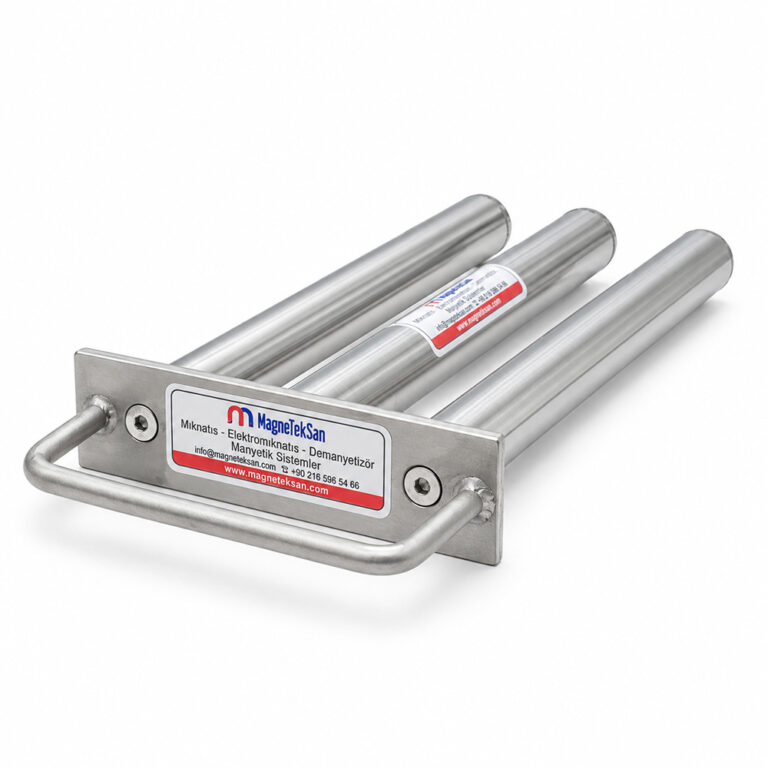
- > Handle Neodymium Grid Magnet – 150×250 mm, 3xØ25 mm N35, 10000 Gauss
Handle Neodymium Grid Magnet – 150×250 mm, 3xØ25 mm N35, 10000 Gauss
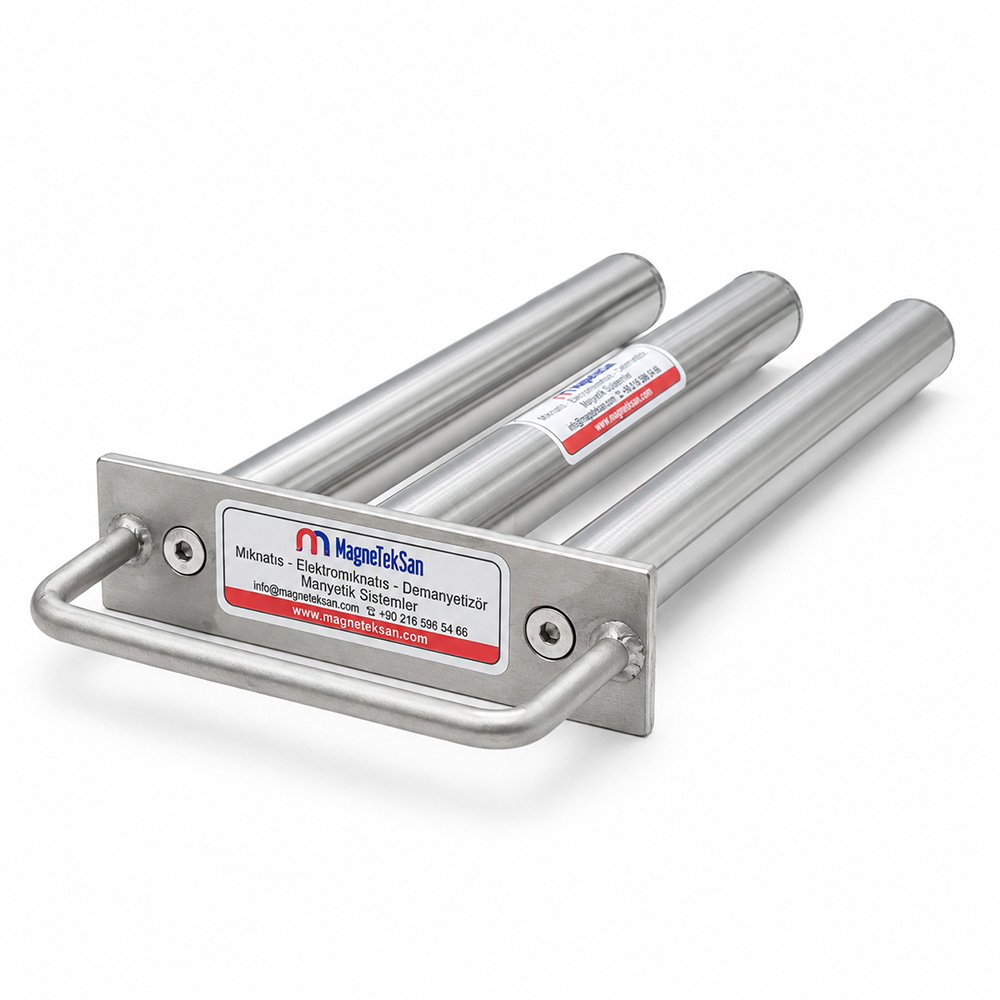
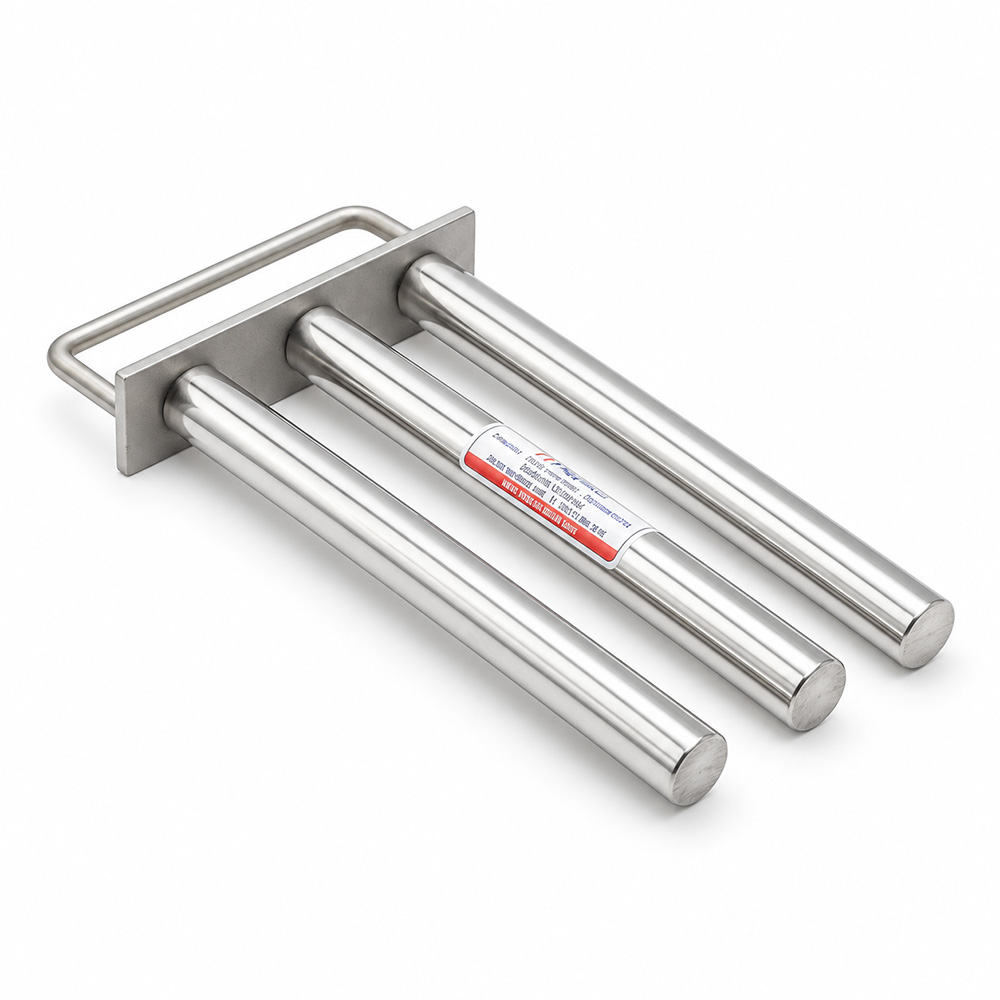
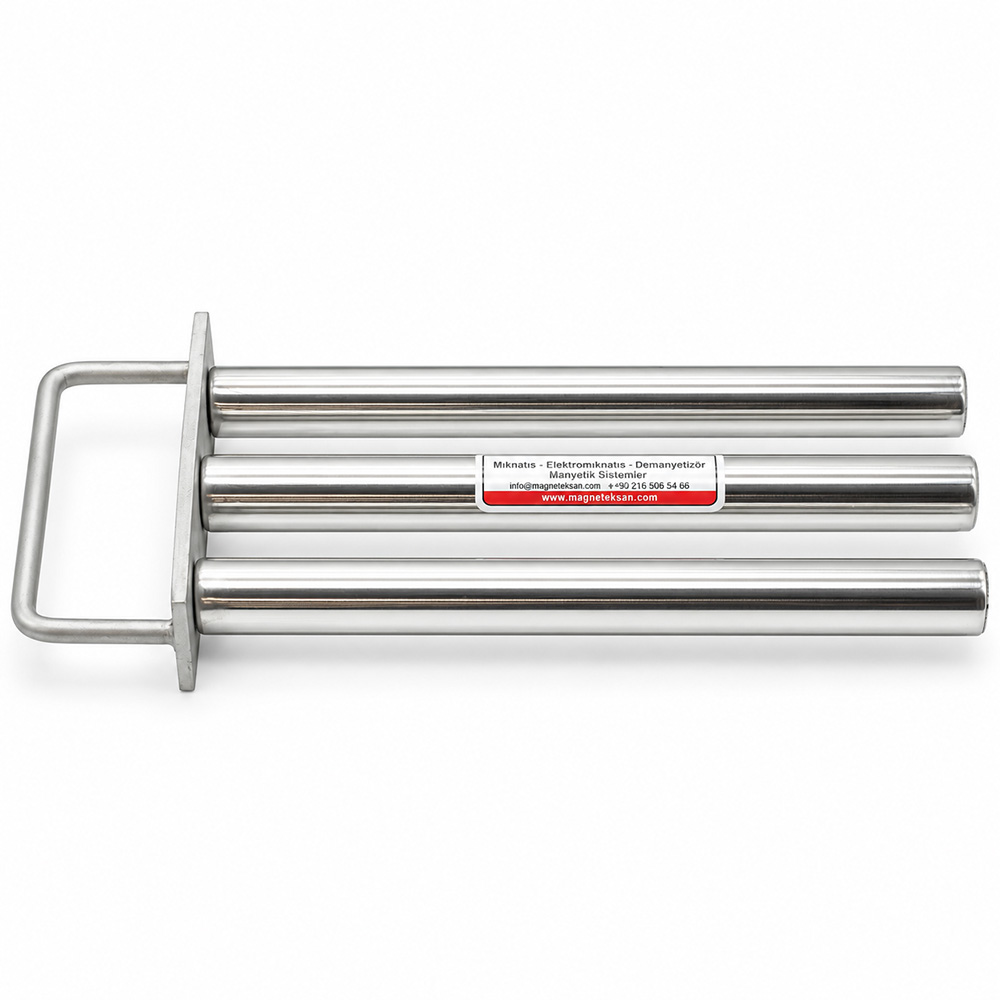
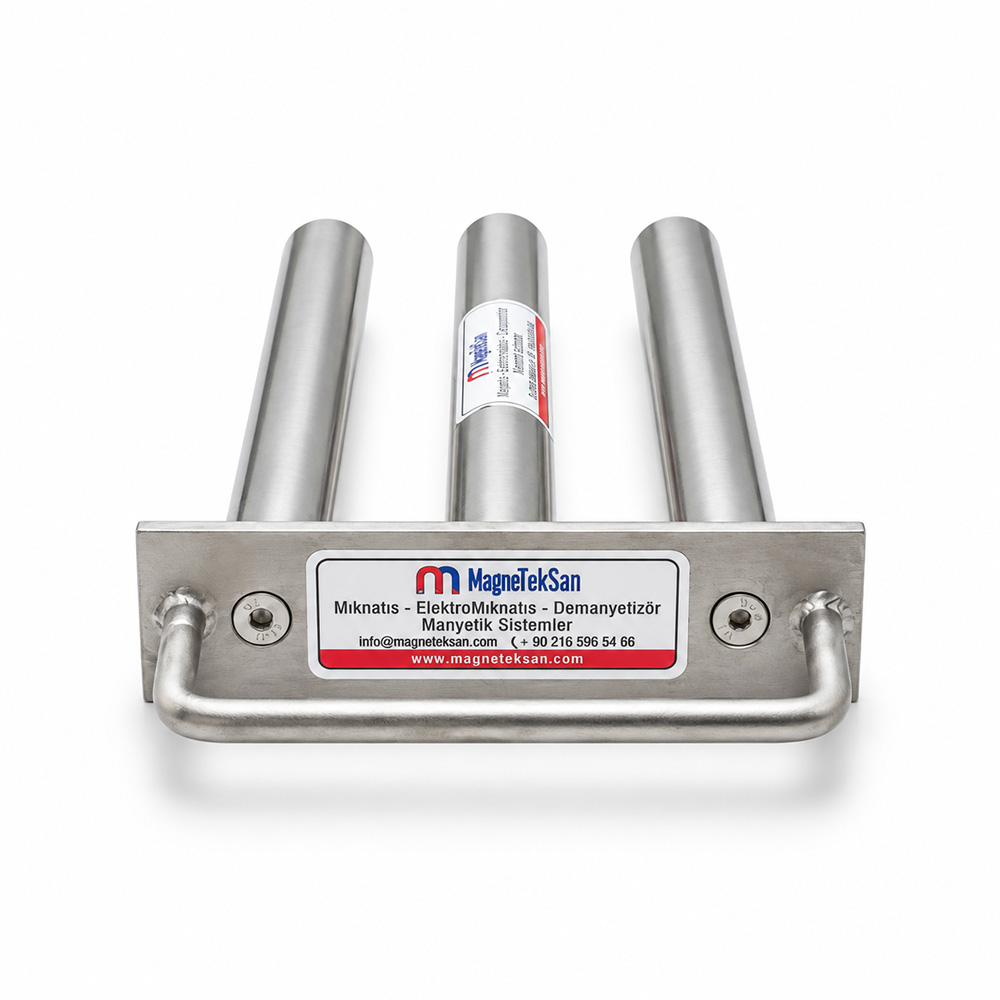
Handle Neodymium Grid Magnet – 150×250 mm, 3xØ25 mm N35, 10000 Gauss
General Features
- Suitable for hoppers, chutes and compatible product transfer points.
- Compact removable design with overall dimensions of 150×250 mm.
- Contains 3 Ø25 mm N35 neodymium magnetic bars.
- Magnetic field value: 10000 Gauss.
- Manufactured from AISI 304 stainless steel.
- Integrated handle allows convenient removal for inspection and cleaning.
- Maximum operating temperature: 80°C.
- Permanent magnetic system requires no electricity.
Technical Specifications
- Product Type: Handle Neodymium Grid Magnet
- Dimensions: 150×250 mm
- Magnetic Bars: 3 Pieces
- Magnetic Bar Diameter: Ø25 mm
- Magnet Grade: N35 Neodymium
- Magnetic Field: 10000 Gauss
- Material: AISI 304 Stainless Steel
- Design: Handle / Removable
- Maximum Temperature: 80°C
- Cleaning: Manual
- Electricity Required: No
Kategori: Handle Grid Magnets
Product Information
Extra Information
Product Information
The Handle Neodymium Grid Magnet – 150×250 mm is a compact removable magnetic separator designed to capture ferromagnetic metal contamination from dry and free-flowing products. It features 3xØ25 mm N35 neodymium magnetic bars with a 10000 Gauss magnetic field and an AISI 304 stainless steel construction.
| Technical Specification | Value |
|---|---|
| Product Type | Handle Neodymium Grid Magnet |
| Dimensions | 150×250 mm |
| Magnetic Bars | 3 Pieces |
| Magnetic Bar Diameter | Ø25 mm |
| Magnet Grade | N35 Neodymium |
| Magnetic Field | 10000 Gauss |
| Material | AISI 304 Stainless Steel |
| Design | Handle / Removable |
| Maximum Operating Temperature | 80°C |
| Cleaning | Manual |
| Electricity Required | No |
Extra Information
What is a 150×250 mm Handle Neodymium Grid Magnet?
The 150×250 mm Handle Neodymium Grid Magnet is a removable magnetic separation unit designed to help capture iron and suitable ferromagnetic steel contamination from product flows.
The unit features:
- 150×250 mm overall dimensions,
- 3 Ø25 mm magnetic bars,
- N35 neodymium magnets,
- 10000 Gauss magnetic field,
- AISI 304 stainless steel construction.
Where Can It Be Used?
When the mechanical dimensions and product flow geometry are suitable, it can be used in:
- product hoppers,
- chutes,
- gravity-fed product channels,
- magnetic housings,
- bunker outlets,
- product transfer points before dosing,
- product transfer points before packaging.
The main objective is to pass the product through the effective magnetic area around the bars.
Why Does the Grid Magnet Have a Handle?
The integrated handle makes it easier to remove the magnetic group from the process equipment.
This helps simplify:
- surface inspection,
- removal of accumulated metal,
- periodic maintenance,
- replacement when required.
Can It Be Used as a Replacement Magnetic Group?
Yes.
If the dimensions and mounting geometry are compatible, it can be used as a replacement magnetic group in existing magnetic housings.
The following dimensions should be checked:
- front plate dimensions,
- magnetic bar length,
- spacing between bars,
- housing opening,
- handle geometry,
- mounting geometry.
What is the Purpose of the 3 Ø25 mm Magnetic Bars?
The product contains 3 magnetic bars, each Ø25 mm in diameter.
As the product flows around and between the bars, suitable ferromagnetic metal particles can be attracted and retained on the magnetic bar surfaces.
What Does N35 Neodymium Mean?
The product uses N35 grade neodymium magnets.
N35 identifies the grade of the neodymium magnetic material.
Because neodymium is a permanent magnetic material, the system continuously generates a magnetic field without electrical power.
What Does 10000 Gauss Mean?
The specified magnetic field value of the product is:
10000 Gauss
This value represents the magnetic field level available at the magnetic bar surface for attracting suitable ferromagnetic contamination.
However, 10000 Gauss does not mean:
- a fixed attraction distance,
- a fixed lifting capacity in kilograms,
- a guaranteed 100% capture rate.
Actual separation performance depends on the application.
What Metals Can It Capture?
Suitable ferromagnetic contamination may include:
- iron particles,
- steel fragments,
- wire pieces,
- screw fragments,
- small ferromagnetic wear particles.
Does It Capture Aluminium?
No.
Aluminium is not ferromagnetic and is not captured like iron by a standard neodymium magnetic separator.
Does It Capture Copper or Brass?
No.
Copper and brass are not ferromagnetic.
The primary target of this product is iron and suitable ferromagnetic steel contamination.
Does It Capture Stainless Steel?
It depends on the stainless-steel grade.
Some stainless steels can react to a magnetic field, while others may show very low magnetic response.
For this reason, capture of all stainless-steel contamination should not be assumed. Actual samples should be tested where necessary.
Why is AISI 304 Stainless Steel Used?
The product is manufactured from AISI 304 stainless steel.
This material is commonly preferred because it provides:
- corrosion resistance,
- a cleanable surface,
- suitability for many industrial and process applications.
Can It Be Used in Food Processing?
The AISI 304 stainless steel construction allows the product to be evaluated for suitable food-processing applications.
However, the final installation should also consider:
- hygiene requirements,
- characteristics of the processed product,
- cleaning procedures,
- required certifications and standards.
What is the Maximum Operating Temperature?
The specified maximum operating temperature is:
80°C
Applications above 80°C should be evaluated separately before using the standard N35 neodymium configuration.
Does It Require Electricity?
No.
The permanent neodymium magnetic system does not require:
- electricity,
- coils,
- electrical control panels,
- power supplies
to generate the magnetic field.
What is the Working Principle?
Typical process:
Product Flow
↓
3xØ25 mm N35 Magnetic Bars
↓
Ferromagnetic Metal Capture
↓
Product Flow Continues
Non-magnetic product passes around the magnetic bars while suitable ferromagnetic contamination is attracted to and retained on the magnetic surfaces.
Does It Work Like a Conventional Sieve?
No.
The term Grid Magnet does not mean that the product separates materials according to particle size like a conventional mechanical sieve.
Its primary function is ferromagnetic metal separation.
Can It Be Used Inside a Hopper?
Yes.
If the hopper dimensions and product-flow geometry are suitable, the magnetic group can be positioned inside the hopper.
The handle can remain accessible outside the product-flow area while the magnetic bars are positioned directly in the material flow.
Can It Be Used in a Chute?
Yes.
It can be integrated into suitably sized rectangular product-flow chutes.
For effective separation, the product should pass as close as reasonably possible to the magnetic bars.
Can It Be Used Inside a Magnetic Housing?
Yes.
The magnetic group can be integrated into a compatible housing or enclosure.
It can therefore be used either as an independent handle-type magnetic group or as a replacement component in compatible magnetic separator systems.
Can the Product Flow Become Blocked?
This depends on:
- particle size,
- product flowability,
- spacing between the magnetic bars,
- product flow rate.
The actual flow behaviour should therefore be evaluated for the specific process.
What is the Capacity in Tons per Hour?
A fixed ton/hour capacity should not be specified for this product.
Actual capacity depends on factors such as:
- product type,
- particle size,
- product density,
- moisture content,
- flow geometry.
How is the Handle Used?
The handle provides a convenient gripping point when:
- installing the magnetic group,
- removing it from the system,
- inspecting the bars,
- cleaning the magnetic surfaces.
Because the magnetic field is strong, care should be taken around nearby ferromagnetic surfaces during removal.
How is Manual Cleaning Performed?
After the production system has been safely stopped, the magnetic group can be removed using the handle.
Ferromagnetic particles accumulated on the magnetic bars are then removed in a controlled manner.
Appropriate personal protective equipment should be used because captured metal fragments may be sharp.
How Often Should It Be Cleaned?
There is no single fixed cleaning interval.
Cleaning frequency should be determined according to:
- quantity of product processed,
- level of metal contamination,
- operating time,
- amount of metal accumulated on the bars.
Does Metal Accumulation Affect Performance?
Yes.
Excessive metal accumulation on the magnetic bar surfaces can prevent newly arriving contamination from approaching the active magnetic surface effectively.
Regular inspection and cleaning are therefore important.
Can the Magnetic Group Be Replaced Easily?
Yes, in compatible systems.
The handle-type design makes it easier to remove the existing magnetic group and install a replacement unit.
However, the dimensions and mechanical connections of the replacement unit must be compatible with the existing system.
What Information is Required When Ordering a Replacement Magnetic Group?
For accurate replacement production, the following should be checked:
- overall dimensions,
- magnetic bar diameter,
- number of magnetic bars,
- magnetic bar length,
- centre-to-centre bar spacing,
- front plate dimensions,
- handle dimensions.