Product Information
Extra Information
Product Information
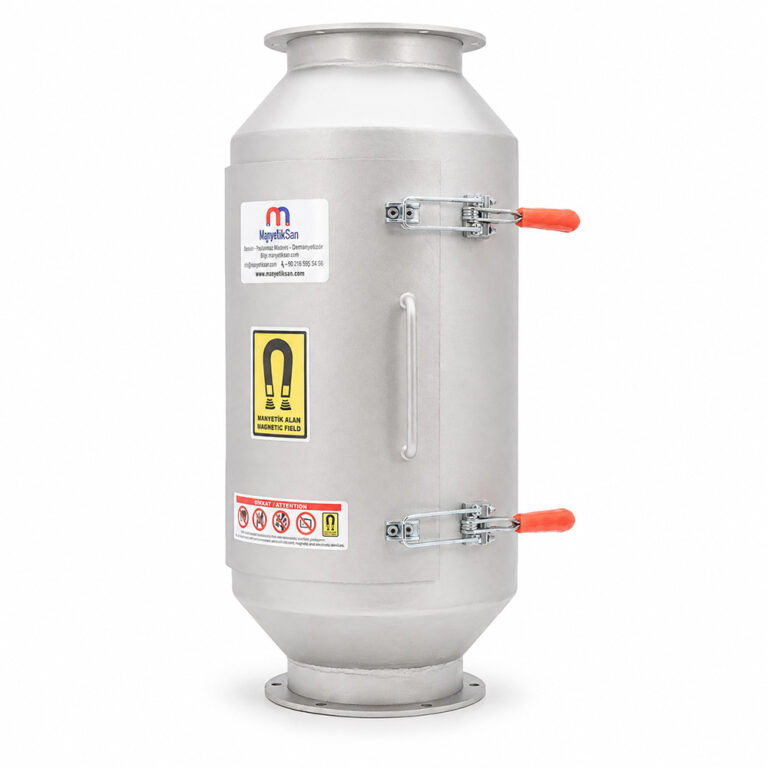
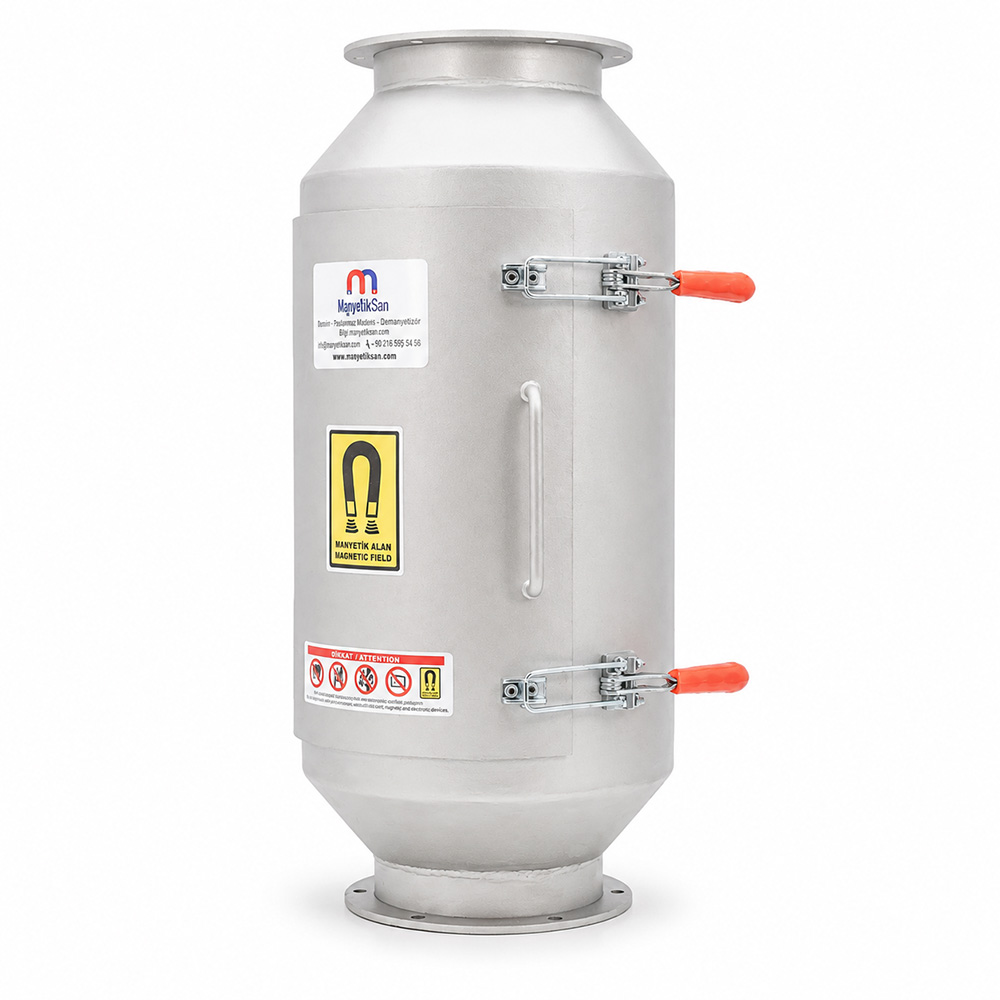
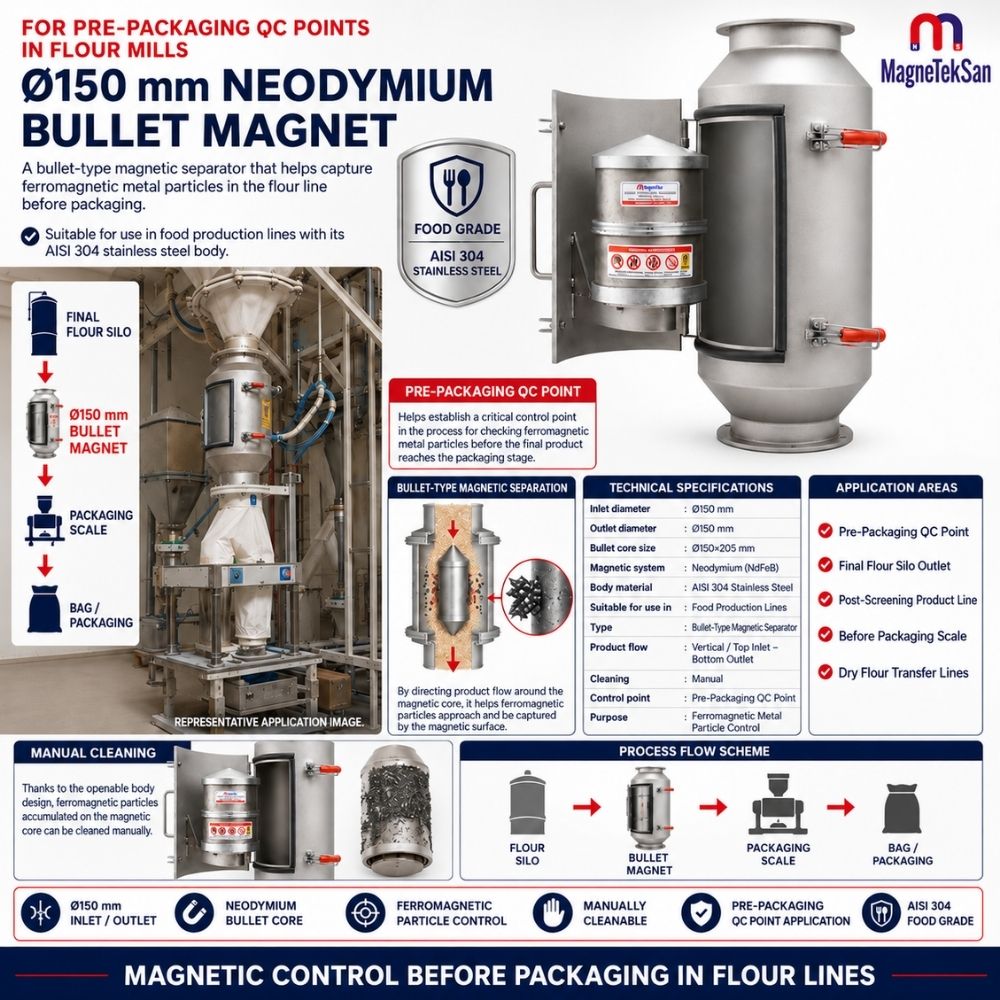
The Ø150 mm Neodymium Bullet Magnet is designed for ferromagnetic metal control in flour mills, particularly at suitable pre-packaging critical control points. Its Ø150×205 mm neodymium magnetic core guides gravity-fed flour around the magnetic separation zone, helping capture iron and steel particles before the product reaches packaging equipment. With Ø150 mm inlet and outlet connections, the separator can be integrated into compatible vertical dry-product lines and is designed for manual inspection and cleaning.
| Technical Specification | Description |
|---|---|
| Product Type | Industrial bullet magnetic separator |
| Main Application | Flour mill processing lines |
| Inlet Diameter | Ø150 mm |
| Outlet Diameter | Ø150 mm |
| Magnetic Core Dimensions | Ø150×205 mm |
| Magnetic Core Type | Bullet-shaped magnetic core |
| Magnetic Material | Neodymium (NdFeB) |
| Magnetic System | Permanent magnet |
| Product Flow Direction | Vertical, top to bottom |
| Material Transfer Principle | Gravity-fed |
| Intended Product | Flour and compatible dry materials |
| Primary Installation Point | Before packaging |
| Quality Control Application | Pre-packaging magnetic control; CCP where designated by the facility |
| Separation Target | Ferromagnetic iron and steel contaminants |
| Cleaning Method | Manual cleaning |
| Electrical Power for Magnet | Not required |
Extra Information
1. Neodymium Bullet Magnet for Flour Mills
The Ø150 mm Neodymium Bullet Magnet is an industrial magnetic separator designed for flour production lines. It helps capture ferromagnetic metal contaminants before flour reaches downstream processing or packaging equipment.
Flour mills use various mechanical systems to transport, process and package their products. During these operations, small iron or steel particles may enter the product stream through equipment wear, maintenance activities or incoming materials.
The separator uses a permanent neodymium magnetic core positioned within the product flow path. As flour moves around the core, suitable ferromagnetic particles can be attracted to its magnetic surface.
This equipment provides an additional contamination-control measure rather than a guarantee of complete metal removal. Its actual separation performance depends on material flow, particle characteristics, magnetic properties and operating conditions.
2. Magnetic Separation Before Flour Packaging
The final stages of flour production are important because the processed product is approaching its packaging operation. Any contamination remaining in the material stream may continue into the finished product.
Installing a bullet magnet before packaging creates an additional opportunity to capture ferromagnetic contaminants. The separator can be positioned within a compatible vertical transfer line.
Flour enters through the upper connection, passes around the magnetic bullet core and continues toward the lower outlet. Ferromagnetic particles that encounter sufficient magnetic attraction may remain on the core surface.
The exact installation position should be determined from the flour mill’s process layout and contamination risk assessment. Magnetic separation may complement other inspection and quality-control equipment.
3. Ø150 mm Inlet and Outlet Connections
The separator has an inlet diameter of Ø150 mm and an outlet diameter of Ø150 mm. These dimensions are important when evaluating integration into an existing flour transfer system.
Matching nominal connection diameters can simplify preliminary equipment selection. However, diameter compatibility alone does not confirm mechanical connection compatibility or adequate process capacity.
The installation must also account for connection geometry, available space, product flow rate and access for maintenance. Actual connection details should be confirmed before preparing fabrication drawings.
The Ø150 mm inlet and outlet are intended for a vertical arrangement with product entering from above and leaving below. This configuration supports gravity-fed operation in compatible dry-product lines.
4. Ø150×205 mm Neodymium Bullet Core
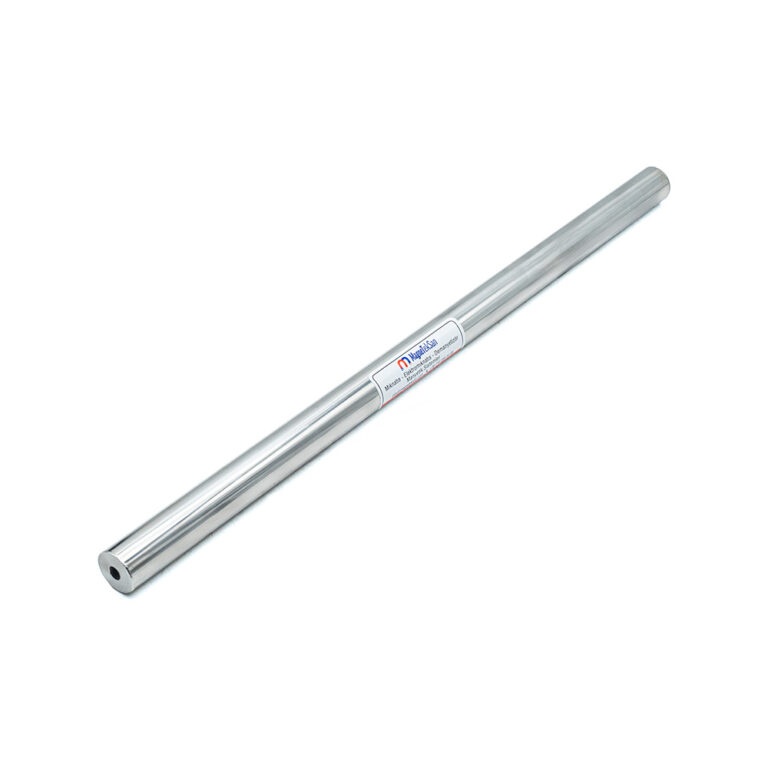
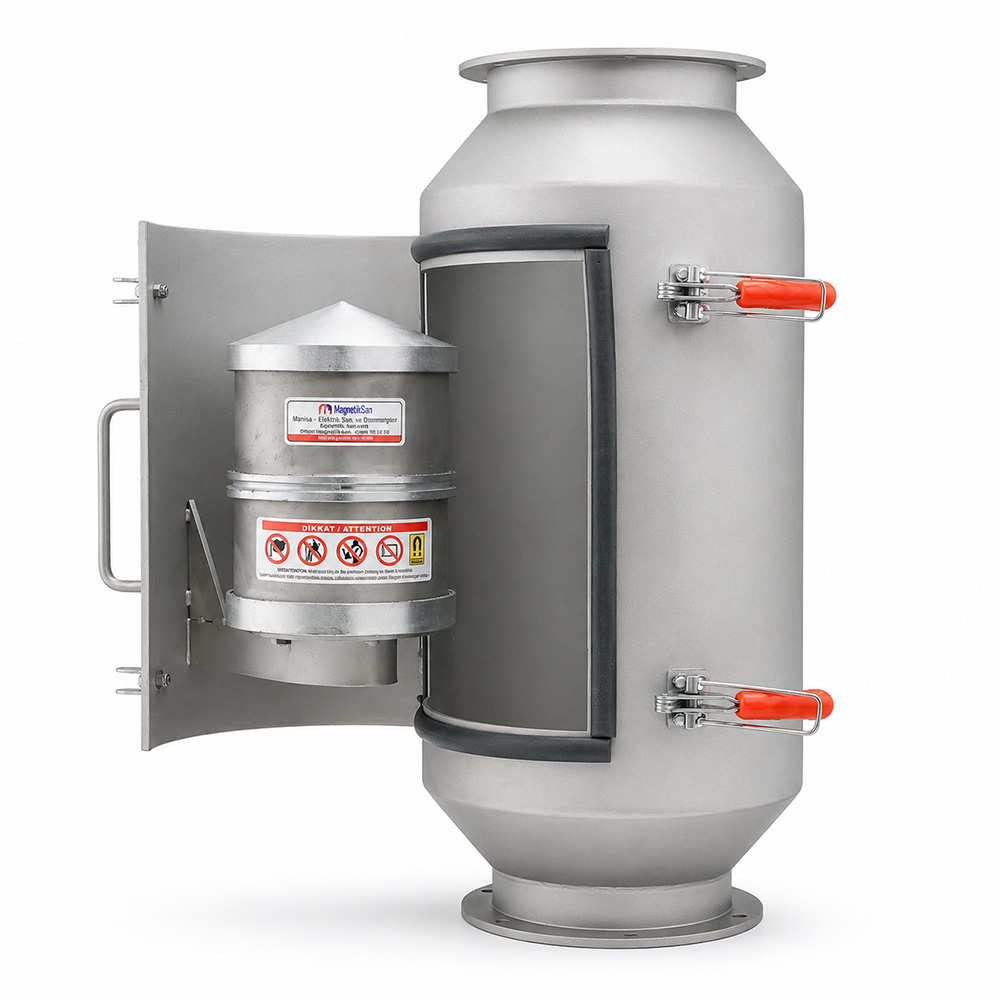
The separator contains a neodymium bullet-shaped magnetic core measuring Ø150×205 mm. This core is the principal magnetic separation component.
Its bullet-shaped geometry helps direct the product around the magnetic separation area. The intention is to bring flowing material into closer proximity to the magnetic surface.
Ferromagnetic particles exposed to sufficient magnetic force may be drawn toward the core and retained. The remaining flour continues through the separator toward the discharge connection.
The core dimensions do not establish a guaranteed capture distance, magnetic flux density or separation efficiency. Such values require appropriate technical verification or application-specific testing.
5. Permanent Neodymium Magnetic System
The separator uses neodymium-based permanent magnets, commonly identified as NdFeB. These magnets create a magnetic field without requiring electrical power.
This operating principle makes the magnetic field continuously available during normal use. The magnetic core also remains active when the surrounding production equipment is stopped.
Magnetic performance depends on the magnetic circuit, core construction, operating distance and characteristics of the contaminants. Magnet material alone does not define the separator’s overall performance.
A specific magnet grade, surface Gauss rating or maximum operating temperature should not be assumed without verified specifications. These parameters must be confirmed when required by the customer’s process.
6. Gravity-Fed Flour Processing Lines
The product is intended for compatible vertical dry-product lines in which material flows downward under gravity. This arrangement is commonly used between process equipment, storage points and packaging systems.
Flour enters through the upper Ø150 mm opening and moves through the internal separation zone. The bullet core influences the path taken by the flowing product.
The magnetic surface can attract suitable ferromagnetic particles while the flour continues downward. The product then exits through the lower Ø150 mm connection.
Actual flow behaviour depends on flour characteristics, equipment geometry and the operating rate. The separator must be evaluated for the specific installation rather than selected solely by connection diameter.
7. Pre-Packaging Critical Control Points
A Critical Control Point, or CCP, is a process stage identified through a facility’s food safety assessment where defined control measures are necessary. Whether a magnetic separator is designated as a CCP depends on the facility’s documented hazard analysis.
A flour mill may position a bullet magnet immediately before packaging as part of its contamination-control programme. This arrangement allows an additional magnetic check before the product enters its final container.
The presence of a magnetic separator does not automatically establish compliance with a particular food safety standard. Appropriate monitoring, verification, corrective actions and records must be determined by the operator.
Where the separator forms part of a CCP, its inspection and cleaning requirements should be documented. Performance verification should follow the site’s approved food safety procedures.
8. Ferromagnetic Contamination in Flour Production
Flour production involves machinery such as elevators, screw conveyors, mills, sifters, storage bins and packaging equipment. These systems contain mechanical components that may experience wear.
Small iron and steel fragments can potentially enter the product through damaged components, maintenance operations or contaminated incoming material. Their size and appearance can vary considerably.
A neodymium bullet magnet provides a means of attracting appropriate ferromagnetic contaminants within the product stream. This helps reduce their passage to downstream equipment.
Magnetic separation cannot be assumed to capture every contaminant. The effectiveness of the system depends on the properties and movement of the particles.
9. Magnetic Control After Flour Sifting
Mechanical sifting separates materials primarily according to particle size. It is used in flour processing to control product characteristics and remove certain oversized materials.
Small metal particles may be sufficiently fine to pass through a sieve opening. A magnetic separator uses a different physical principle and can help capture suitable ferromagnetic particles.
Positioning magnetic separation after a sifting stage may therefore provide complementary contamination control. The actual location should be determined from the mill’s process design.
A bullet magnet does not replace a mechanical sieve, and a sieve does not replace magnetic separation. Both technologies can serve different functions within the same processing line.
10. Installation After Flour Silos
Flour silos provide intermediate or final storage within a milling facility. Material discharged from a silo may be transferred toward blending, weighing or packaging equipment.
A vertical transfer line downstream of a silo can be considered as a possible location for a bullet magnetic separator. Suitability depends on the existing pipework and flow arrangement.
The separator can help retain ferromagnetic contaminants before flour proceeds to the next stage. Its installation should not create unacceptable restrictions or material accumulation.
The final position should provide suitable access for inspection and manual cleaning. It must also remain compatible with the site’s hygiene and maintenance procedures.
11. Installation Before Packaging Scales
Packaging scales measure the quantity of flour delivered into individual bags or containers. They may be positioned near the final discharge stage of the production line.
A bullet magnet can be considered upstream of a packaging scale where the material flows vertically through compatible equipment. This creates a magnetic control stage before weighing and filling.
The arrangement must be assessed for its effect on the product flow and the performance of the weighing system. Stable material delivery remains an important operational requirement.
The separator’s placement should follow the actual process layout. Installation upstream of a packaging scale is one possible configuration, not a universal requirement.
12. Installation Before Flour Filling Equipment
Flour filling machines receive product from storage or transfer equipment and deliver it into the intended packaging. Their inlet arrangements differ between facilities.
A bullet magnetic separator can be installed before a compatible filling system to provide additional ferromagnetic contamination control. The Ø150 mm inlet and outlet are relevant to this integration.
The separator must be positioned so that product flows through the intended magnetic separation area. The surrounding equipment should also allow safe maintenance access.
Its suitability should be confirmed using the actual connection arrangement, process capacity and product characteristics. A magnetic separator should not compromise the required filling operation.
13. Iron and Steel Particle Capture
Iron and many carbon steels are ferromagnetic materials. They can respond strongly to a suitable magnetic field.
Potential contaminants include small steel fragments, iron particles, wire pieces, screws and wear debris. Such materials may originate from different parts of a flour production system.
As the flour passes around the neodymium bullet core, suitable ferromagnetic particles may be attracted to its surface. They remain there until the separator is cleaned.
Capture depends on particle mass, shape, magnetic response, flow speed and proximity to the core. No universal minimum captured particle size can be stated without testing.
14. Fine Metal Particles in Flour
Flour is a fine particulate product, and very small foreign particles may be difficult to detect through visual inspection. Metal fragments can therefore require dedicated control methods.
Wear from industrial machinery may generate fine iron or steel particles. Depending on their characteristics, some of these particles can be attracted by a neodymium magnetic system.
The bullet magnet offers a means of reducing appropriate ferromagnetic contamination within the flowing flour. The product’s fine particle structure makes flow conditions an important consideration.
A guaranteed particle capture threshold should not be specified without supporting measurements. The separator must be evaluated according to the actual contaminant characteristics.
15. Limitations with Nonmagnetic Metals
The neodymium bullet magnet is designed to attract ferromagnetic materials. It is not a universal separator for all metal types.
Aluminium, copper and brass cannot be reliably removed by ordinary permanent-magnet attraction. Certain stainless steel grades may also have weak magnetic responses.
Where nonmagnetic metal contamination presents a risk, additional detection or separation equipment may be necessary. The selection should follow the facility’s hazard assessment.
Magnetic separation and general metal detection should not be treated as identical functions. Each technology addresses different aspects of contamination control.
16. Product Flow Around the Bullet Core
The bullet-shaped core is positioned within the separator body to influence the path of the descending material. Flour flows around the core rather than passing through an unrestricted central opening.
This arrangement is intended to bring the product stream closer to the magnetic separation surface. Proximity is important because magnetic attraction generally decreases with increasing distance.
The internal flow pattern depends on the separator geometry and the properties of the flour. Flow rate and material distribution can influence how contaminants encounter the magnetic field.
The bullet geometry supports the separation principle but does not guarantee complete capture. Actual performance must be assessed under representative operating conditions.
17. Importance of Magnetic Working Distance
Magnetic working distance is the separation between a ferromagnetic particle and the active magnetic surface. It is an important factor in determining whether a particle can be captured.
A particle passing close to the bullet core may experience greater magnetic attraction than a similar particle moving farther away. Its motion and magnetic properties also affect the outcome.
The separator’s internal geometry is intended to guide the product through the magnetic separation region. However, the precise working distance varies with the particle’s path.
The Ø150×205 mm core dimensions should not be interpreted as a specified capture range. Application testing is necessary when a defined separation result is required.
18. Flour Flow Rate and Separation Performance
The quantity of flour passing through the separator affects the operating conditions within the magnetic separation zone. Different production lines may have substantially different flow rates.
At higher flow speeds, particles may spend less time near the magnetic core. Their momentum can also influence the ability of the magnetic force to alter their path.
The separator should therefore be selected with the expected throughput and flow characteristics in mind. The Ø150 mm connection diameter alone does not establish a rated capacity.
No specific hourly flour capacity has been confirmed for this product. Throughput claims should be based on verified technical data or application-specific evaluation.
19. Dry Product Characteristics
Flour characteristics can vary with the raw material, milling process and environmental conditions. Particle size distribution, moisture and flow behaviour can affect equipment operation.
The separator is intended for compatible dry-product applications. Its suitability for a particular material should be considered in relation to the complete processing system.
Poor flow conditions or material accumulation may affect the movement of particles through the magnetic zone. Appropriate installation geometry and maintenance access are therefore important.
The product should not automatically be assumed suitable for liquids, sticky materials or every type of bulk solid. Such applications require separate technical assessment.
20. Manual Cleaning of the Magnetic Core
During operation, captured ferromagnetic particles can accumulate on the bullet core. These particles must be removed through periodic manual cleaning.
Before opening or servicing the separator, the connected production equipment should be safely stopped and isolated against unintended operation. The facility’s approved maintenance and energy-isolation procedures must be followed.
The magnetic core should be accessed through the equipment’s intended service arrangement. Captured metal fragments must be removed carefully using suitable tools and protective equipment.
After cleaning, the core, accessible product-contact surfaces and closure arrangement should be inspected before production resumes. The permanent magnetic field remains active throughout maintenance.
21. Determining Cleaning Intervals
There is no universal cleaning interval suitable for every flour mill. The required frequency depends on the amount of ferromagnetic contamination entering the separator.
During initial operation, more frequent inspections can help establish the rate at which metal particles accumulate. These observations can support a facility-specific cleaning schedule.
Production volume, raw material quality and equipment condition may influence contamination levels. Changes in any of these factors can affect cleaning requirements.
Cleaning and inspection records can provide useful evidence for process monitoring. Unexpected increases in captured metal may indicate a need to investigate upstream equipment.
22. Inspection and Preventive Maintenance
Routine inspection helps confirm that the bullet magnet remains correctly installed and accessible. The housing, connections and service components should be checked for visible defects.
The magnetic core should be inspected for accumulated contaminants and damage. Any condition that may affect hygiene, safety or separation performance should be addressed.
Maintenance should also verify that product flow and installation conditions have not changed significantly. Modifications to nearby equipment may influence the separator’s effectiveness.
Where magnetic performance verification is required, an appropriate measurement or functional test programme should be established. The acceptance criteria must be defined by the facility’s quality procedures.
23. Magnetic Separator Monitoring at CCP Locations
When a flour mill designates the separator location as a CCP, monitoring becomes part of its documented food safety system. The specific requirements depend on the site’s hazard analysis.
Monitoring activities may include inspections of the magnetic core, cleaning records and checks of equipment condition. Magnetic performance verification may also be included where justified.
The facility must define its own limits, inspection frequency, responsibilities and corrective actions. The installation of a magnet alone does not demonstrate that a CCP is adequately controlled.
Clear records can support traceability and process review. They may also help identify recurring contamination sources and maintenance requirements.
24. Comparison with Mechanical Sieves
Mechanical sieves separate materials according to particle size relative to the sieve openings. Their function is distinct from magnetic separation.
A small iron particle may pass through a sieve if it is smaller than the opening. A bullet magnet may retain that particle when it passes sufficiently close to the magnetic core.
Conversely, a sieve may retain larger nonmagnetic foreign objects that the magnet cannot attract. Each system therefore has different strengths and limitations.
Using both technologies can provide complementary control in flour processing. Their arrangement should be based on the actual contaminants and the process requirements.
25. Comparison with Metal Detectors
A bullet magnet physically attracts and retains suitable ferromagnetic contaminants. It performs separation directly within the product flow.
A metal detector uses electronic sensing to identify certain metallic objects. Depending on its design and operating conditions, it may detect nonmagnetic metals as well.
Detection does not necessarily mean physical removal. A metal detection system may require a reject mechanism, alarm or controlled production stop.
A flour mill may use magnetic separation and metal detection at different stages of the process. The appropriate combination depends on its risk assessment and quality objectives.
26. Advantages of Pre-Packaging Magnetic Control
A magnetic control point before packaging provides an additional opportunity to reduce ferromagnetic contamination close to the finished-product stage. This can complement controls used earlier in production.
The separator’s permanent magnetic system does not require electricity to create its magnetic field. Its operation is based on the attraction of suitable metal particles to the core.
The Ø150 mm inlet and outlet allow the product to be considered for compatible vertical flour transfer lines. The bullet core is designed to guide product flow through the magnetic separation region.
These features do not eliminate the need for inspection, cleaning and verification. The separator should be integrated into the facility’s broader contamination-control programme.
27. Custom Bullet Magnet Solutions for Flour Mills
Flour mills differ in production capacity, pipe dimensions, equipment arrangement and packaging configuration. A single standard separator design may not suit every installation.
Magneteksan can evaluate application-specific bullet magnet systems with alternative connection diameters, core dimensions and housing configurations. The design can be considered according to the customer’s process requirements.
Important selection information includes the hourly flour throughput, transfer-line dimensions, available installation space and intended control location. The required magnetic performance should also be established.
A suitable solution should account for product flow, inspection access and the facility’s operating procedures. Customisation must be supported by the actual technical requirements of the installation.
28. Magneteksan Magnetic Separation Solutions for Flour Processing
Magneteksan develops magnetic separation equipment for industrial material processing, including applications involving flour and other compatible dry products. Bullet magnets provide one method of controlling ferromagnetic contamination.
The Ø150 mm Neodymium Bullet Magnet is intended for suitable gravity-fed flour lines, particularly before packaging. It features Ø150 mm inlet and outlet connections and a Ø150×205 mm neodymium magnetic bullet core.
As flour passes around the core, suitable iron and steel particles may be attracted and retained on its surface. The system uses permanent magnets and requires manual cleaning.
Correct equipment selection depends on the production layout, material characteristics, expected contaminants and operating conditions. These factors should guide integration into the flour mill’s quality-control process.