- Magneteksan
- > Trolley Grid Magnets
- > Trolley Grid Magnet Separator – 250×250 mm, 5xØ25 mm N35 Neodymium, 10000 Gauss
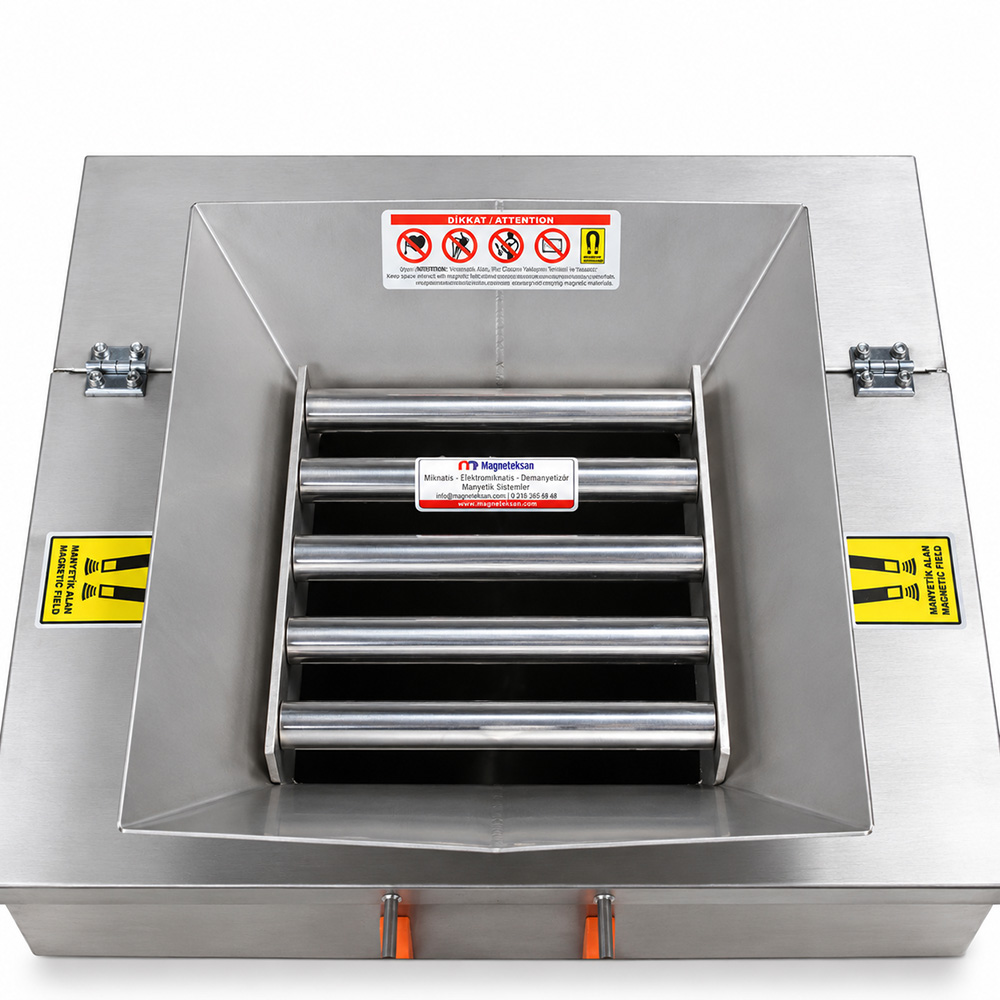
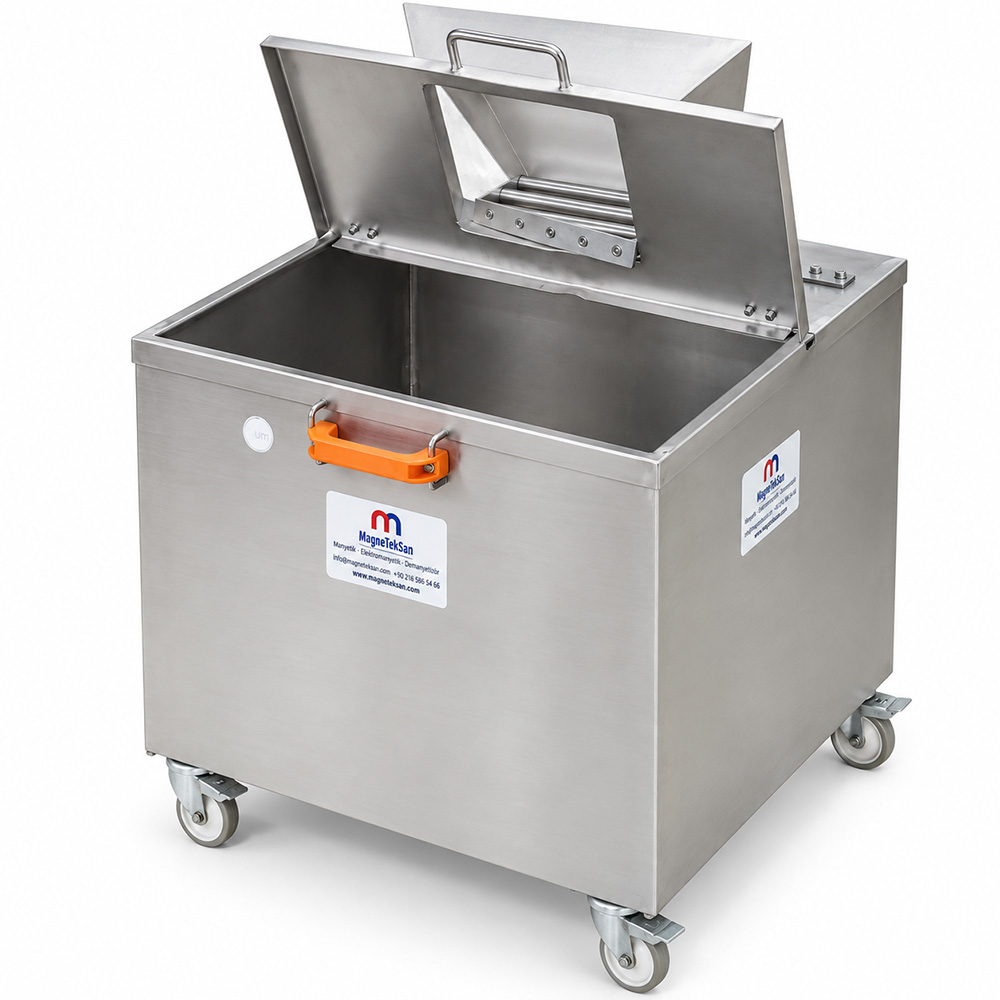
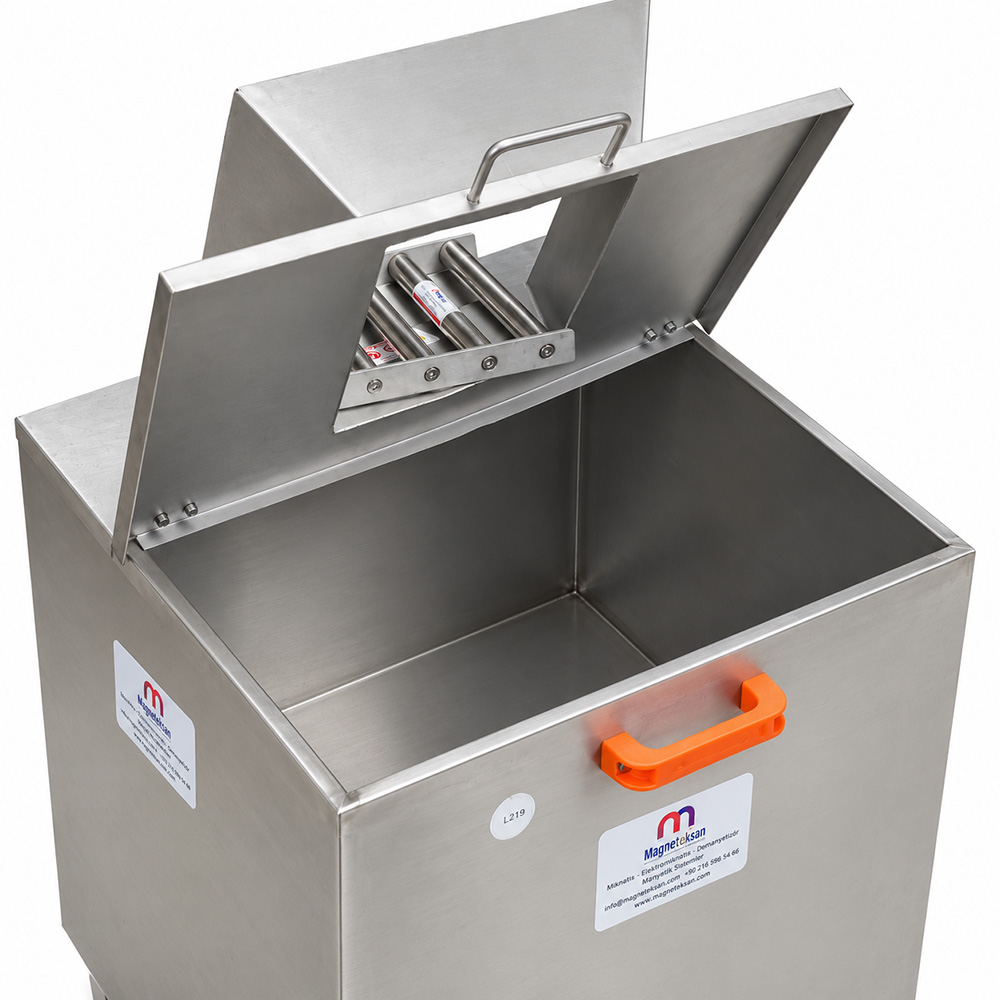
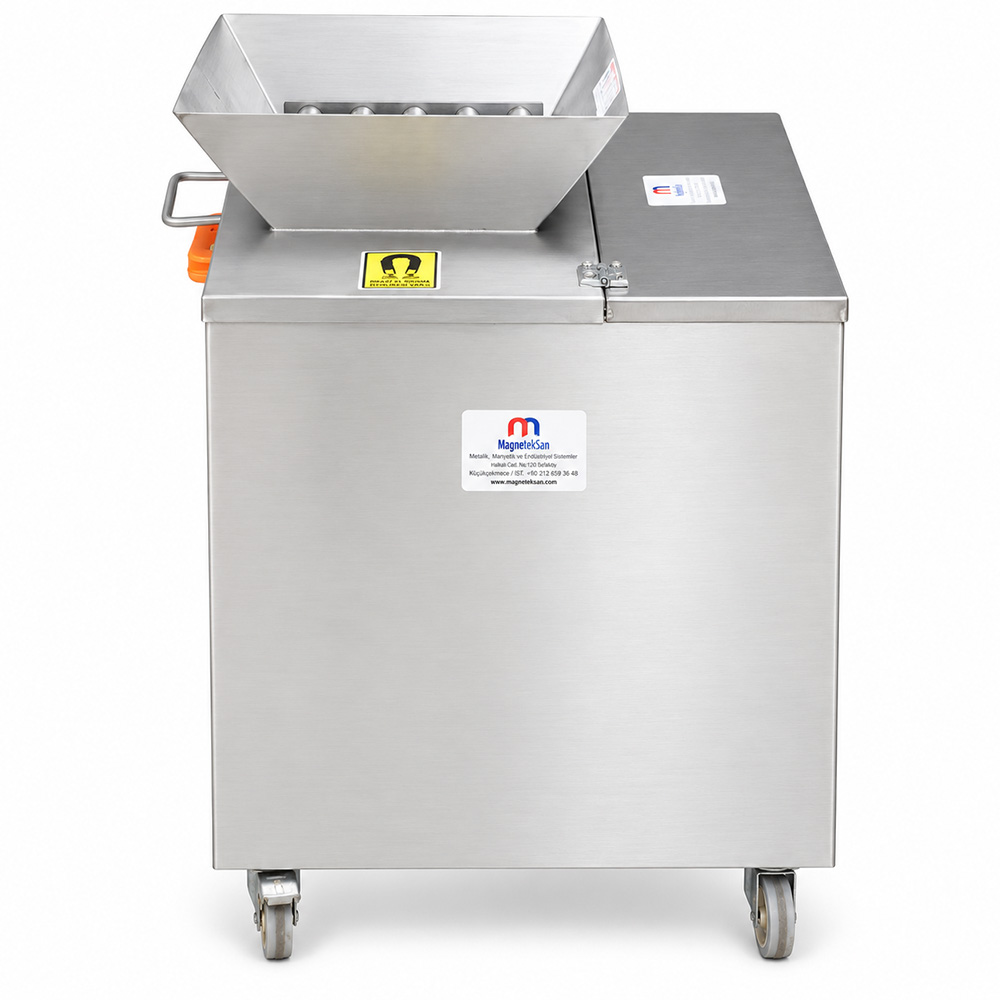
Trolley Grid Magnet Separator – 250×250 mm, 5xØ25 mm N35 Neodymium, 10000 Gauss
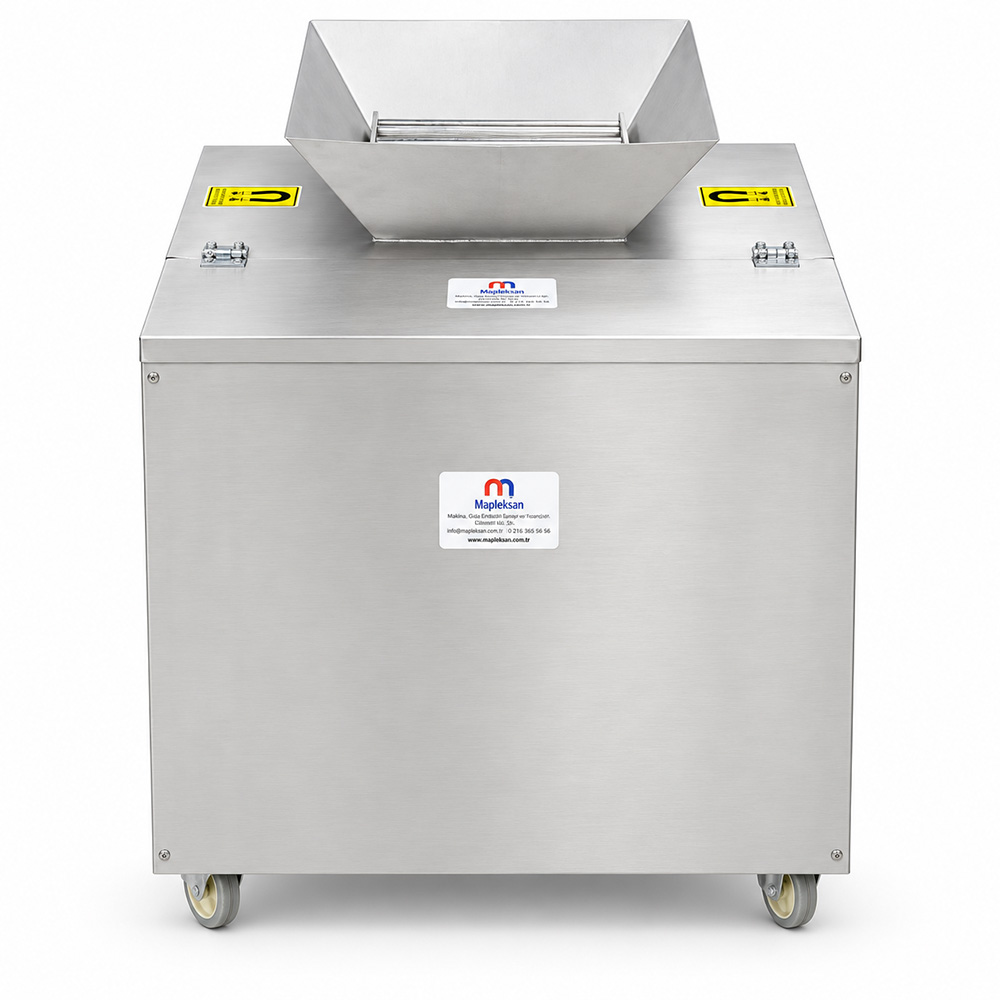
Trolley Grid Magnet Separator – 250×250 mm, 5xØ25 mm N35 Neodymium, 10000 Gauss
General Features
- Suitable for dry and free-flowing materials.
- Mobile construction with a wheeled trolley.
- Top-fed magnetic grid separation system.
- Contains 5 Ø25 mm N35 neodymium magnetic bars.
- Magnetic field value: 10000 Gauss.
- AISI 304 stainless steel construction.
- Integrated bottom product collection container.
- Maximum operating temperature: 80°C.
Technical Specifications
- Product Type: Trolley Grid Magnet Separator
- Magnetic Grid Size: 250×250 mm
- Magnetic Bars: 5 Pieces
- Bar Diameter: Ø25 mm
- Magnet Grade: N35 Neodymium
- Magnetic Field: 10000 Gauss
- Material: AISI 304 Stainless Steel
- Body: Wheeled / Mobile
- Feeding: Top Feed
- Collection: Bottom Container
- Maximum Temperature: 80°C
- Cleaning: Manual
- Electricity Required: No
Kategori: Trolley Grid Magnets
Product Information
Extra Information
Product Information
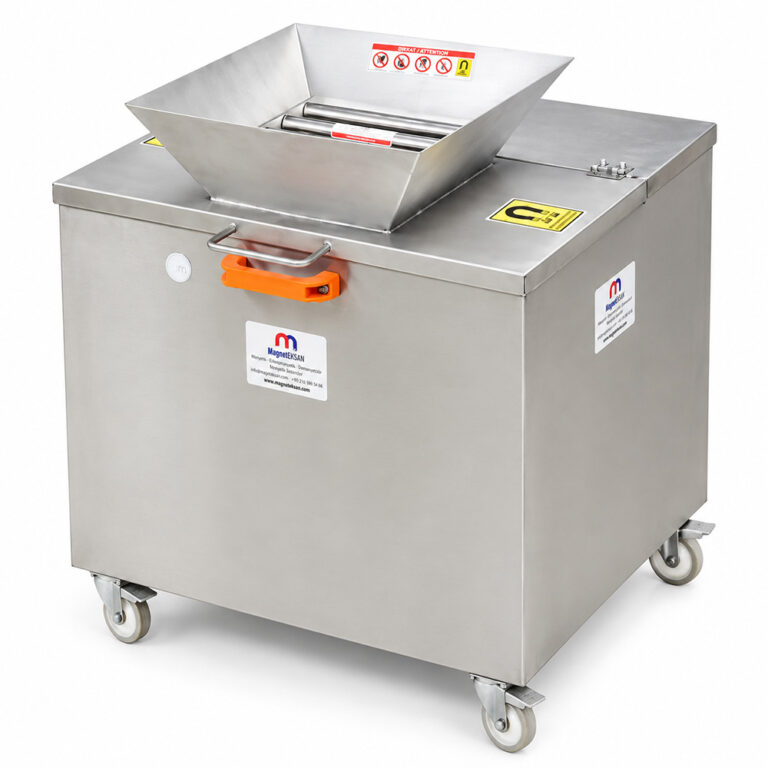
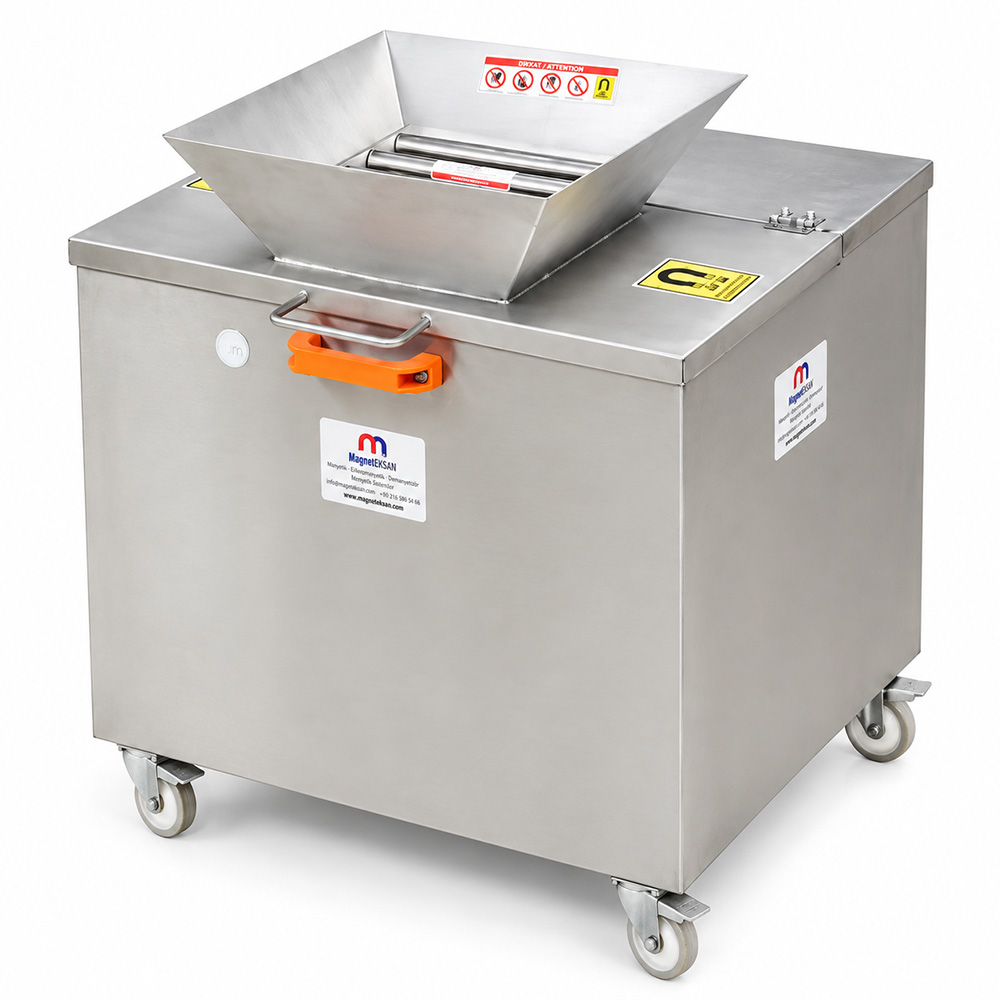
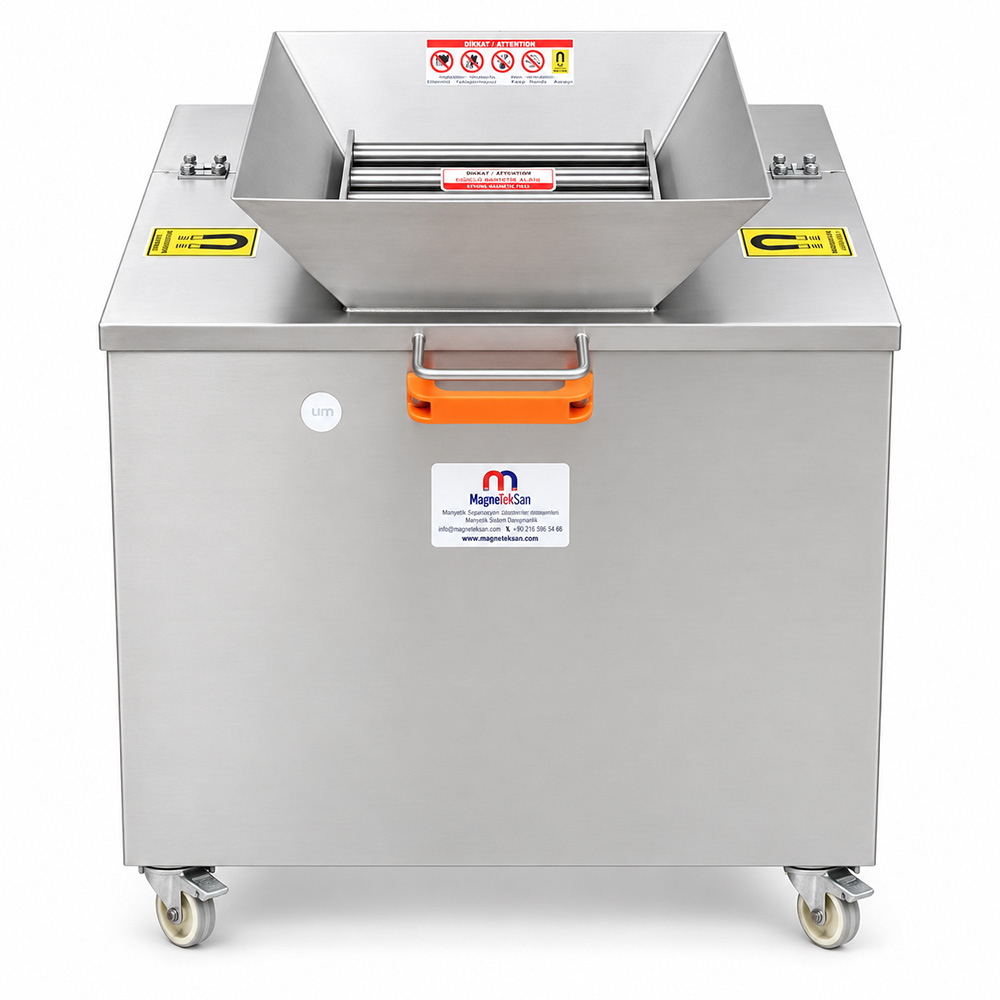
The Trolley Grid Magnet Separator is a mobile magnetic separation system designed to help remove ferromagnetic metal contaminants from dry and free-flowing materials during filling, handling or transfer between production stages. Product fed into the upper section passes through a 250×250 mm magnetic grid containing 5 Ø25 mm N35 neodymium magnetic bars. Iron and suitable steel-based contaminants are attracted to and retained on the 10000 Gauss magnetic bar surfaces, while the main product falls into the collection container below. Manufactured from AISI 304 stainless steel, the wheeled construction allows the system to be moved between different working locations. The permanent neodymium magnetic system requires no electrical power to generate its magnetic field and has a maximum operating temperature of 80°C.
|
Technical Specification |
Value |
|---|---|
|
Product Type |
Trolley Grid Magnet Separator |
|
Magnetic Grid Size |
250×250 mm |
|
Number of Magnetic Bars |
5 Pieces |
|
Magnetic Bar Diameter |
Ø25 mm |
|
Magnet Grade |
N35 Neodymium |
|
Magnetic Field |
10000 Gauss |
|
Material |
AISI 304 Stainless Steel |
|
Body Type |
Wheeled / Mobile |
|
Product Feeding |
Top Feed |
|
Product Collection |
Bottom Collection Container |
|
Maximum Operating Temperature |
80°C |
|
Cleaning Method |
Manual |
|
Electricity Requirement |
Not Required |
Extra Information
What is a Trolley Grid Magnet Separator?
A Trolley Grid Magnet Separator is a mobile magnetic separation system that combines a magnetic grid and a product collection container within a wheeled stainless steel construction.
Its primary purpose is to help remove ferromagnetic metal contaminants from materials before they reach the collection container.
The mobile design allows the equipment to be positioned at different points within a production or material handling facility.
What are the advantages of the trolley design?
The system can be moved between different working locations without being permanently installed in a fixed production line.
This allows the same equipment to be used in:
-
warehouses,
-
production areas,
-
raw material preparation sections,
-
filling and transfer stations.
The wheeled construction provides flexibility for facilities requiring magnetic separation at multiple locations.
How does the system work?
The basic operating principle is based on gravity-fed magnetic separation.
Example Process
Product Feeding ↓ 250×250 mm Magnetic Grid ↓ 5xØ25 mm N35 Neodymium Magnetic Bars ↓ Ferromagnetic Metal Capture ↓ Bottom Collection Container
As the non-magnetic product moves downwards through the magnetic grid, iron and suitable steel-based contaminants are attracted to the magnetic bar surfaces.
The main product continues into the collection container below.
What types of materials can it be used with?
Provided that the physical properties and flow characteristics are suitable, the system may be used with:
-
granules,
-
grains,
-
dry powders,
-
flakes,
-
dry blends,
-
various free-flowing raw materials.
The actual particle size and flowability of the material should be assessed before use.
Is it designed for a specific industry?
No.
The Trolley Grid Magnet Separator is not limited to a single industry.
It can be considered for mobile magnetic separation applications involving dry materials with suitable physical and flow properties.
This allows it to be used at different material handling and production stages.
How is the product fed into the system?
The material is introduced through the upper feeding section.
It moves downwards under gravity and passes through the magnetic grid containing five neodymium magnetic bars.
After passing through the magnetic separation area, the main product reaches the bottom collection container.
What is the function of the bottom collection container?
The bottom container temporarily collects the product after it has passed through the magnetic separation stage.
The collected material can then be transferred to the next processing location according to the facility’s production or material handling procedures.
What does the wheeled construction provide?
The wheels allow the equipment to be moved manually between different working locations.
This is particularly useful when one magnetic separation system is required at several raw material preparation or production points.
The mobile design reduces the need to dedicate the equipment permanently to one location.
What does the 250×250 mm dimension represent?
The specified dimension refers to the magnetic grid section:
250×250 mm
This is the magnetic separation area containing the five magnetic bars through which the product passes.
It does not represent the overall dimensions of the complete trolley.
How many magnetic bars does the system contain?
The product contains:
5 magnetic bars
These bars form the magnetic grid used for capturing suitable ferromagnetic contaminants.
What is the diameter of the magnetic bars?
Each magnetic bar has a diameter of:
Ø25 mm
The bars are integrated into the magnetic grid assembly.
What is N35 Neodymium?
The product uses N35 grade neodymium magnets.
N35 identifies the grade of the permanent neodymium magnet material used in the magnetic system.
The magnets generate a magnetic field without requiring electrical power.
What does 10000 Gauss mean?
The specified magnetic field value of the magnetic bars is:
10000 Gauss
This magnetic field helps attract and retain suitable ferromagnetic contaminants on the bar surfaces.
However, 10000 Gauss alone does not indicate:
-
a fixed attraction distance,
-
a specific lifting capacity in kilograms,
-
a guaranteed 100% metal capture rate.
Actual separation performance depends on the material and operating conditions.
Which metals can it capture?
The system can affect suitable ferromagnetic materials, including:
-
iron,
-
carbon steel,
-
steel fragments,
-
screws,
-
steel wire pieces,
-
small ferromagnetic machine wear particles.
The actual capture performance depends on the contaminant’s physical and magnetic properties.
Does it capture aluminium?
No.
Aluminium is not ferromagnetic under normal conditions.
The product is not designed to separate aluminium using its permanent magnetic field.
Does it capture copper or brass?
No.
Copper and brass are not ferromagnetic under normal conditions.
These materials are not the target contaminants for this type of magnetic separator.
Does it capture stainless steel?
The magnetic behaviour of stainless steel depends on its grade and metallurgical structure.
Some stainless steel grades may respond to a magnetic field, while others exhibit very little magnetic attraction.
For this reason, capture of all stainless steel contaminants cannot be guaranteed.
What are the benefits of AISI 304 stainless steel?
The system is manufactured from AISI 304 stainless steel.
This material is widely used in industrial applications due to characteristics such as:
-
corrosion resistance,
-
cleanable surfaces,
-
suitability for industrial processing environments.
The stainless steel construction also supports routine inspection and cleaning.
What is the maximum operating temperature?
The maximum operating temperature of the standard magnetic system is:
80°C
For applications operating above 80°C, the suitability of the standard N35 neodymium configuration should be evaluated separately.
Does the system require electricity?
No.
The magnetic field is generated by permanent neodymium magnets.
Therefore, the magnetic system does not require:
-
electrical coils,
-
a power supply,
-
a magnetic control panel.
The magnetic field is maintained without electrical power.
Is the system motorised?
No.
Material feeding and collection operate according to the principle of gravity.
The wheels are intended for moving the trolley between different working locations.
Does the magnetic grid physically sieve the material?
No.
The term magnetic grid does not refer to a conventional mechanical sieve that classifies material according to particle size.
The primary purpose of the system is to capture suitable ferromagnetic metal contaminants.
The product passes between the magnetic bars rather than being graded through a conventional screening mesh.
How are the magnetic bars cleaned?
After the feeding operation has been safely stopped, accumulated metal contaminants can be manually removed from the magnetic bar surfaces.
During cleaning, particular attention should be paid to:
-
the strong magnetic field,
-
sharp metal fragments,
-
safe handling of the magnetic assembly.
How frequently should the system be cleaned?
Cleaning frequency should be determined according to:
-
the amount of material processed,
-
operating duration,
-
the quantity of metal contamination in the product.
There is no universal cleaning interval suitable for every application.
Does accumulated metal affect separation performance?
Yes.
Excessive accumulation of ferromagnetic material on the bar surfaces may reduce the available magnetic working area.
Regular inspection and cleaning are therefore recommended.
Can the magnetic field be checked with a Gauss meter?
Yes.
The magnetic bar surfaces can be checked periodically using a suitable Gauss meter.
For comparable measurements, the same measurement points and measurement method should be used during each inspection.
Can the product flow become blocked?
This depends on the material’s physical characteristics, including:
-
particle size,
-
moisture content,
-
flowability,
-
tendency to stick,
-
feeding rate.
It is recommended to assess the actual product flow before introducing the system into regular operation.
What is the processing capacity in tonnes per hour?
A fixed tonnes-per-hour capacity should not be specified for this product without evaluating the application.
Actual throughput depends on the physical characteristics of the material and the operator’s feeding rate.
What happens if material is fed too quickly?
Excessively fast feeding may affect:
-
the controlled passage of material through the magnetic bars,
-
the material flow pattern,
-
the filling of the collection container.
Controlled feeding is therefore preferred.
Can it be used for mobile product transfer?
Yes.
After passing through the magnetic separation stage, the product is collected in the bottom container.
The trolley can then be moved to another processing location.
This mobile transfer capability is one of the principal features of the system.
Can it be used between the warehouse and production area?
Yes.
In suitable processes, raw material can be introduced into the system in the warehouse, passed through the magnetic grid and collected in the bottom container.
The trolley can then be moved to the production area.
However, the product is not limited to this application and can be considered for other suitable material transfer operations.
Can it be used instead of a fixed magnetic separator?
It may be suitable for applications where a permanently installed separation system is not required or where mobile use at different locations is preferred.
For high-throughput continuous production lines, a fixed or automatic magnetic separator may be more appropriate.
Should the wheels be secured during operation?
The system should be positioned securely to prevent unintended movement during operation.
If the wheels are equipped with brakes, they should be engaged before use.
Can the upper section be opened?
Yes.
The product design shown in the photographs includes an openable upper section that allows access to the magnetic separation area and collection container.
This arrangement can facilitate:
-
inspection,
-
cleaning,
-
maintenance.
How should the complete system be cleaned?
During product changeovers or periodic maintenance, the following components should be cleaned according to the facility’s appropriate cleaning procedures:
-
magnetic bars,
-
upper feeding section,
-
collection container,
-
internal stainless steel surfaces.
The cleaning method should be suitable for the material being processed.
Can it be used with different raw materials?
Yes.
The system can be used with different suitable dry and free-flowing materials.
However, when changing from one material to another, the following should be considered:
-
residues from the previous product,
-
cross-contamination risks,
-
cleaning requirements.
These should be managed according to the facility’s own operating procedures.
Does it replace a metal detector?
No.
The Trolley Grid Magnet Separator physically captures suitable ferromagnetic contaminants using a permanent magnetic field.
A metal detector operates according to a different detection principle.
Where required by the process, magnetic separation and metal detection systems can be used together.
Similar Products


Latest Products