- Magneteksan
- > Special Design Neodymium Magnets
- > 54x46x1 mm N52 Neodymium Phone Ring Magnet for MagSafe-Style Accessories
54x46x1 mm N52 Neodymium Phone Ring Magnet for MagSafe-Style Accessories
54x46x1 mm N52 Neodymium Phone Ring Magnet for MagSafe-Style Accessories
General Features
- Designed for magnetic phone-back accessory applications.
- MagSafe-style ring layout for phone cases and holders.
- N52-grade neodymium permanent magnet.
- Thin and compact profile for slim product designs.
- Segmented ring magnet construction.
- Supplied with a separate rectangular magnet piece.
- Suitable for phone case and accessory manufacturers.
- Permanent magnet that requires no electrical power.
Technical Features
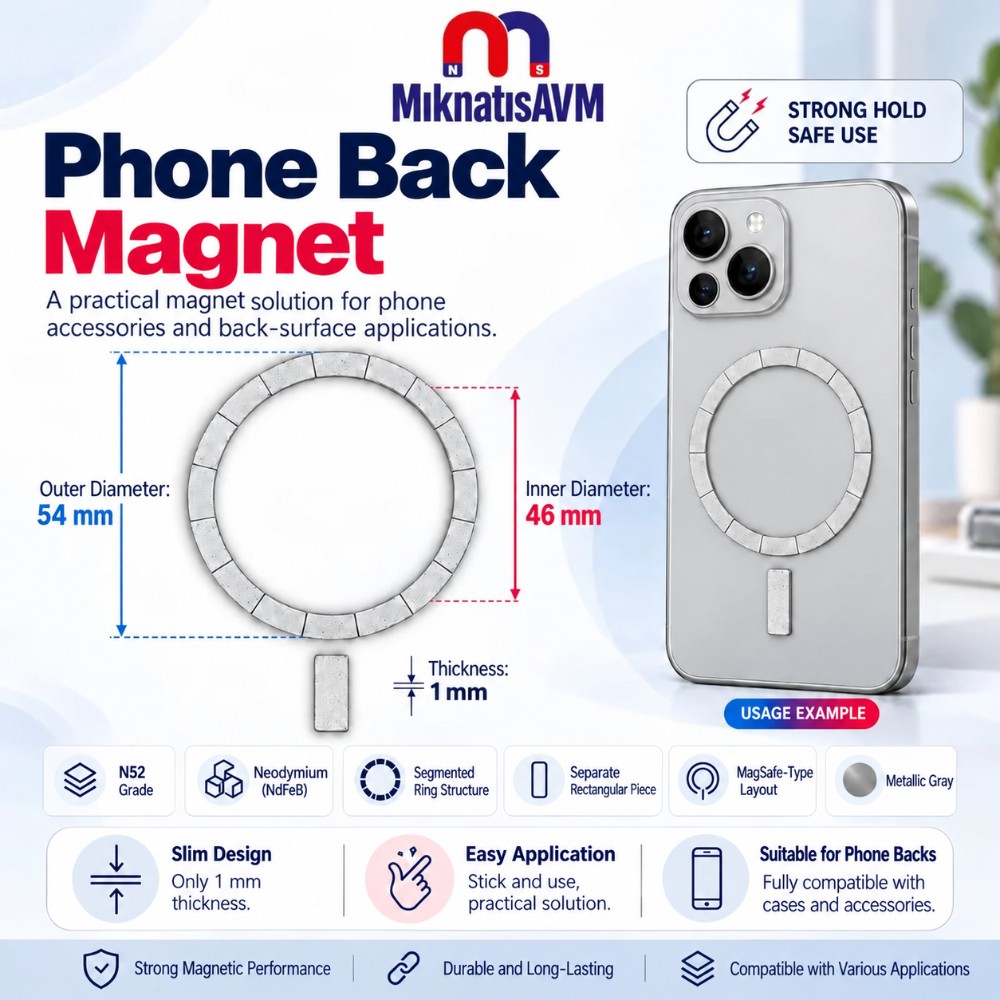
- Outer diameter: 54 mm
- Inner diameter: 46 mm
- Thickness: 1 mm
- Magnet type: Neodymium
- Magnetic material: NdFeB
- Magnet grade: N52
- Main geometry: Ring
- Ring construction: Segmented arrangement
- Additional part: Rectangular magnet
- Appearance: Metallic grey
- Working principle: Permanent magnetic field
- Application: Phone-back accessories
Kategori: Special Design Neodymium Magnets
Product Information
Extra Information
Product Information
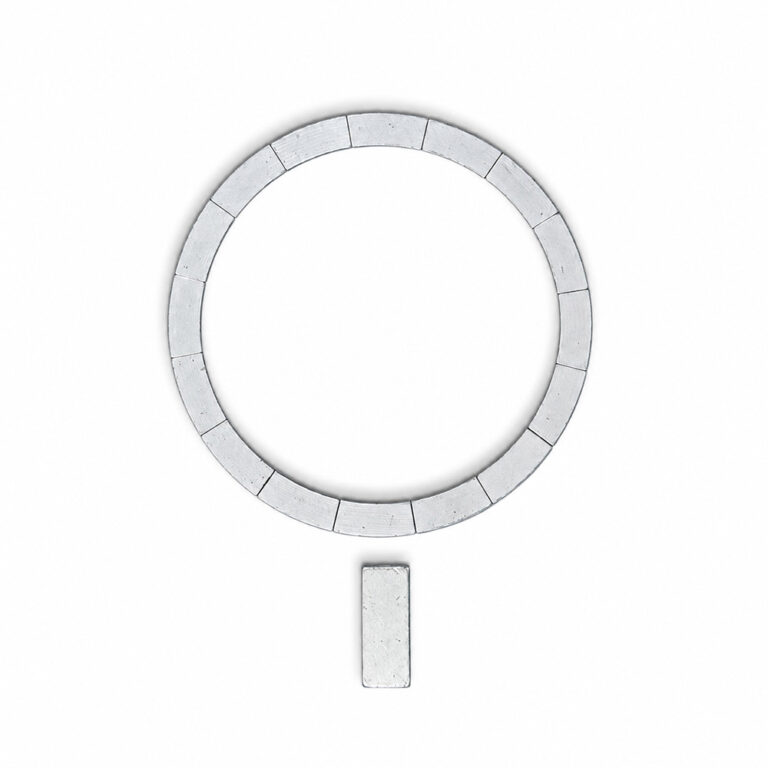
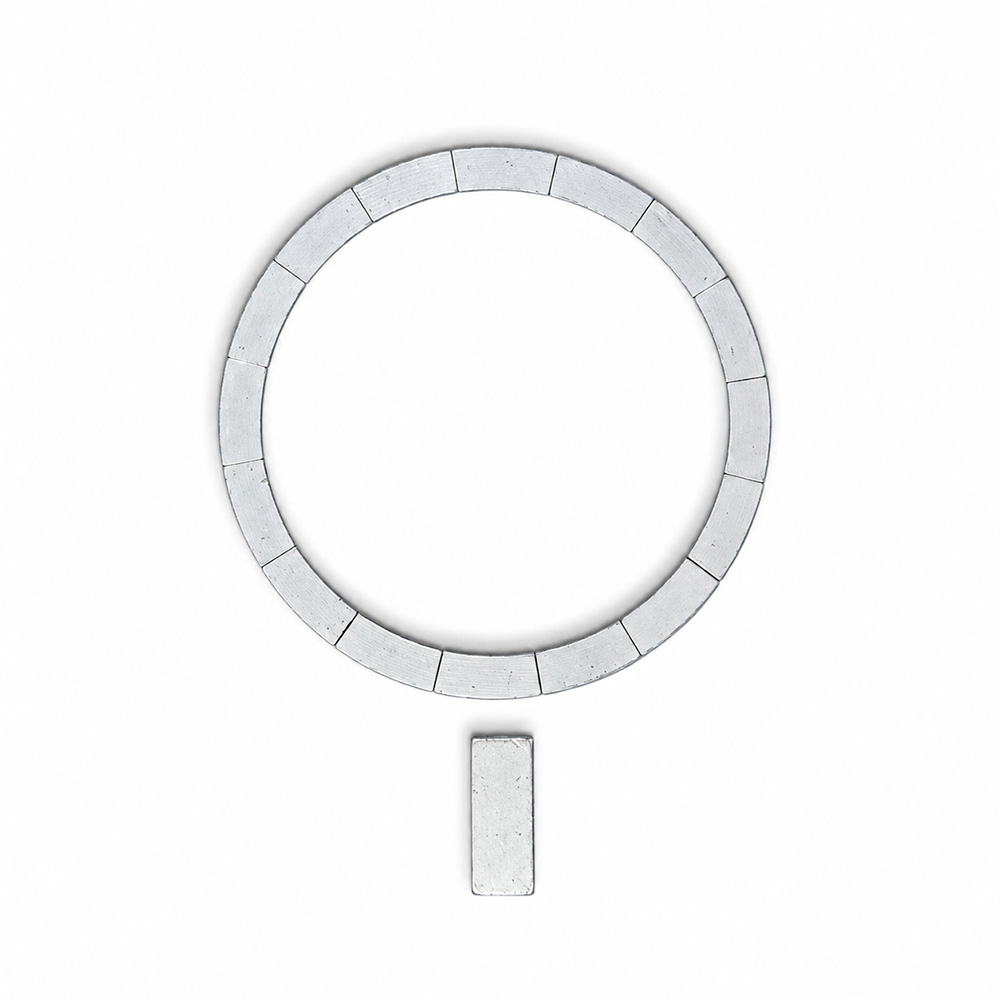
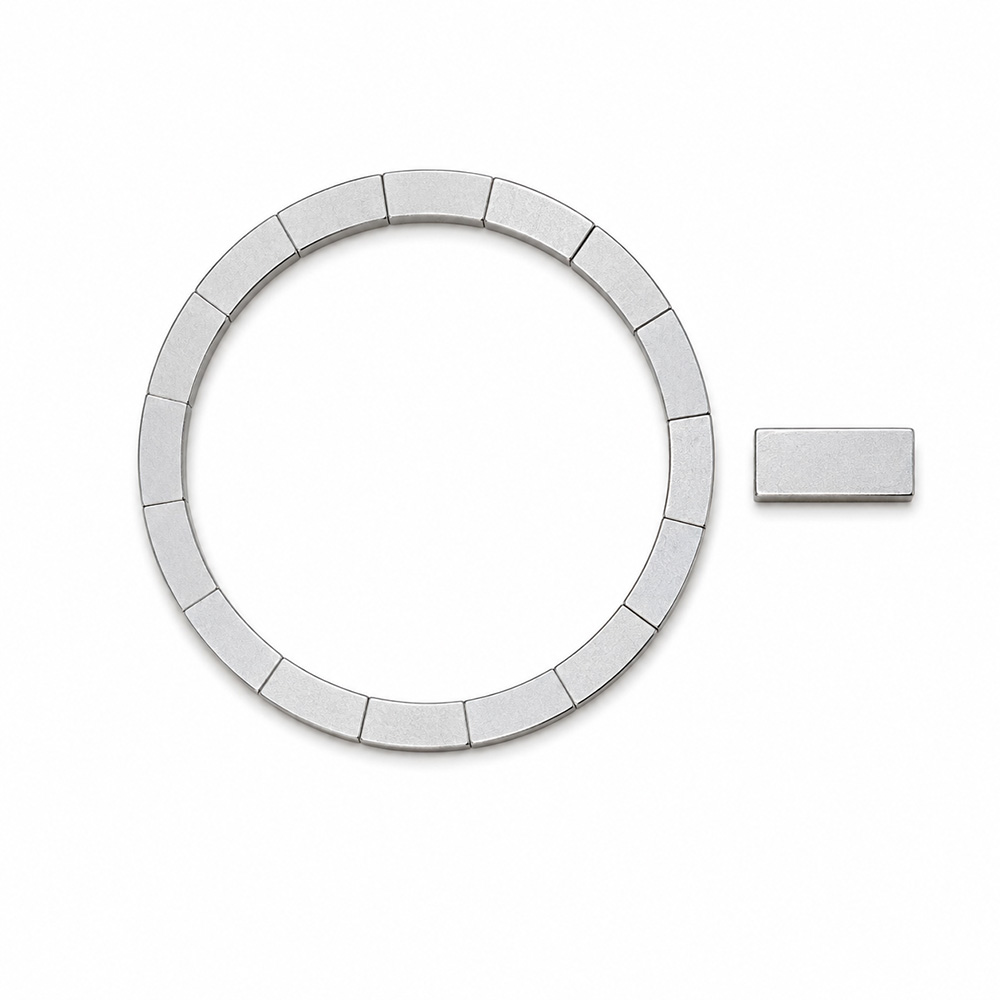
The 54x46x1 mm N52 neodymium phone ring magnet is a thin ring magnet arrangement designed for magnetic phone cases and MagSafe-style accessories. With a 54 mm outer diameter, 46 mm inner diameter and a thickness of only 1 mm, it can be used to build compact magnetic attachment solutions for phone accessories. A separate rectangular magnet piece accompanies the segmented ring.
| Technical Specification | Value |
|---|---|
| Product Type | Phone-back neodymium magnet |
| Magnetic Material | Neodymium (NdFeB) |
| Magnet Grade | N52 |
| Ring Outer Diameter | 54 mm |
| Ring Inner Diameter | 46 mm |
| Ring Thickness | 1 mm |
| Dimension Notation | 54x46x1 mm |
| Main Product Geometry | Ring |
| Ring Construction | Segmented magnet arrangement |
| Complementary Part | Separate rectangular magnet |
| Surface Appearance | Metallic grey |
| Operating Type | Permanent magnet |
| Target Application | Phone-back accessories |
| Other Application | Magnetic phone cases |
| Attachment Concept | MagSafe-style ring layout |
| Design Feature | Thin profile |
Extra Information
1. What Is the 54x46x1 mm N52 Phone Magnet?
The 54x46x1 mm N52 phone magnet is a thin neodymium ring magnet arrangement intended for phone-back accessories. It combines a segmented ring with a separate rectangular magnet piece.
The ring has an outer diameter of 54 mm, an inner diameter of 46 mm and a thickness of 1 mm. These dimensions give a narrow 4 mm ring width that fits inside slim accessory housings.
The magnet is made from N52-grade neodymium iron boron, known as NdFeB. N52 is one of the highest standard grades used for sintered neodymium magnets.
The product is a permanent magnet and does not need electrical power. Its magnetic field is present at all times once the part is magnetised.
2. What Does a Phone-Back Magnet Do?
A phone-back magnet creates a magnetic attachment point on the rear of a phone or phone case. Accessories such as holders, stands and wallets can then attach to it magnetically.
In a case design, the ring is usually embedded between the case layers. The accessory side carries a matching magnet or a ferromagnetic counterpart.
The ring shape helps the accessory locate itself around a fixed centre. This makes it easier to place the accessory in the same position each time.
The separate rectangular magnet is typically used for orientation. It helps an accessory settle in the intended rotational position.
3. MagSafe-Style Magnetic Ring Design
The ring layout follows the MagSafe-style concept used in many magnetic phone accessories. A circular magnet array is combined with a small alignment magnet below it.
This arrangement is widely used by accessory manufacturers who want a magnetic case or holder for phones without a built-in magnet ring. Final compatibility depends on the accessory design and should be tested.
The segmented ring is built from individual magnet sections placed on a circle. The section layout is visible on the product images.
The term MagSafe-style describes the layout only. This product is a magnet component and is not an Apple-certified accessory.
4. N52 Neodymium Magnet Technology
N52 indicates the energy product class of the neodymium material. Higher N-grades provide a stronger magnetic field for the same magnet volume.
Using N52 is useful in thin parts such as this 1 mm ring. It helps compensate for the limited material volume of a slim design.
Neodymium magnets are sintered, which makes them hard but brittle. Thin sections should be handled carefully during assembly.
Sintered NdFeB is sensitive to heat and corrosion compared with ferrite magnets. Product design should protect the magnet from moisture and high temperatures.
5. 54 mm Outer Diameter
The 54 mm outer diameter defines the overall footprint of the ring on the phone back. It should be checked against the available flat area of the case or accessory.
For phone cases, the ring is normally centred on the back of the case. The case wall and camera area must leave enough room for the full 54 mm diameter.
The outer diameter also influences how far the magnetic field spreads. A larger ring distributes the holding effect over a wider circle.
Accessory designers should match the counterpart ring diameter to 54 mm. A mismatch can reduce alignment accuracy.
6. 46 mm Inner Diameter
The 46 mm inner diameter leaves an open centre inside the ring. This open area keeps the middle of the phone back free of magnet material.
Together with the outer diameter, it gives a ring width of 4 mm. This narrow band suits slim case structures.
The open centre can be used for logos, labels or other design elements in the case. It also reduces the total magnet weight.
When designing a recess for the ring, both the inner and outer diameters should be reflected in the mould or cut-out.
7. 1 mm Thin Neodymium Magnet Structure
The 1 mm thickness keeps the magnet nearly invisible inside a phone case. It adds very little to the overall case thickness.
Thin magnets are more fragile than thicker parts. Bending, impact or hard contact with other magnets can crack them.
The holding effect of a thin magnet is limited by its volume. The final strength should be verified in the assembled product.
A 1 mm part can be bonded into a shallow pocket. Adhesive and pocket depth should be chosen to avoid stress on the magnet.
8. Ring-Shaped Magnet Arrangement
The ring arrangement places the magnetic sections evenly around a circle. This gives a balanced attachment around the centre.
A circular layout lets round accessories attach in a centred position. It also allows the accessory to be rotated if no orientation magnet is used.
The segmented construction is common for thin ring magnets. Individual sections are easier to produce than a single continuous ring.
During assembly, the sections must be kept in the correct order and polarity. Their positions should be fixed with a jig or carrier film.
9. Use of the Rectangular Magnet Piece
The separate rectangular magnet is placed below the ring in a MagSafe-style layout. It acts as an orientation reference for the accessory.
With this piece, an accessory can settle in a defined rotational position. This is useful for wallets, stands and holders that must stay upright.
The rectangular piece should be positioned according to the accessory design. Its distance from the ring affects alignment.
Like the ring, it is a neodymium permanent magnet. It should be handled with the same care during assembly.
10. Use in Phone Case Production
Phone case manufacturers can integrate the ring between case layers. This turns a standard case into a magnetic case.
The magnet can be placed in a moulded recess or laminated between layers. The process should prevent the magnet from moving.
Case materials such as TPU, PC and silicone are not magnetic. They do not affect the magnet but also do not hold it, so bonding is needed.
Each production batch should be checked for correct magnet position and polarity. A simple test with the counterpart accessory is effective.
11. Phone-Back Accessory Design
Accessory designers can use the ring as the magnetic interface of holders, stands and grips. The accessory then attaches to a magnetic phone case.
The counterpart in the accessory must match the ring layout. Polarity and diameter should be planned together.
Accessories that carry weight, such as wallets, need enough holding force. Performance should be tested with the full accessory weight.
A thin magnet keeps the accessory slim. This is an advantage for pocket-friendly designs.
12. Advantages of the Thin Ring Design
A thin ring adds little thickness to cases and accessories. The product remains slim and comfortable to hold.
The open centre reduces magnet material and weight. It also leaves space for other design elements.
The circular shape centres round accessories naturally. Combined with the rectangular piece, it also controls orientation.
The segmented build makes the thin geometry practical. It supports a stable ring layout in slim products.
13. Mounting Methods
The ring is usually bonded into a shallow recess using a suitable adhesive. The adhesive should be compatible with both the magnet surface and the case material.
Another method is lamination between two layers of the case. The magnet is then fully enclosed and protected.
Double-sided adhesive film can also be used for prototypes. It allows quick positioning of the segmented ring.
Mechanical clamping is not recommended for a 1 mm magnet. Pressure points can crack the brittle material.
14. Selecting Adhesives and Fixing Materials
Adhesives for neodymium magnets should give a strong bond without high curing stress. Two-component epoxies and structural adhesives are common choices.
The adhesive layer should be thin and even. An uneven layer can tilt the magnet sections.
Curing temperature must stay within the safe range of the magnet. The supplier’s temperature limits should be confirmed before production.
Adhesive tests should be done on the real case material. Plastics differ widely in how well they bond.
15. Points to Consider During Assembly
Neodymium magnets attract each other strongly and can snap together. Keep loose magnets apart and handle them one at a time.
Use non-magnetic tools and work surfaces where possible. Steel tools can pull thin sections out of position.
Check the polarity of each section before fixing it. A reversed section weakens the ring and can repel the accessory.
Wear protective gloves and eye protection when handling many magnets. Chipped edges can be sharp.
16. Surface Appearance and Protection
The product images show a metallic grey surface. The coating type is not specified on the product page and should be confirmed for the order.
Neodymium magnets can corrode if their surface is unprotected. In phone cases, the magnet is normally enclosed, which limits exposure.
Moisture, sweat and cleaning agents should not reach the magnet directly. A closed case structure helps protect it.
Damaged or chipped surfaces can start corrosion. Parts with visible damage should not be used in production.
17. Operating Temperature
The maximum operating temperature is not specified on the product page. It should be confirmed with Magneteksan before use in heat-exposed processes.
Standard N-grade neodymium magnets lose strength at elevated temperatures. Heat during moulding or adhesive curing must therefore be controlled.
Phones can become warm during charging. The case design should keep the magnet away from direct heat sources.
If the application involves high temperatures, a magnet with a higher temperature class may be more suitable. Our team can advise on alternatives.
18. Factors Affecting Performance
Holding performance depends on the counterpart magnet, the distance between parts and the case material thickness. Each extra millimetre of distance reduces the attraction.
Correct polarity of all ring sections is essential. Mixed polarity reduces the effective magnetic interface.
Alignment between the ring and the accessory magnet affects both centring and strength. Offsets reduce the holding effect.
Temperature and surface damage can also lower performance. The final product should be tested under real use conditions.
19. Quantity and Placement in the Application
Each phone case or accessory typically uses one ring and one rectangular piece. The layout should match the counterpart product.
The ring is centred on the phone back and the rectangular piece is placed below it. Exact positions depend on the case model.
For large production runs, a positioning jig ensures repeatable placement. This reduces assembly errors and rework.
Order quantities should include a small reserve for assembly tests. This helps validate the process before series production.
20. Industrial Use Example
An accessory manufacturer can integrate the ring into a magnetic car holder. The holder then attaches to a magnetic phone case.
In this setup, the case carries the ring and the holder carries the matching magnet array. The rectangular piece helps keep the phone upright.
Production lines can place the ring with automated pick-and-place equipment if the parts are supplied in suitable packaging. Packaging needs should be agreed in advance.
Quality control can test each assembled case with a reference accessory. This confirms position, polarity and attachment.
21. Equipment and Device Use Example
Beyond phones, the ring can be used in small devices that need a magnetic attachment point. Examples include tablets, handheld terminals and smart accessories.
The thin profile suits devices with limited internal space. The open centre leaves room for other components.
Electronic devices may contain components that are sensitive to magnetic fields. Their placement must be checked in the device design.
Prototype tests should confirm that the magnet does not disturb sensors such as compasses. Adjusting the magnet position can reduce interference.
22. Other Suitable Applications
The ring can be used in magnetic wallets, card holders and grip accessories. These products attach to a magnetic phone case.
It can also serve in magnetic stands and desk holders. The ring provides a centred attachment surface.
Designers of DIY and hobby projects can use the ring for custom magnetic mounts. Careful handling is required because of the thin, brittle material.
For applications outside phone accessories, the suitability should be confirmed by testing.
23. Safety and Usage Limits
Keep neodymium magnets away from children because swallowed magnets can cause serious injury. Accessories must enclose the magnet securely.
Keep magnets away from pacemakers and other medical implants. A safe distance should be maintained at all times.
Magnetic cards, such as bank cards with magnetic stripes, can be affected by strong magnets. Wallet accessories should be designed with this in mind.
Thin magnets can break if they snap together. Store and transport them with spacers.
24. Energy Requirement and Operating Characteristics
This is a permanent magnet and does not require electricity. It works without batteries, wiring or control electronics.
The magnetic field is constant and does not switch on or off. Attachment and release are done mechanically by the user.
Wireless charging behaviour depends on the full case and charger design. It should be tested in the final product.
Because no power is used, the magnet does not generate heat or consume energy during use.
25. Vibration and Mechanical Conditions
Phones and accessories are exposed to daily drops, vibration and bending. The magnet must be fixed so that it cannot move inside the case.
A rigid bond spreads mechanical loads over the whole magnet surface. This lowers the risk of cracking.
In car holders, road vibration can loosen poorly bonded parts. Adhesive selection and testing are important for these products.
Drop tests of finished cases help confirm that the magnet stays intact and in position.
26. Magnetic Performance and Technical Evaluation
The holding force of this ring is not stated on the product page. It depends strongly on the counterpart and on the case thickness.
For a reliable evaluation, the ring should be tested in the actual case with the intended accessory. Pull tests give the most useful data.
N52 grade provides a high magnetic output for its size. The thin geometry still limits the absolute force.
Magneteksan can support customers with measurement and alternative magnet options if the required performance is not reached.
27. Information Needed to Choose the Right Product
To select the right magnet, share the phone or case model and the accessory type. This defines the space available for the ring.
State the counterpart design, case wall thickness and expected accessory weight. These factors determine the required magnetic performance.
Mention production conditions such as moulding or curing temperatures. They influence the choice of magnet grade.
Provide the expected order quantity and packaging requirements. This helps plan supply for series production.
28. Overall Evaluation and Advantages
The 54x46x1 mm N52 phone magnet offers a thin, ring-shaped magnetic interface for MagSafe-style phone accessories. It suits case and accessory manufacturers looking for a slim solution.
Its segmented N52 ring and separate rectangular magnet support both centring and orientation. The 1 mm thickness keeps products slim.
As a permanent magnet, it needs no power and has no moving parts. Correct bonding and protection give stable long-term use.
Technical values not listed here, such as coating type and temperature limits, should be confirmed before ordering. Magneteksan can advise on the most suitable option for each project.